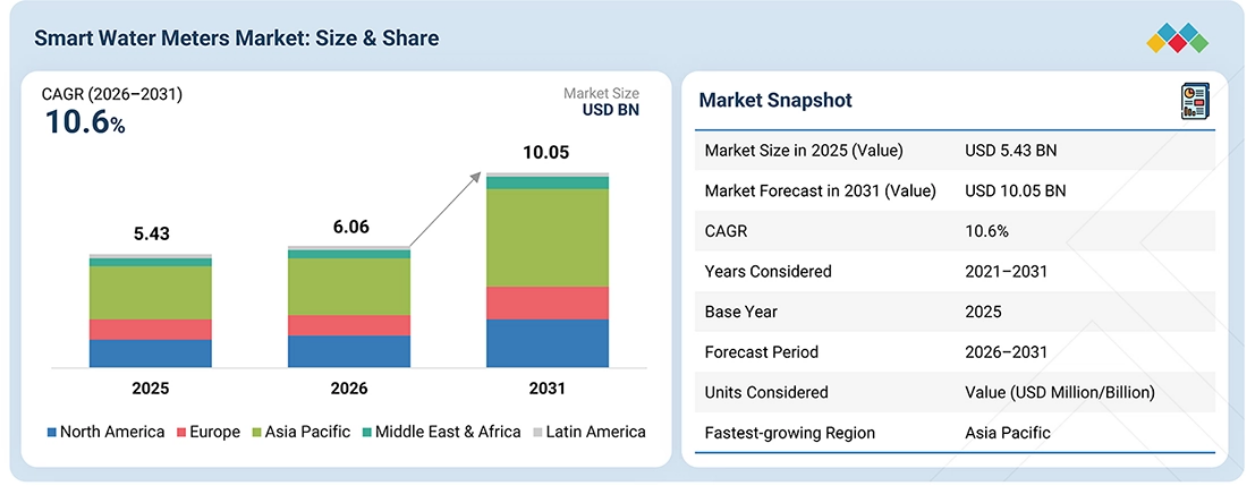
According to MarketsandMarkets™, the global “Smart Water Meter Market by Technology (Automated Meter Reading [AMR], Automated Metering Infrastructure [AMI]), Meter Type (Ultrasonic Meter, Electromagnetic Meter, Smart Mechanical Meter), Component (Meter & Accessories, IT Solutions, Communications), Application (Water Utilities, Industries), and Region – Global Forecast to 2031″ is projected to grow from USD 6.06 billion in 2026 to USD 10.05 billion by 2031, at a CAGR of 10.6% during the forecast period.
The international industry for smart water meters continues to advance, as multiple water users such as municipal bodies, water utility companies, and industrial plants focus on conserving water, managing resources efficiently and minimizing water losses. Smart water meters are increasingly used in the process of measuring water consumption, finding leaks, improving water billing, and obtaining necessary information about water consumption. The installation of smart meters is largely dictated by the need to overcome the problems of old water infrastructure, increase efficiency of operations, and manage growing water consumption. Further development of smart metering systems is facilitated by the growth of urban areas and increase of investments in the sphere of smart cities and digital water infrastructure.
The trends in the water metering market are influenced by scientific developments in ultrasonic and electromagnetic metering, as well as emerging technologies such as AMR, AMI, Internet of Things, as well as remote reading of water meters, leakage detection, data analytics, and cloud-based platforms. The use of smart water meters enables measuring and processing data on water consumption, allowing efficient evaluation of water supply and distribution. Continuous data collection allows for remote monitoring of the given processes, automated billing, consumption notifications, leakage identifying, and more efficient demand management. With the help of digital water management platforms, metering data becomes more available and usable for both utilities and consumers. The advancement of the communication technology sphere and connected metering also contributes to the upgrade of the old water meter fleets.
Smart Water Meters Market Size & Forecast:
- Market Size Available for Years: 2021–2031
- 2025 Market Size: USD 5.43 billion
- 2031 Projected Market Size: USD 10.05 billion
- CAGR (2026–2031): 10.6%
Smart Water Meters Market Trends & Insights:
- The Asia Pacific Smart Water Meters Market is expected to register the highest CAGR of 11.4% during the forecast period.
- By technology, the automated meter reading is expected to have the highest CAGR during the forecast period.
- By meter type, Ultrasonic Meter is expected to register the highest CAGR during the forecast period.
- By component, meter & accessories segment is expected to register the highest CAGR during the forecast period.
- By application, Water Utilities segment is expected to register the highest CAGR during the forecast period.
- Badger Meter Inc, Xylem, and Kamstrup were identified as star players focused on Smart Water Meter Market.
Download PDF Brochure @ https://www.marketsandmarkets.com/pdfdownloadNew.asp?id=250996975
Automated meter reading (AMR), by technology, is likely to record the highest CAGR during 2026–2031.
The automated meter reading (AMR) systems are anticipated to see a considerable growth as water companies continue to adopt remote reading technologies to enhance their efficiency and clip the costs related to reading meters by hand. AMR makes it possible to collect data on water consumption from the meters automatically by using one-way communication networks, which enables companies to obtain the necessary readings without any access to the meters. This makes AMR useful for implementation in large-scale applications in residential, commercial and municipal water systems. With the expansion of water distribution networks and a growing demand for accuracy in billings, the adoption of AMR technology is expected to rise significantly.
Ultrasonic meter, by meter type, is likely to record the highest CAGR during 2026–2031.
The expected growth of ultrasonic meters is due to the increasing implementation of sophisticated metering systems by water utilities that offer dependable performance with lower maintenance needs. Unlike traditional mechanical meters, ultrasonic meters employ sound waves to monitor water flow, leading to the improvement in the reliability of measurements and their extended operational life. By enabling precise measurements under different flow situations, ultrasonic water meters can be utilized in various applications. In addition to the growing popularity of AMR and AMI solutions, ultrasonic meters can provide cool water consumption information for remote management, billing, and leak detection. The increase in awareness of water conservation, non-revenue water reduction, and modernization of classical metering systems will also boost the use of ultrasonic smart water meters.
Request Sample Copy @ https://www.marketsandmarkets.com/requestsampleNew.asp?id=250996975
Asia Pacific to be the fastest-growing region in the smart water meters market during the forecast period.
The smart water meter market is estimated to grow significantly in the Asia Pacific region due primarily to urbanization, increased demand for water, a growing emphasis on water scarcity, and the spread of smart water infrastructure. Moreover, the establishment of municipal water distribution systems and increased funding for water-saving tools is raising interest in efficient water metering and loss management in the region. Countries such as China, India, Japan, South Korea, and the nations of Southeast Asia are investing in the modernization of their water infrastructure and utility businesses, which serve to indirectly promote the use of smart water meters, AMR and AMI systems, remote monitoring, and data analysis. Interest in minimizing non-revenue water rates, improving billing efficiency, and managing water use is helping to further accelerate the rollout of smart water metering technologies in the region.
Key Players
Key players in the global smart water meter market include Badger Meter, Inc. (US), Kamstrup (Denmark), Diehl Stiftung & Co. KG (Germany), Landis+Gyr (Switzerland), Aclara Technologies (US), Xylem (US), Itron, Inc. (US), Bmeters Srl (Italy), Honeywell International Inc. (US), MOM Co. Ltd. (South Korea), WaterTech (Arad Group) (Israel), Zenner International GmbH & Co. KG (Germany), Neptune Technology Group Inc. (US), Iskraemeco Group (Slovenia), and Sagemcom (France). These companies are strengthening their market positions through smart water meter portfolio expansion, energy-efficiency improvements, product innovation, geographic expansion, strategic acquisitions, and investments in water utilities and industrial applications.