The GPS Tracking Device Market Trends are evolving as businesses increasingly adopt artificial intelligence (AI), the Internet of Things (IoT), cloud computing, and advanced telematics to improve location visibility and operational efficiency. GPS tracking devices have become essential tools for monitoring vehicles, managing fleets, tracking valuable assets, and improving the safety of people and goods across multiple industries.
These devices use signals from global navigation satellite systems to determine location and transmit tracking information through cellular or satellite communication networks. Depending on the device, the collected information can include location, movement history, vehicle diagnostics, driving behavior, and other operational data. This information helps businesses make informed decisions, optimize routes, reduce delays, and improve asset utilization.
According to MarketsandMarkets, the global GPS tracking device market is projected to grow from USD 3.1 billion in 2023 to USD 5.7 billion by 2028, registering a compound annual growth rate (CAGR) of 13.1% during the forecast period. Increasing demand for commercial vehicles, growing logistics activities, and the adoption of connected tracking technologies are important factors supporting market expansion.
The integration of AI and IoT is taking GPS tracking beyond basic location monitoring. Modern platforms can combine location data with vehicle diagnostics, historical movement patterns, and operational information to support predictive maintenance, route optimization, and fleet performance analysis. These developments are creating new opportunities for device manufacturers, telematics providers, software developers, and transportation companies.
Key GPS Tracking Device Market Trends Transforming the Industry
Artificial Intelligence and Predictive Analytics
Artificial intelligence is becoming an important technology in the evolution of GPS tracking devices. Traditional tracking systems primarily display vehicle locations and movement histories, whereas AI-enabled platforms can analyze tracking data to identify patterns, detect anomalies, and generate operational insights.
For fleet operators, AI can help evaluate driving behavior, identify inefficient routes, and estimate arrival times using available location and traffic information. When integrated with vehicle diagnostics, analytics can also identify patterns that may indicate maintenance requirements or unusual vehicle performance.
Predictive analytics can support fleet managers in planning maintenance schedules, allocating vehicles, and reducing unexpected operational disruptions. For example, a logistics company can combine historical journey data with vehicle usage information to identify routes associated with frequent delays and improve future dispatch planning.
AI capabilities depend on the quality, volume, and relevance of available data. Nevertheless, the growing use of intelligent analytics is expanding the role of GPS tracking devices from location-reporting tools to broader fleet intelligence solutions.
Download PDF Brochure @ https://www.marketsandmarkets.com/pdfdownloadNew.asp?id=142
Internet of Things and Connected Tracking Devices
The Internet of Things is another major force shaping GPS Tracking Device Market Trends. IoT enables GPS trackers to communicate with sensors, onboard vehicle systems, cloud platforms, and enterprise applications. This connectivity creates a more comprehensive view of asset location and operating conditions.
Connected tracking devices can support applications such as vehicle monitoring, cargo tracking, equipment management, and supply chain visibility. When combined with temperature, humidity, vibration, or other sensors, tracking platforms can provide additional information about the condition of sensitive goods and valuable equipment.
In logistics, connected devices can help businesses monitor shipments throughout transportation and identify potential disruptions. In construction and mining, they can support the monitoring of machinery and mobile equipment operating across large or remote sites.
IoT integration also allows businesses to connect tracking information with enterprise resource planning (ERP), transportation management systems (TMS), and fleet management software. This interoperability helps organizations use location data across multiple workflows and improve coordination between departments.
Real-Time Fleet Tracking and Route Optimization
Real-time tracking remains a central application of GPS tracking devices. Transportation and logistics companies rely on location data to monitor vehicle movement, coordinate deliveries, and respond to changing operating conditions.
GPS tracking platforms provide fleet managers with visibility into vehicle positions, route progress, stops, and estimated arrival times. This information helps organizations identify deviations from planned routes and coordinate alternative arrangements when delays occur.
Route optimization tools can use location information alongside traffic conditions, delivery priorities, road restrictions, and vehicle capacity to improve trip planning. More efficient routing can help reduce unnecessary mileage, fuel consumption, and delivery delays.
These benefits are particularly important for companies operating large commercial fleets, including trucks, buses, delivery vans, and service vehicles. As businesses prioritize productivity and customer satisfaction, real-time tracking and route optimization are expected to remain important drivers of GPS tracking device adoption.
Cloud-Based Tracking and Telematics Platforms
Cloud computing is transforming how GPS tracking information is stored, processed, and accessed. Cloud-based platforms enable businesses to monitor vehicles and assets through centralized dashboards, mobile applications, and web-based interfaces.
These platforms can support fleet operations across multiple locations without requiring all tracking information to be managed through separate local systems. They can also simplify software updates, reporting, user management, and integration with business applications.
Cloud-based tracking solutions are especially relevant for organizations with geographically distributed fleets and supply chains. Managers can review vehicle performance, monitor delivery progress, and access historical tracking information from different locations.
The combination of cloud computing, IoT, and analytics also supports the development of subscription-based fleet management services. However, businesses must consider data privacy, cybersecurity, network availability, and integration requirements when selecting a platform.
Advanced GPS Hardware and Multi-Network Connectivity
GPS tracking devices are becoming more compact, durable, and capable of supporting diverse operating environments. Advances in receiver technology, chipset design, battery performance, and communication modules are enabling manufacturers to develop devices for vehicles, containers, machinery, and portable assets.
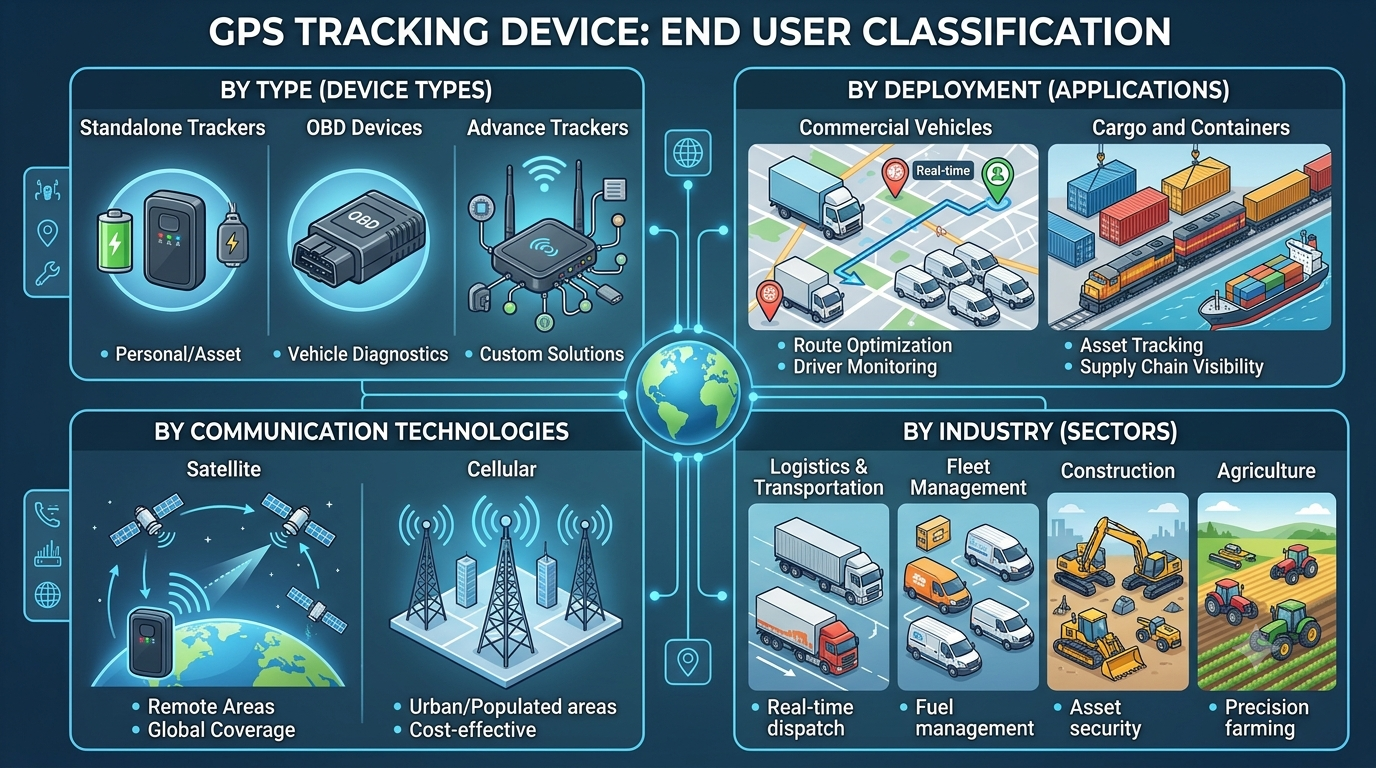
The market includes standalone trackers, onboard diagnostics (OBD) devices, and advanced trackers. Standalone devices can be suitable for independent asset monitoring, while OBD devices connect to compatible vehicle diagnostic ports. Advanced trackers may provide additional information, including vehicle performance and diagnostic data, depending on their configuration.
Communication technologies are equally important. Cellular connectivity supports frequent data transmission in areas with network coverage, while satellite communication can help maintain tracking capabilities in remote locations where cellular connectivity is limited.
Some devices combine multiple positioning and communication technologies to improve location availability under different operating conditions. As customer requirements become more diverse, flexible hardware and reliable connectivity will remain important areas of product development.
Major Drivers Supporting GPS Tracking Device Market Growth
Increasing Demand for Commercial Vehicles
The expanding use of commercial vehicles is a significant driver of GPS tracking device adoption. Trucks, buses, vans, delivery vehicles, and service fleets require effective monitoring to improve utilization, manage schedules, and protect valuable assets.
GPS tracking devices help fleet operators monitor vehicle locations, identify unauthorized usage, assess driving behavior, and coordinate dispatch operations. They can also provide information that supports route planning and fleet performance analysis.
Businesses increasingly view tracking systems as part of their broader fleet management infrastructure rather than as standalone security products. The growing need to improve operational visibility and control transportation costs is expected to support demand for advanced GPS tracking solutions.
Expansion of E-Commerce and Logistics
The growth of e-commerce has increased the importance of timely deliveries, shipment visibility, and efficient last-mile logistics. Businesses must coordinate vehicles, warehouses, distribution centers, and delivery personnel while providing customers with reliable shipment information.
GPS tracking devices help logistics providers monitor vehicles and mobile assets throughout the delivery process. Real-time tracking can support dispatch coordination, delivery-status updates, and the investigation of unexpected delays.
For companies transporting high-value cargo, tracking systems can also support theft prevention and help identify deviations from planned routes. When integrated with warehouse management and transportation management systems, GPS data can improve coordination across the supply chain.
As logistics networks expand and customer expectations for delivery visibility increase, transportation and logistics will remain a major end-use industry for GPS tracking devices.
Vehicle Security and Theft Prevention
Vehicle theft and unauthorized asset movement create financial and operational risks for businesses and individual owners. GPS tracking devices can help owners locate vehicles, review movement histories, and receive alerts when predefined conditions are triggered.
For commercial fleets, geofencing features can notify managers when vehicles enter or leave designated geographic areas. Such alerts can help businesses identify unexpected movements and respond according to their security procedures.
Tracking systems can also be used to monitor construction equipment, trailers, containers, and other valuable mobile assets. Their effectiveness depends on device placement, power availability, communication coverage, and the response procedures used by the organization.
The increasing emphasis on asset security is creating opportunities for tracking solutions that combine location monitoring with alerts, analytics, and connected security platforms.
Growing Adoption of Usage-Based Insurance
Usage-based insurance (UBI) is creating additional opportunities for GPS tracking devices and telematics services. Depending on the insurance program, tracking devices or connected vehicle systems can provide information about mileage, driving behavior, and vehicle usage.
Insurers may use approved telematics data to assess selected driving patterns and support insurance pricing models. Fleet operators can also use this information to encourage safer driving practices and identify opportunities for driver training.
This application creates potential value for insurance companies, fleet managers, and vehicle owners. However, adoption depends on consent, data protection, program design, and the rules applicable in each market.
As telematics becomes more integrated with insurance services, GPS tracking devices may play a larger role in connected mobility and risk assessment.
GPS Tracking Device Market Segmentation and Opportunities
By Type: Standalone Trackers, OBD Devices, and Advanced Trackers
GPS tracking devices are available in different configurations to meet varying customer requirements.
Standalone trackers are designed to provide location information independently of a vehicle’s diagnostic system. Depending on their design, they may use internal batteries or an external power source and can be used to track vehicles and other mobile assets.
OBD devices connect to compatible onboard diagnostic ports in vehicles. In addition to location information, these devices may collect vehicle-related data supported by the vehicle and device configuration. Their relatively straightforward installation can make them suitable for selected fleet and vehicle monitoring applications.
Advanced trackers offer more comprehensive monitoring capabilities and may integrate location data with vehicle diagnostics, driver behavior information, and additional telematics functions. These solutions are particularly useful for fleet operators seeking detailed operational insights.
MarketsandMarkets highlights advanced trackers as an important product category, particularly for commercial vehicle applications where businesses increasingly need information beyond basic location data.
By Deployment: Commercial Vehicles, Cargo, and Containers
Commercial vehicles represent an important deployment segment because transportation businesses need to monitor vehicle locations, driving behavior, route performance, and fleet utilization.
Cargo and container tracking addresses the need to monitor shipments and mobile assets across transportation networks. GPS tracking solutions can help logistics companies improve shipment visibility, identify unexpected movement, and coordinate the transfer of goods between locations.
Tracking requirements vary depending on the asset, journey duration, operating environment, connectivity availability, and security risks. Device manufacturers therefore have opportunities to develop solutions with different battery capacities, durability levels, communication options, and sensor capabilities.
By Industry: Transportation and Logistics, Construction, Government, and Others
Transportation and logistics is a key industry for GPS tracking devices. Companies use tracking systems for route planning, fleet monitoring, driver safety, delivery coordination, and asset protection.
In construction, GPS tracking devices can help monitor heavy equipment, vehicles, and machinery operating across multiple sites. This supports equipment utilization, theft prevention, and coordination of field operations.
Government agencies may use GPS tracking to monitor public service fleets, emergency response vehicles, and other mobile assets. Oil and gas, metals and mining, and related industrial sectors can also benefit from tracking equipment in remote or challenging environments.
The broad range of applications reduces the market’s dependence on a single industry and creates opportunities for specialized tracking products and services.
Regional Outlook for GPS Tracking Device Market Trends
Europe
MarketsandMarkets identifies Europe as the largest regional market for GPS tracking devices during the 2023–2028 forecast period. The region benefits from established automotive and transportation industries, commercial fleet operations, and demand for telematics-based services.
Countries such as Germany, the United Kingdom, and France provide opportunities for tracking device manufacturers and service providers. Businesses across the region use tracking systems to monitor commercial vehicles, optimize fleet operations, and improve asset visibility.
The adoption of telematics, fleet modernization, and demand for connected vehicle services are expected to support continued market development. Compliance with applicable vehicle, privacy, and data protection requirements remains important for solution providers.
North America
North America represents an important market for GPS tracking devices because of its established fleet management ecosystem, logistics networks, and adoption of connected technologies.
Businesses use tracking devices to improve fleet visibility, manage vehicle usage, coordinate deliveries, and monitor valuable assets. Integration with cloud platforms, telematics systems, and vehicle diagnostics is expanding the range of available applications.
Demand is also supported by the need to improve transportation efficiency and monitor geographically distributed operations. Vendors that offer scalable platforms and reliable customer support can address the needs of both large fleets and smaller businesses.
Asia Pacific
Asia Pacific is expected to experience strong growth as commercial vehicle fleets expand and logistics infrastructure develops. Increasing digitalization, growing e-commerce activity, and investments in connected transportation systems are creating opportunities for GPS tracking device providers.
China, India, Japan, and other markets have diverse requirements across transportation, construction, industrial operations, and public services. In India, tracking solutions can support fleet operators, delivery businesses, construction companies, and logistics providers seeking better visibility into mobile assets.
Price competitiveness, device durability, connectivity, and after-sales support are important considerations in the region. As businesses continue to modernize operations, demand for connected tracking and fleet management solutions is expected to increase.
Challenges Affecting the GPS Tracking Device Market
Despite favorable demand trends, several challenges can influence the adoption of GPS tracking devices.
Data Privacy and Cybersecurity
GPS tracking systems collect location and movement information that may be commercially sensitive or personally identifiable. Organizations must ensure that access to this information is controlled and that data is stored and transmitted securely.
Cybersecurity risks can arise from insecure devices, weak authentication, outdated software, and poorly configured cloud platforms. Manufacturers and service providers need to implement appropriate security controls, software updates, and data protection practices.
Connectivity and Location Limitations
GPS performance can be affected by buildings, tunnels, dense urban environments, and other conditions that obstruct satellite signals. Cellular tracking may also be limited in remote areas without adequate network coverage.
Solutions that combine positioning methods and communication technologies can help address some of these limitations, although performance depends on the device and environment. Organizations should assess coverage, update frequency, and power requirements before selecting a tracking system.
Device Quality and Total Cost of Ownership
Low-cost devices may offer limited accuracy, durability, battery performance, or software support. Poor-quality hardware can reduce user confidence and increase maintenance requirements.
Businesses must consider the full cost of deployment, including hardware, connectivity, platform subscriptions, installation, maintenance, and support. Reliable products and effective integration are important for achieving long-term value.
Competition from Smartphone-Based Tracking
Smartphones contain positioning capabilities and can support many location-based applications. For some use cases, smartphone-based tracking may be a practical alternative to dedicated GPS hardware.
However, dedicated tracking devices can offer advantages in continuous operation, specialized interfaces, external power connections, ruggedness, and integration with vehicle systems. The most appropriate option depends on the application, tracking frequency, operating environment, and required data.
Competitive Landscape and Key Companies
The GPS tracking device market includes hardware manufacturers, telematics providers, communication technology companies, and software developers. Competition is shaped by device reliability, location accuracy, connectivity options, analytics capabilities, integration flexibility, and customer support.
Key companies identified in the MarketsandMarkets report include CalAmp Corp., ORBCOMM Inc., Sierra Wireless, Queclink Wireless Solutions, Shenzhen Concox Information Technology, TomTom International, Teltonika, ATrack Technology, Ruptela, and Sensata Technologies.
Companies are developing products that combine location monitoring with advanced telematics, asset tracking, and fleet management functions. Product differentiation increasingly depends on the ability to support diverse vehicles and assets, integrate with business software, and provide actionable data.
Partnerships between hardware manufacturers, connectivity providers, fleet management platforms, and insurance companies can also create new business opportunities. As customers seek end-to-end tracking capabilities, providers that combine dependable devices with effective software and services may be better positioned to compete.
Future Outlook for GPS Tracking Device Market Trends
The future of GPS Tracking Device Market Trends will be shaped by the convergence of AI, IoT, cloud computing, advanced telematics, and connected mobility. Tracking devices are increasingly becoming part of broader digital platforms that help businesses manage vehicles, equipment, cargo, and mobile assets.
AI-powered analytics can support predictive maintenance, route planning, and the identification of unusual operating patterns. IoT connectivity can combine location data with information from vehicle diagnostics and environmental sensors. Cloud platforms can provide centralized access to tracking data, while improvements in device design can support new applications across industrial and commercial environments.
Transportation and logistics will remain an important source of demand, while construction, government, mining, and other industries will continue to create opportunities for specialized tracking solutions. Usage-based insurance and asset security may also support the development of new services.
According to MarketsandMarkets, the GPS tracking device market is projected to reach USD 5.7 billion by 2028, at a CAGR of 13.1% from 2023 to 2028. This forecast reflects the growing role of tracking technology in connected fleet management and asset monitoring.
Overall, AI and IoT are expanding the value of GPS tracking devices beyond location reporting. As organizations prioritize real-time visibility, operational efficiency, security, and data-driven decisions, the market is expected to evolve toward more intelligent, connected, and application-specific tracking solutions.
Frequently Asked Questions (FAQs)
1. What is the projected size of the GPS tracking device market?
According to MarketsandMarkets, the global GPS tracking device market is projected to grow from USD 3.1 billion in 2023 to USD 5.7 billion by 2028, registering a CAGR of 13.1% during the forecast period.
2. What are the major GPS Tracking Device Market Trends?
Major GPS Tracking Device Market Trends include AI-powered analytics, IoT connectivity, real-time fleet tracking, cloud-based telematics, advanced vehicle diagnostics, and integration with usage-based insurance services.
3. Which factors are driving GPS tracking device market growth?
Key growth drivers include increasing commercial vehicle adoption, expanding e-commerce and logistics operations, demand for vehicle and asset security, and the need to improve fleet efficiency and visibility.
4. Which industry uses GPS tracking devices the most?
Transportation and logistics is a key end-use industry. Businesses use GPS tracking devices to monitor vehicles, optimize routes, coordinate deliveries, improve driver safety, and track valuable assets throughout supply chains.
5. Which regions offer opportunities for the GPS tracking device market?
Europe is identified by MarketsandMarkets as the largest regional market during the 2023–2028 forecast period. North America remains important for fleet telematics, while Asia Pacific offers growth opportunities through expanding commercial fleets, logistics activities, and connected transportation infrastructure.
About MarketsandMarkets™
MarketsandMarkets™ has been recognized as one of America’s Best Management Consulting Firms by Forbes, as per their recent report.
MarketsandMarkets™ is a blue ocean alternative in growth consulting and program management, leveraging a man-machine offering to drive supernormal growth for progressive organizations in the B2B space. With the widest lens on emerging technologies, we are proficient in co-creating supernormal growth for clients across the globe.
Today, 80% of Fortune 2000 companies rely on MarketsandMarkets, and 90 of the top 100 companies in each sector trust us to accelerate their revenue growth. With a global clientele of over 13,000 organizations, we help businesses thrive in a disruptive ecosystem.
The B2B economy is witnessing the emergence of $25 trillion in new revenue streams that are replacing existing ones within this decade. We work with clients on growth programs, helping them monetize this $25 trillion opportunity through our service lines – TAM Expansion, Go-to-Market (GTM) Strategy to Execution, Market Share Gain, Account Enablement, and Thought Leadership Marketing.
Built on the ‘GIVE Growth’ principle, we collaborate with several Forbes Global 2000 B2B companies to keep them future-ready. Our insights and strategies are powered by industry experts, cutting-edge AI, and our Market Intelligence Cloud, KnowledgeStore™, which integrates research and provides ecosystem-wide visibility into revenue shifts.
To find out more, visit www.MarketsandMarkets™.com or follow us on Twitter , LinkedIn and Facebook .
Contact:
Mr. Rohan Salgarkar
MarketsandMarkets™ INC.
1615 South Congress Ave.
Suite 103, Delray Beach, FL 33445
USA: +1-888-600-6441
