The global semiconductor industry is experiencing a major transformation as demand for artificial intelligence (AI), high-performance computing (HPC), automotive electronics, 5G connectivity, and advanced consumer devices continues to increase. Semiconductor manufacturers are investing in advanced fabrication facilities to produce smaller, faster, and more energy-efficient chips. In this environment, fab automation is becoming essential for improving production efficiency, maintaining process consistency, reducing contamination, and increasing manufacturing yields.
Fab automation refers to the use of automated material handling systems (AMHS), robotics, equipment control software, advanced process control, and intelligent manufacturing technologies to streamline semiconductor fabrication. These technologies help move wafers between processing tools, monitor equipment performance, coordinate production activities, and maintain precise operating conditions.
According to MarketsandMarkets, the Fab Automation Market was valued at USD 25.24 billion in 2025 and is projected to reach USD 41.44 billion by 2032, growing at a compound annual growth rate (CAGR) of 7.3% during 2025–2032. Growth is supported by the expansion of 300 mm fabrication facilities, the adoption of AI-driven factory software, and increasing investment in advanced-node and high-volume semiconductor manufacturing
As semiconductor production becomes more complex, automation is shifting from individual machines toward connected, intelligent factory environments. This transition is creating opportunities for hardware manufacturers, software providers, robotics companies, and system integrators.
Fab Automation Market Overview
Semiconductor fabrication facilities, commonly known as fabs, require highly controlled environments to manufacture integrated circuits. Production involves multiple processes, including deposition, lithography, etching, cleaning, inspection, and metrology. Wafers must move through these processes with precise timing and minimal contamination.
Manual handling and disconnected production systems can increase the risk of delays, human error, and inconsistent operating conditions. Fab automation addresses these issues by connecting equipment, material handling, software, and process control into coordinated workflows.
Automated material handling systems transport wafers and other materials between tools. Robotics support precise wafer handling and equipment operations, while manufacturing software coordinates production schedules and equipment communication. Advanced process control systems analyze process data and help maintain consistent manufacturing conditions.
The market is segmented by offering, deployment type, wafer size, and end user. By offering, it includes hardware, software, and services. Deployment types cover greenfield fabs, which are newly constructed facilities, and brownfield fabs, which involve upgrades to existing facilities. Wafer-size categories include below 150 mm, 200 mm, and 300 mm. Major end users include integrated device manufacturers (IDMs), foundries, outsourced semiconductor assembly and test (OSAT) providers, and research fabs.
These segments reflect the different automation requirements of semiconductor manufacturers. While new fabs can integrate automation from the beginning, existing facilities often need modernization strategies that accommodate legacy equipment and established production processes.
Key Trends Shaping the Fab Automation Market
1. Increasing Adoption of AI and Machine Learning
Artificial intelligence and machine learning are becoming important components of modern fab automation. Semiconductor facilities generate large volumes of data through production tools, sensors, inspection systems, and equipment monitoring platforms. AI-driven analytics can help manufacturers interpret this information, identify unusual patterns, and improve production decisions.
Predictive maintenance is one important application. By analyzing equipment performance and historical operating data, machine learning models can help identify signs of potential failure before a breakdown occurs. This can reduce unexpected downtime and improve equipment availability.
AI can also support intelligent scheduling, process optimization, and defect analysis. In high-volume fabs, even small improvements in equipment utilization or cycle time can have a meaningful impact on overall production performance.
However, AI systems depend on reliable data, appropriate integration, and effective validation. Manufacturers must ensure that automated recommendations fit their production requirements and do not compromise process stability.
2. Expansion of 300 mm Semiconductor Fabs
The shift toward 300 mm wafer manufacturing is a major growth driver for the Fab Automation Market. Larger wafers allow manufacturers to produce more chips per wafer than smaller formats, supporting high-volume manufacturing when combined with suitable process technology.
However, the scale and complexity of 300 mm fabs require sophisticated material handling, robotics, and software. Automated systems must transport wafers efficiently while maintaining cleanroom conditions and coordinating operations across numerous processing tools.
According to MarketsandMarkets, the 300 mm wafer segment held the largest market share in 2024 and is expected to remain dominant through 2032. The expansion of advanced logic, memory, and high-density packaging production is supporting demand for automation solutions in these facilities.
As semiconductor manufacturers expand production capacity, suppliers of automated material handling systems, overhead hoist transport systems, and precision robotics are positioned to benefit.
3. Growth of Advanced-Node and EUV Manufacturing
Advanced semiconductor manufacturing involves increasingly demanding process requirements. Extreme ultraviolet (EUV) lithography and advanced-node production require precise equipment coordination, stable operating conditions, and strict contamination control.
Automation helps coordinate wafer movement between sensitive processing tools while reducing unnecessary human intervention. Robotics designed for cleanroom environments can improve handling precision, while software systems can monitor equipment status and production progress.
At advanced nodes, small particles, vibrations, or handling errors can affect manufacturing yield. Automated systems therefore need to maintain consistent performance under strict environmental requirements.
As demand for advanced processors, AI accelerators, and high-performance computing chips increases, the need for reliable automation across sophisticated fabrication processes is expected to grow.
4. Integration of Digital Twins and Smart Manufacturing
Digital twins are virtual representations of physical equipment, production lines, or entire manufacturing environments. In fab automation, they can help engineers simulate equipment behavior, evaluate factory layouts, and identify potential production bottlenecks before implementing changes.
By combining operational data with simulation models, manufacturers can assess different production scenarios and plan equipment upgrades with greater confidence. Digital twins may also support capacity planning, workflow optimization, and maintenance strategies.
Smart manufacturing extends these capabilities by connecting equipment, software, sensors, and analytics platforms. This enables real-time visibility into production operations and helps fabs respond more quickly to changes in equipment availability or manufacturing demand.
The integration of digital twins with AI, predictive analytics, and automated material handling can improve planning and operational flexibility. However, realizing these benefits requires accurate data, compatible systems, and ongoing model maintenance.
5. Rising Demand for Brownfield Fab Modernization
Although new semiconductor fabs continue to attract investment, upgrading existing facilities is becoming an important opportunity. Brownfield modernization allows manufacturers to improve production performance without necessarily building entirely new facilities.
Existing fabs may introduce automated material handling systems, robotics, manufacturing execution software, equipment control systems, and advanced process control platforms to improve throughput and process visibility.
MarketsandMarkets expects brownfield deployments to become the leading deployment type by 2032, supported by modernization and automation upgrades. Retrofitting existing facilities can help manufacturers improve production efficiency and adapt established operations to evolving semiconductor requirements.
Successful upgrades depend on compatibility with legacy equipment, careful installation planning, and minimizing disruption to ongoing production. This creates opportunities for automation providers that can deliver modular solutions and phased integration services.
Major Growth Drivers of the Fab Automation Market
Increasing Demand for Advanced Semiconductors
AI computing, cloud data centers, autonomous driving, industrial electronics, and connected devices are increasing demand for advanced semiconductor components. Manufacturers must produce chips with high performance and consistent quality while managing increasingly complex production processes.
Fab automation helps manufacturers coordinate equipment, optimize wafer movement, and improve process repeatability. These capabilities are particularly important in high-volume production environments, where delays or defects can increase costs and reduce output.
As chip designs and fabrication techniques become more sophisticated, automation is increasingly viewed as a core manufacturing capability rather than an optional improvement.
Need for Higher Yield and Operational Efficiency
Yield improvement is a major priority for semiconductor manufacturers. A wafer may pass through numerous production stages, and defects introduced at any point can affect the final output. Automated handling, equipment monitoring, and process control can reduce operational variability and support consistent production conditions.
Automation also helps manufacturers track production status and identify bottlenecks. Better coordination between equipment and material handling systems can reduce unnecessary waiting time and improve equipment utilization.
These benefits are encouraging fabs to invest in connected automation systems that improve manufacturing efficiency while supporting quality objectives.
Download PDF Brochure @ https://www.marketsandmarkets.com/pdfdownloadNew.asp?id=219676619
Government Investments in Semiconductor Manufacturing
Governments across several regions are supporting semiconductor manufacturing through industrial policies, incentives, and infrastructure investment. These initiatives aim to strengthen domestic chip production, diversify supply chains, and support strategic technology industries.
The establishment of new fabrication facilities creates demand for automation hardware, factory software, robotics, and integration services. Existing facilities may also invest in automation to remain competitive and meet evolving production requirements.
The impact of these investments varies by country and project. Nevertheless, the expansion of semiconductor manufacturing capacity is an important long-term opportunity for fab automation providers.
Fab Automation Market Segmentation Analysis
By Offering: Hardware, Software, and Services
The market includes hardware, software, and services. Hardware comprises automated material handling systems, wafer-handling robots, transport systems, and supporting automation equipment. These components are essential for moving materials and maintaining controlled production environments.
MarketsandMarkets reports that hardware held the largest share of the Fab Automation Market in 2024 and is expected to maintain its leading position through 2032. Demand is supported by the expansion of 300 mm fabs, advanced-node manufacturing, and requirements for reliable wafer transport.
Software includes equipment control, manufacturing execution, advanced process control, yield management, and analytical platforms. These systems coordinate operations, monitor process performance, and support data-driven decisions.
Services include system integration, installation, maintenance, technical support, and automation consulting. As fab environments become more connected, services will remain important for ensuring interoperability and maintaining reliable operations.
By Deployment Type: Greenfield and Brownfield Fabs
Greenfield fabs are newly constructed facilities that can incorporate automation into the factory design from the beginning. These facilities offer opportunities to integrate material handling, robotics, software, and environmental controls into a coordinated architecture.
Brownfield fabs involve upgrades to existing facilities. These projects may require more complex integration because automation solutions must work with established equipment and software. However, modernization can help manufacturers improve efficiency and extend the useful life of existing production infrastructure.
Both deployment types contribute to market demand, with the balance shaped by new fab construction, capacity expansion, and the need to modernize existing facilities.
By Wafer Size: Below 150 mm, 200 mm, and 300 mm
The below-150 mm and 200 mm segments serve applications such as specialty semiconductors, power devices, sensors, and other components that do not always require the most advanced fabrication nodes.
The 300 mm segment is particularly important for high-volume logic and memory manufacturing. These facilities require efficient wafer transport, precise robotics, and coordinated production systems to support throughput and yield objectives.
The continuing expansion of 300 mm manufacturing is expected to sustain demand for advanced automation systems, while smaller wafer formats will continue to require solutions tailored to their production processes.
By End User: IDMs, Foundries, OSAT Providers, and Research Fabs
Integrated device manufacturers design and manufacture semiconductors, often operating their own fabrication facilities. They use automation to improve manufacturing consistency, reduce downtime, and manage complex production flows.
Foundries manufacture chips for external customers and must balance high-volume production with diverse customer requirements. MarketsandMarkets identifies foundries as the largest end-user segment in 2024, with demand supported by advanced logic, automotive semiconductors, AI, and high-performance computing.
Regional Outlook: Asia Pacific Leads Market Development
Asia Pacific is expected to remain a major region for the Fab Automation Market, supported by its semiconductor manufacturing ecosystem and investments in fabrication capacity. China, Taiwan, South Korea, and Japan have established roles in semiconductor manufacturing and related equipment supply chains.
MarketsandMarkets identifies Asia Pacific as the largest regional market in 2024, driven by capacity expansion and the adoption of advanced-node manufacturing technologies. <Cite refs={[“turn236269search0″,”turn487991view0”]}/>
North America is an important market due to investment in semiconductor manufacturing, advanced computing, and technology infrastructure. New facilities and modernization programs create demand for integrated automation systems and factory software.
Europe also offers opportunities through investments in semiconductor production, automotive electronics, industrial technologies, and specialized chip manufacturing. Across regions, fab automation adoption depends on manufacturing investment, local technical capabilities, infrastructure readiness, and access to skilled engineers.
Competitive Landscape and Key Market Players
Competition in the Fab Automation Market centers on system reliability, material-handling performance, cleanroom compatibility, integration capability, and product innovation. Providers are developing solutions to improve wafer movement, reduce equipment downtime, and support increasingly complex manufacturing environments.
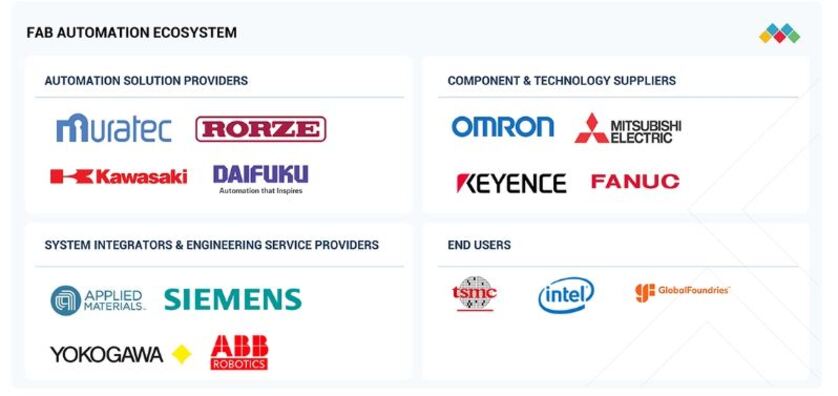
Key companies identified in the MarketsandMarkets report include:
- Daifuku
- Murata Machinery
- Atlas Copco
- Rorze Corporation
- Ebara Corporation
- FANUC
- Kawasaki Heavy Industries
- Hirata Corporation
- Yaskawa
- KUKA AG
These companies supply technologies spanning material handling, robotics, equipment automation, and related industrial systems. <Cite refs={[“turn236269search1″,”turn236269view0”]}/>
Market participants can strengthen their positions through product development, strategic partnerships, software integration, and improved cleanroom automation. Modular systems and intelligent robotics may also help suppliers address both new facilities and existing fabs undergoing modernization.
Challenges Facing the Fab Automation Market
High Initial Investment
Fab automation requires substantial investment in equipment, software, integration, and supporting infrastructure. For existing facilities, the costs of upgrading systems can be particularly significant when operations must continue during installation.
Manufacturers must evaluate expected improvements in throughput, yield, equipment availability, and operating costs before making investment decisions. Modular deployment and phased upgrades can help manage implementation risks.
Integration with Legacy Systems
Semiconductor fabs frequently operate equipment and software from multiple vendors and technology generations. Integrating these systems into a unified automation environment can be difficult, particularly when data formats, communication protocols, and control architectures differ.
Interoperability challenges may increase deployment time and require specialized engineering expertise. Standardized interfaces, effective system design, and close collaboration among suppliers can help reduce these difficulties.
Shortage of Skilled Automation Professionals
Modern fab automation requires expertise in robotics, software engineering, process control, AI analytics, and cleanroom operations. Shortages of qualified professionals can slow implementation and make system maintenance more difficult.
Training programs, collaboration with technical institutions, and improved vendor support will be important for developing the workforce required to operate next-generation automated fabs.
Strict Contamination and Reliability Requirements
Semiconductor manufacturing requires stringent contamination control, particularly in advanced-node production. Automation systems must minimize particle generation, maintain precise positioning, and operate reliably around sensitive equipment.
Even small deviations in handling or environmental conditions can affect production outcomes. Vendors must therefore design systems that meet demanding cleanroom requirements while maintaining throughput and equipment availability.
Future Opportunities in Advanced Semiconductor Manufacturing
The Fab Automation Market offers opportunities across AI-driven process control, predictive maintenance, advanced packaging, modular material handling, and digital-twin technologies.
AI and machine learning can support more intelligent production scheduling and equipment monitoring. Modular automation systems can simplify upgrades and allow manufacturers to adjust capacity as production requirements change. Collaborative robotics designed for cleanroom use may reduce manual intervention and improve handling consistency.
Advanced packaging, including 2.5D and 3D integration, is another opportunity. These approaches combine multiple semiconductor components into increasingly sophisticated packages, creating requirements for precise material handling, inspection, and assembly automation.
As semiconductor manufacturing expands across regions and technology generations, suppliers that combine reliable hardware with integrated software and engineering services will be well positioned to address evolving customer needs.
Conclusion
The Global Fab Automation Market is becoming increasingly important as semiconductor manufacturers expand capacity and adopt advanced production technologies. Rising demand for AI chips, high-performance computing, automotive electronics, and advanced memory is increasing the need for reliable wafer handling, robotics, intelligent software, and precise process control.
With the market projected to grow from USD 25.24 billion in 2025 to USD 41.44 billion by 2032, opportunities are emerging in 300 mm fabs, brownfield modernization, predictive maintenance, digital twins, and advanced packaging. Hardware will remain a major market component, while software and integration services will support the transition toward connected manufacturing environments.
Although investment costs, system interoperability, workforce shortages, and contamination control remain challenges, continued innovation and fab expansion are expected to support market development. Companies that deliver reliable, scalable, and integrated automation solutions will play an important role in the future of semiconductor manufacturing.
Frequently Asked Questions (FAQs)
1. What is the projected size of the Fab Automation Market?
According to MarketsandMarkets, the global Fab Automation Market is projected to grow from USD 25.24 billion in 2025 to USD 41.44 billion by 2032, at a CAGR of 7.3%.
2. What are the major drivers of the Fab Automation Market?
Key drivers include the expansion of 300 mm fabs, growing demand for advanced semiconductors, increasing use of robotics and automated material handling, and adoption of AI-driven factory software.
3. Which segment holds the largest share of the Fab Automation Market?
Hardware held the largest share by offering in 2024, while the 300 mm wafer segment and foundries were leading segments in their respective categories.
4. Which region is a major market for fab automation?
Asia Pacific held the largest regional share in 2024, supported by semiconductor manufacturing capacity and investments in advanced production facilities.
5. What are the key trends shaping the Fab Automation Market?
Important trends include AI-driven predictive maintenance, digital twins, smart manufacturing, modular material handling systems, cleanroom robotics, and automation for advanced packaging.
About MarketsandMarkets™
MarketsandMarkets™ is a blue ocean alternative in growth consulting and program management, leveraging a man-machine offering to drive supernormal growth for progressive organizations in the B2B space. We have the widest lens on emerging technologies, making us proficient in co-creating supernormal growth for clients.
The B2B economy is witnessing the emergence of $25 trillion of new revenue streams that are substituting existing revenue streams in this decade alone. We work with clients on growth programs, helping them monetize this $25 trillion opportunity through our service lines – TAM Expansion, Go-to-Market (GTM) Strategy to Execution, Market Share Gain, Account Enablement, and Thought Leadership Marketing.
Built on the ’GIVE Growth’ principle, we work with several Forbes Global 2000 B2B companies – helping them stay relevant in a disruptive ecosystem. Our insights and strategies are molded by our industry experts, cutting-edge AI-powered Market Intelligence Cloud, and years of research. The KnowledgeStore™ (our Market Intelligence Cloud) integrates our research, facilitates an analysis of interconnections through a set of applications, helping clients look at the entire ecosystem and understand the revenue shifts happening in their industry.
To find out more, visit www.MarketsandMarkets™.com or follow us on Twitter, LinkedIn and Facebook.
Contact:
Mr. Rohan Salgarkar
MarketsandMarkets™ INC.
1615 South Congress Ave.
Suite 103
Delray Beach, FL 33445
USA : 1-888-600-6441
