The rapid expansion of artificial intelligence (AI), cloud computing, big data analytics, and high-performance computing is transforming the global data center industry. Businesses are processing larger volumes of information, deploying advanced AI models, and expanding digital services. These developments are increasing the need for powerful, reliable, and energy-efficient semiconductor solutions. As a result, the Data Center Chip Market is becoming an important part of the global technology ecosystem.
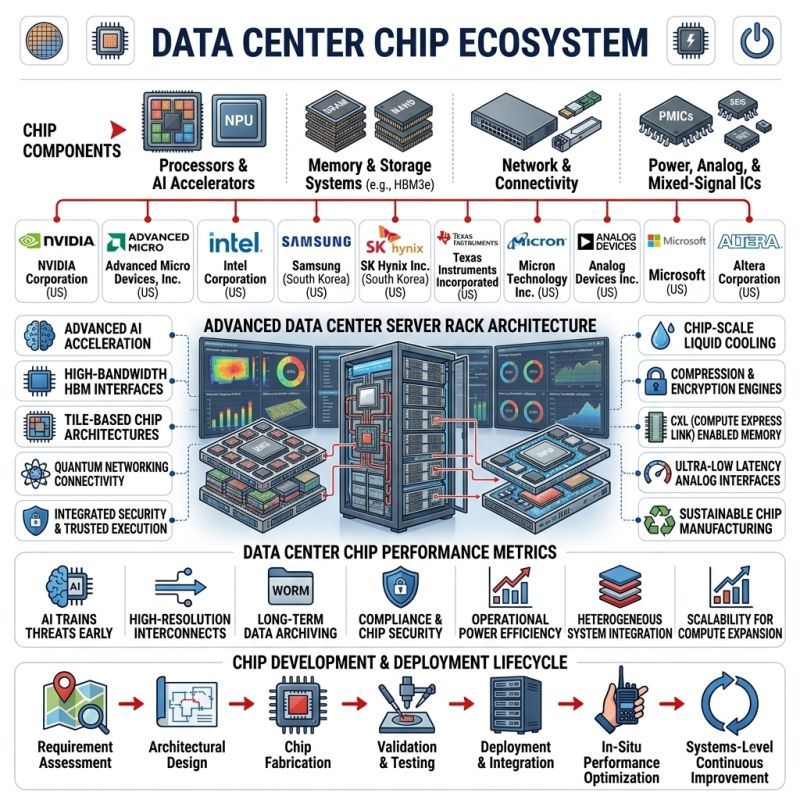
Data center chips are specialized semiconductor components that support computing, data storage, networking, power management, and system monitoring within data centers. They include processors, memory chips, networking chips, sensors, power management integrated circuits, and analog and mixed-signal ICs. Each component plays a role in enabling servers and related infrastructure to operate efficiently.
According to MarketsandMarkets, the global Data Center Chip Market is projected to grow from USD 283.16 billion in 2026 to USD 687.65 billion by 2032, registering a compound annual growth rate (CAGR) of 15.9% during the forecast period. This growth is supported by increasing AI workloads, the expansion of hyperscale data centers, rising cloud adoption, and the demand for advanced chips that can deliver higher performance with improved power efficiency.
As data center workloads become more complex, chip manufacturers are focusing on specialized processors, advanced memory technologies, high-speed connectivity, and workload-specific chip designs. These innovations are creating new growth opportunities for semiconductor companies, cloud service providers, and data center infrastructure developers.
Data Center Chip Market Overview
The Data Center Chip Market covers semiconductor components used to support computing and infrastructure operations in data centers. These chips help servers execute instructions, process AI workloads, transfer data between systems, manage power consumption, and monitor environmental and operational conditions.
Traditional data center infrastructure primarily supported enterprise applications, databases, websites, and general-purpose computing. However, the increasing use of generative AI, machine learning, real-time analytics, and cloud-native applications is changing hardware requirements. Modern data centers need chips that can manage intensive parallel processing, move large volumes of data quickly, and operate within strict power and thermal limits.
Processors are essential for general-purpose computing and workload coordination. Graphics processing units (GPUs) and other AI accelerators support parallel computing and AI model training and inference. Memory chips provide fast access to data, while networking chips and interconnect solutions enable communication among servers, storage systems, and accelerator clusters. Power management chips regulate electricity delivery, and sensors monitor operating conditions.
The market is segmented by component, application, data center size, and end user. Major components include processors, memory, network chips, sensors, power management solutions, and analog and mixed-signal ICs. Applications include AI and general-purpose computing, while end users include cloud service providers and enterprises.
These segments reflect the growing diversity of data center workloads. As organizations adopt AI and expand digital services, demand is increasing not only for faster processors but also for memory, networking, and power solutions that can support entire computing systems.
Key Trends Shaping the Data Center Chip Market
1. Rising Demand for AI Processors and Accelerators
Artificial intelligence is one of the most important drivers of the Data Center Chip Market. Training and running AI models requires substantial computing resources, particularly when applications involve large language models, generative AI, image recognition, recommendation systems, and advanced analytics.
Conventional CPUs remain important for general-purpose computing, operating systems, databases, and workload management. However, AI workloads often benefit from specialized processors and accelerators designed to execute many calculations simultaneously. GPUs, application-specific integrated circuits (ASICs), and other AI-focused chips can help improve processing throughput for suitable workloads.
The growth of generative AI is encouraging cloud providers and technology companies to invest in AI infrastructure. Data centers are expanding accelerator capacity to support model development, AI-powered applications, and inference services used by businesses and consumers.
Another important development is the increasing use of custom silicon. Large cloud providers are designing or commissioning chips optimized for specific workloads, allowing them to balance performance, power consumption, and operating costs. This trend is expected to create opportunities for semiconductor designers, foundries, advanced packaging providers, and chip design service companies.
2. Expansion of Hyperscale Data Centers
Hyperscale data centers are large facilities designed to support extensive computing, storage, and networking requirements. Cloud service providers and major technology companies are expanding these facilities to meet growing demand for digital services, AI computing, and enterprise cloud platforms.
As data centers increase in size, they require larger numbers of processors, memory devices, networking components, and power management chips. Infrastructure operators also need high-speed interconnects that allow servers and accelerators to exchange data efficiently.
Hyperscale environments place particular emphasis on performance at scale. A small improvement in chip efficiency can have a meaningful impact when deployed across thousands of servers. Consequently, data center operators are evaluating chip solutions based on processing capability, power requirements, reliability, and total cost of ownership.
The expansion of hyperscale infrastructure is also increasing demand for high-bandwidth memory, advanced networking silicon, and chips that support efficient communication between computing resources. These components are becoming increasingly important as AI clusters grow in size and complexity.
Download PDF Brochure @ https://www.marketsandmarkets.com/pdfdownloadNew.asp?id=39999570
3. Growing Adoption of Cloud Computing
Cloud computing allows businesses to access computing, storage, and software resources without maintaining all the required infrastructure themselves. The continued migration of enterprise applications to cloud platforms is increasing demand for data center capacity and the chips that power it.
Cloud service providers need flexible infrastructure that can support diverse workloads, including enterprise databases, web applications, cybersecurity services, analytics, and AI. This diversity creates demand for both general-purpose processors and specialized computing components.
Cloud environments must also support scalability. Operators need to add capacity as customer demand increases while maintaining service availability and cost efficiency. Advanced data center chips help support these goals through improved performance, integrated security features, and more efficient processing.
The growth of hybrid and multicloud strategies is contributing to this demand. Organizations increasingly distribute applications across public cloud platforms, private data centers, and edge environments. Although these deployment models differ, they rely on semiconductor components to process information, connect systems, and manage infrastructure resources.
4. Focus on Energy-Efficient Computing
Power consumption has become a major concern for data center operators. As facilities deploy more servers and AI accelerators, electricity demand and cooling requirements can rise significantly. Chip efficiency is therefore becoming a key consideration in data center planning.
Semiconductor companies are developing processors and accelerators that aim to deliver more computing performance per watt. Power management ICs help regulate voltage and current, while improved chip architectures and manufacturing processes can support better energy efficiency.
Energy-efficient chip design is important for both economic and environmental reasons. Lower power consumption can help reduce operating expenses and ease pressure on electrical infrastructure. It may also help data centers improve sustainability performance, although the overall environmental impact depends on factors such as electricity sources, cooling methods, utilization, and hardware lifecycle.
Power efficiency is not determined by the processor alone. Memory, networking, server design, cooling systems, and software optimization also affect total data center energy use. As a result, chip manufacturers increasingly need to consider how their products perform within complete systems rather than evaluating isolated components.
5. Advances in High-Bandwidth Memory and Data Movement
Modern AI and high-performance computing workloads require rapid movement of data between processors, memory, and other system components. When data cannot be delivered quickly enough, expensive processing resources may remain underutilized.
Memory chips are therefore an essential part of the Data Center Chip Market. High-bandwidth memory (HBM) can provide substantial data throughput for suitable accelerator systems, helping support AI training and inference. Conventional server memory also remains important for databases, virtualization, and general-purpose computing.
At the same time, networking chips and high-speed interconnect technologies help transfer data among servers and accelerator clusters. As AI systems scale, communication between chips can become a performance bottleneck, making bandwidth, latency, and network efficiency increasingly important.
Chip designers are addressing these challenges through improvements in memory interfaces, packaging, interconnects, and system architecture. The ability to balance compute performance with efficient data movement will remain an important factor in next-generation data center design.
6. Increasing Use of Custom Silicon and Workload-Specific Chips
A single chip architecture may not deliver the best combination of cost, speed, and power efficiency for every data center workload. AI training, AI inference, database operations, networking, and storage each have different performance requirements.
This is encouraging the development of workload-specific silicon. Cloud service providers and large technology companies are investing in custom processors and accelerators designed for particular tasks. These solutions can enable closer coordination between hardware and software and may reduce dependence on general-purpose components for selected workloads.
ASICs are designed for specific functions, while field-programmable gate arrays (FPGAs) offer reconfigurable logic for applications that require flexibility. CPUs and GPUs remain important across many workloads, but specialized designs can provide advantages where performance and efficiency requirements are well defined.
Custom silicon development requires significant investment, design expertise, software support, and access to advanced manufacturing. However, the potential benefits of improved efficiency and differentiated infrastructure are making it an important trend in the market.
7. Growth of Edge Computing and Distributed Infrastructure
Edge computing processes information closer to where it is generated rather than relying exclusively on centralized data centers. It is useful for applications that require low latency, local processing, or reduced data transfer to remote facilities.
Examples include industrial automation, connected vehicles, telecommunications, smart infrastructure, and real-time monitoring. These applications can require specialized chips that balance computing performance with limited space, power, and cooling capacity.
Edge infrastructure does not replace large data centers. Instead, it complements centralized cloud and enterprise systems by distributing workloads across different locations. This creates demand for a broad range of semiconductor solutions, from powerful server processors to lower-power computing and networking chips.
As connected devices and real-time applications expand, edge computing is expected to contribute to the wider demand for efficient processing and data management technologies.
Major Drivers of Data Center Chip Market Growth
Increasing AI and Machine Learning Workloads
AI applications require substantial computing power for training, inference, data preparation, and model deployment. As organizations integrate AI into business operations, they are increasing investments in servers and accelerator infrastructure.
This creates demand for processors, memory, networking components, and power management chips. The growing diversity of AI workloads is also encouraging the adoption of specialized hardware and custom silicon.
Rising Data Generation and Digital Transformation
Businesses generate increasing volumes of data through connected devices, online transactions, digital platforms, industrial systems, and enterprise applications. Processing and storing this information requires scalable data center infrastructure.
Digital transformation initiatives across banking, healthcare, retail, manufacturing, telecommunications, and other sectors are supporting demand for computing capacity. Data center chips enable these systems to process information, run applications, and maintain reliable services.
Growth of Cloud Services and Enterprise Infrastructure
Cloud providers continue to expand their infrastructure to support enterprise applications, software-as-a-service platforms, analytics, and AI services. Enterprises are also modernizing private data centers to improve security, control, and performance.
These investments support demand for general-purpose processors, memory, networking chips, and power management solutions. As customers expect faster and more reliable digital services, data center operators must improve both capacity and efficiency.
Demand for Faster Networking and Lower Latency
Modern computing workloads depend on rapid communication among servers, accelerators, memory, and storage systems. Networking chips and interconnect solutions help minimize communication delays and support higher data throughput.
These capabilities are particularly important in AI clusters, where many accelerators work together to train or operate large models. Improvements in network bandwidth, latency, and efficiency can help data centers use computing resources more effectively.
Need to Reduce Operating Costs
Electricity, cooling, hardware, and infrastructure maintenance represent significant costs for data center operators. Semiconductor solutions that improve performance per watt and increase system utilization can help reduce the cost of delivering computing services.
Operators are increasingly evaluating chips based on system-level performance rather than processing speed alone. This creates opportunities for manufacturers that can demonstrate improvements in energy efficiency, workload performance, reliability, and total cost of ownership.
Data Center Chip Market Segmentation Analysis
By Component
The Data Center Chip Market includes processors, memory, network chips, sensors, power management solutions, and analog and mixed-signal ICs.
Processors: CPUs support general-purpose computing and workload coordination, while GPUs and specialized accelerators support parallel processing and AI applications. Demand is growing as data centers expand computing capacity.
Memory: Memory chips provide rapid access to instructions and data. Demand is supported by AI systems, enterprise applications, databases, and high-performance computing workloads.
Network chips: Networking components enable communication between servers, switches, accelerators, and storage systems. Higher data volumes and larger AI clusters are increasing the need for high-speed connectivity.
Sensors: Sensors monitor parameters such as temperature, humidity, airflow, and other operating conditions. Their data can support facility monitoring, equipment management, and operational reliability.
Power management solutions: These chips regulate and distribute power to computing systems. They are increasingly important as server power demands rise and operators seek improved energy efficiency.
Analog and mixed-signal ICs: These components support functions such as signal conversion, monitoring, interface management, and control within complex electronic systems.
By Application: AI and General-Purpose Computing
AI is a major growth application because model training and inference require high-performance computing and efficient data movement. AI data centers use combinations of accelerators, processors, memory, and networking components to support increasingly complex workloads.
General-purpose computing remains essential for enterprise applications, databases, virtualization, web services, and cloud infrastructure. CPUs and supporting chips continue to serve these workloads, while infrastructure operators may combine general-purpose and specialized processors to improve efficiency.
The coexistence of AI and traditional computing means that data centers will continue to need a diverse mix of chip architectures. Demand will depend on workload requirements, system design, software compatibility, and operating costs.
By Data Center Size
The market includes small, medium, and large data centers. Smaller facilities may support local enterprise requirements, regional services, or specialized workloads. Medium-sized facilities can serve business applications and regional infrastructure needs.
Large data centers, including hyperscale facilities, require extensive computing, networking, memory, and power infrastructure. Their scale can create substantial demand for semiconductor components, particularly as AI workloads and cloud services expand.
Each size category has different requirements for capacity, redundancy, connectivity, and energy management. Chip manufacturers must therefore develop solutions that meet varying performance and efficiency needs.
By End User: Cloud Service Providers and Enterprises
Cloud service providers operate infrastructure that supports applications and services for large numbers of customers. Their investments in AI, cloud computing, and custom silicon make them important buyers of data center chips.
Enterprises operate data centers to support internal applications, business-critical databases, security, analytics, and digital services. Some organizations maintain on-premises facilities, while others use hybrid environments that combine private infrastructure with public cloud resources.
Both end-user groups are seeking improved performance, scalability, and energy efficiency. Their purchasing decisions increasingly consider how chips fit into server architectures, software platforms, and long-term infrastructure strategies.
Regional Outlook for the Data Center Chip Market
North America is an important market due to the presence of major cloud providers, technology companies, semiconductor designers, and AI infrastructure developers. Investment in hyperscale facilities and AI computing is supporting demand for advanced processors, accelerators, memory, and networking components.
Asia Pacific is also a major region for the semiconductor and data center ecosystem. Countries such as China, Japan, South Korea, Taiwan, and India contribute through different combinations of chip manufacturing, electronics production, cloud infrastructure, and digital services. Regional investment in data centers and semiconductor capabilities creates opportunities across the supply chain.
Europe supports demand through enterprise digitization, cloud infrastructure, telecommunications, industrial computing, and data sovereignty initiatives. Investments in energy-efficient infrastructure and regional computing capacity may contribute to further adoption of advanced data center chips.
Market growth across regions will depend on data center construction, electricity availability, semiconductor supply, government policies, access to advanced manufacturing, and the pace of AI adoption.
Competitive Landscape and Key Market Players
Competition in the Data Center Chip Market is shaped by processing performance, energy efficiency, memory bandwidth, connectivity, software compatibility, and manufacturing capabilities. Companies are investing in new architectures, specialized accelerators, custom silicon, and integrated platforms to meet evolving customer requirements.
Major companies identified in the MarketsandMarkets report include:
- NVIDIA Corporation
- Advanced Micro Devices, Inc. (AMD)
- Intel Corporation
- Samsung Electronics
- SK hynix
- Amazon Web Services (AWS)
- Monolithic Power Systems
- Texas Instruments
- Analog Devices
- Micron Technology
- Microsoft
- Altera Corporation
- Imagination Technologies
- Graphcore
These companies participate in different parts of the ecosystem, including processors, memory, networking, power management, and custom chip development. Their roles vary, as some design semiconductor products, some manufacture memory or other components, and some develop chips for their own infrastructure.
Competitive strategies include improving performance per watt, developing workload-specific processors, strengthening software ecosystems, and integrating chips into complete server and networking platforms. Partnerships across chip design, foundry manufacturing, memory, packaging, and data center operations are also important in bringing advanced solutions to market.
Challenges Facing the Data Center Chip Market
High Development and Manufacturing Costs
Designing advanced data center chips requires significant investment in research, engineering, verification, and manufacturing. Leading-edge production and advanced packaging can add further cost and complexity.
These requirements may limit the number of companies able to compete at the highest performance levels. Smaller chip developers may need partnerships with established semiconductor manufacturers, cloud providers, or design service firms to bring products to market.
Power Consumption and Thermal Management
AI accelerators and high-performance processors can consume substantial amounts of power, creating additional cooling requirements. If power and thermal constraints are not managed effectively, they can limit data center capacity and increase operating costs.
Chip designers must balance performance with power efficiency, while data center operators need to coordinate chip selection with server design, cooling, and facility infrastructure.
Supply Chain Constraints
The production of advanced semiconductors depends on specialized manufacturing facilities, equipment, materials, packaging technologies, and testing capabilities. Disruptions or capacity limitations at any stage can affect chip availability and delivery schedules.
Geopolitical restrictions and regional concentration in parts of the supply chain can create additional uncertainty. Manufacturers and data center operators are therefore paying greater attention to supply chain resilience, supplier diversification, and long-term capacity planning.
Rapid Technological Change
Data center workloads and chip architectures are evolving quickly. Products must keep pace with new AI models, changing software requirements, and improvements in memory and networking technologies.
Companies that fail to innovate may struggle to maintain competitiveness. At the same time, frequent hardware upgrades can increase capital expenditure for customers and complicate infrastructure planning.
Future Opportunities in the Data Center Chip Market
The future of the Data Center Chip Market will be shaped by AI infrastructure expansion, custom silicon, high-bandwidth memory, advanced packaging, and energy-efficient computing. As organizations deploy more complex AI services, they will need balanced systems in which processors, memory, networking, and power management operate efficiently together.
Custom chip development offers opportunities for cloud providers and semiconductor designers to optimize hardware for specific workloads. Chiplet architectures and advanced packaging may also help integrate different computing and memory components into compact, high-performance systems.
Another opportunity lies in improving the efficiency of AI inference. As AI applications move from experimentation into routine business use, organizations will seek cost-effective ways to run models at scale. Specialized inference chips and optimized system architectures may help reduce latency and power consumption for suitable applications.
The growing importance of data center sustainability will also encourage innovation in power management and performance-per-watt improvements. Solutions that reduce energy use without compromising reliability or computing capability may become increasingly attractive.
Conclusion
The Data Center Chip Market is expanding as AI, cloud computing, digital transformation, and data-intensive applications increase the need for powerful semiconductor infrastructure. According to MarketsandMarkets, the market is projected to grow from USD 283.16 billion in 2026 to USD 687.65 billion by 2032, at a CAGR of 15.9%.
Key trends include rising demand for AI accelerators, hyperscale data center expansion, custom silicon, high-bandwidth memory, faster networking, and energy-efficient computing. Growth opportunities extend across processors, memory, networking, sensors, power management, and analog and mixed-signal ICs.
Challenges such as high development costs, power requirements, supply chain risks, and rapid technological change will continue to influence the industry. However, companies that deliver efficient, scalable, and workload-optimized semiconductor solutions will be well positioned to benefit from ongoing investment in next-generation data center infrastructure.
Frequently Asked Questions (FAQs)
1. What is the projected size of the Data Center Chip Market?
According to MarketsandMarkets, the global Data Center Chip Market is projected to grow from USD 283.16 billion in 2026 to USD 687.65 billion by 2032, at a CAGR of 15.9%.
2. What are the major drivers of Data Center Chip Market growth?
Major drivers include increasing AI and machine learning workloads, cloud computing adoption, hyperscale data center expansion, rising data generation, and demand for energy-efficient computing.
3. Which components are included in the Data Center Chip Market?
The market includes processors, memory chips, networking chips, sensors, power management solutions, and analog and mixed-signal integrated circuits.
4. How is AI influencing the Data Center Chip Market?
AI is increasing demand for GPUs, specialized accelerators, high-bandwidth memory, and high-speed networking. These technologies help data centers train and run AI models while managing performance and power requirements.
5. What are the key trends shaping the Data Center Chip Market?
Key trends include custom silicon development, AI accelerators, high-bandwidth memory, advanced networking, energy-efficient chip design, and the expansion of hyperscale and edge computing infrastructure.
About MarketsandMarkets™
MarketsandMarkets™ is a blue ocean alternative in growth consulting and program management, leveraging a man-machine offering to drive supernormal growth for progressive organizations in the B2B space. We have the widest lens on emerging technologies, making us proficient in co-creating supernormal growth for clients.
The B2B economy is witnessing the emergence of $25 trillion of new revenue streams that are substituting existing revenue streams in this decade alone. We work with clients on growth programs, helping them monetize this $25 trillion opportunity through our service lines – TAM Expansion, Go-to-Market (GTM) Strategy to Execution, Market Share Gain, Account Enablement, and Thought Leadership Marketing.
Built on the ’GIVE Growth’ principle, we work with several Forbes Global 2000 B2B companies – helping them stay relevant in a disruptive ecosystem. Our insights and strategies are molded by our industry experts, cutting-edge AI-powered Market Intelligence Cloud, and years of research. The KnowledgeStore™ (our Market Intelligence Cloud) integrates our research, facilitates an analysis of interconnections through a set of applications, helping clients look at the entire ecosystem and understand the revenue shifts happening in their industry.
To find out more, visit www.MarketsandMarkets™.com or follow us on Twitter, LinkedIn and Facebook.
Contact:
Mr. Rohan Salgarkar
MarketsandMarkets™ INC.
1615 South Congress Ave.
Suite 103
Delray Beach, FL 33445
USA : 1-888-600-6441
