The Data Center PDU Market Growth is accelerating as organizations worldwide invest in hyperscale data centers, artificial intelligence (AI) infrastructure, cloud computing, and high-performance computing (HPC). As data centers handle increasingly complex workloads, the demand for reliable, scalable, and energy-efficient power distribution systems is becoming more important. Power Distribution Units (PDUs) play a critical role in delivering electricity to servers, networking equipment, storage systems, and other essential IT infrastructure while maintaining operational reliability.
The growing adoption of AI-powered applications, generative AI, machine learning, and cloud-based services is increasing rack power density and creating new requirements for advanced power management. Traditional power distribution solutions are gradually giving way to intelligent, monitored, and switched PDUs that provide real-time visibility into power consumption, remote management, and improved energy utilization.
The Data Center PDU Market Growth also highlights the transition toward intelligent infrastructure, where automation, digital monitoring, and energy optimization are becoming essential for managing next-generation data center operations.
Increasing AI Workloads Accelerate Data Center PDU Market Growth
Artificial intelligence is emerging as one of the major factors influencing the Data Center PDU Market Growth. AI applications require powerful computing infrastructure, including GPUs, high-performance processors, advanced networking equipment, and specialized storage systems. These technologies consume significant amounts of electricity and increase power requirements at the rack level.
The expansion of generative AI, large language models, deep learning, and machine learning applications is encouraging data center operators to upgrade their electrical infrastructure. Traditional PDUs may not provide the monitoring capabilities and power capacity required by modern AI environments.
Intelligent PDUs are becoming increasingly important because they enable operators to monitor electrical consumption, identify power fluctuations, balance loads, and manage individual outlets remotely. These capabilities help prevent overload conditions and improve infrastructure availability.
Furthermore, the increasing deployment of GPU-based servers is creating opportunities for high-capacity and three-phase PDUs. These systems support higher electrical loads and help data centers distribute power efficiently across high-density computing environments.
As AI adoption continues across healthcare, financial services, manufacturing, telecommunications, and other industries, investments in AI-ready data centers are expected to support long-term Data Center PDU Market Growth.
Rising Demand for Intelligent Power Distribution Units
The transition from traditional power distribution systems to intelligent PDUs is another important trend shaping the industry. Basic PDUs primarily distribute electrical power to connected equipment, whereas intelligent PDUs provide advanced capabilities such as remote monitoring, outlet-level control, power metering, and environmental sensing.
Data center operators increasingly require real-time information about power consumption to improve operational efficiency and reduce unnecessary energy usage. Intelligent PDUs provide visibility into voltage, current, power, and energy consumption at different levels of the electrical infrastructure.
Monitored PDUs help operators identify unusual power consumption patterns and understand equipment-level energy requirements. Switched PDUs offer additional functionality by allowing individual outlets to be remotely controlled, enabling IT teams to restart equipment and manage power distribution without physically accessing server racks.
Integration with Data Center Infrastructure Management (DCIM) platforms further strengthens these capabilities. By combining PDU data with information from cooling systems, servers, and other infrastructure components, operators can make more informed decisions about capacity planning, energy management, and maintenance.
These developments are strengthening the importance of intelligent power distribution solutions and contributing to Data Center PDU Market Growth.
Download PDF Brochure @ https://www.marketsandmarkets.com/pdfdownloadNew.asp?id=183927907
Technological Innovations Transforming the Data Center PDU Industry
Emerging technologies are changing how power distribution infrastructure is designed, deployed, and managed. Manufacturers are introducing advanced PDU solutions to support higher rack densities, improved energy efficiency, and increasingly automated data center environments.
Some of the major technology trends influencing the industry include:
1. AI-Based Power Monitoring: Artificial intelligence and analytics are helping data center operators analyze power consumption patterns, identify abnormal operating conditions, and improve load management. AI-enabled monitoring can also support predictive maintenance by identifying potential electrical issues before they affect operations.
2. Remote Power Management: Remote monitoring and outlet-level switching allow operators to manage connected equipment from centralized management platforms. This reduces the need for manual intervention and improves operational flexibility across geographically distributed data centers.
3. Advanced Metering Technologies: Modern PDUs incorporate sophisticated metering capabilities that provide detailed information about electrical consumption. These technologies help organizations understand power usage at rack, circuit, and outlet levels.
4. DCIM Integration: Integration with digital infrastructure management platforms enables centralized monitoring of power distribution, cooling, and IT equipment. This improves infrastructure visibility and supports more efficient capacity utilization.
5. High-Density Power Distribution: Increasing AI and HPC workloads are encouraging manufacturers to develop high-capacity PDUs that can support demanding electrical requirements while maintaining reliable power delivery.
6. Environmental Monitoring: Temperature and humidity sensors integrated with intelligent PDUs help operators monitor environmental conditions around IT equipment. This information supports better coordination between power distribution and cooling infrastructure.
These innovations are creating new opportunities for manufacturers and strengthening the long-term Data Center PDU Market Growth outlook.
Hyperscale and Colocation Data Centers Drive Market Expansion
The rapid expansion of hyperscale and colocation data centers is creating significant opportunities for the PDU industry. Cloud service providers, technology companies, and enterprises are investing in large-scale data center facilities to support growing digital workloads, online services, and enterprise applications.
Hyperscale data centers require scalable power distribution infrastructure capable of supporting thousands of servers and high-density computing systems. These facilities increasingly deploy intelligent rack PDUs to improve power monitoring, load balancing, and operational reliability.
Colocation data centers are also contributing to Data Center PDU Market Growth. These facilities provide shared infrastructure to multiple organizations, making efficient power management essential. Operators must deliver reliable electricity to different customers while maintaining visibility into individual rack-level consumption.
The growing deployment of edge data centers is creating additional demand for compact and remotely managed PDUs. Edge facilities are often located closer to end users to support low-latency applications, telecommunications networks, industrial automation, and connected devices.
As hyperscale, colocation, enterprise, and edge facilities continue expanding, demand for flexible and intelligent power distribution solutions is expected to increase.
Rack PDU Segment Maintains a Strong Market Position
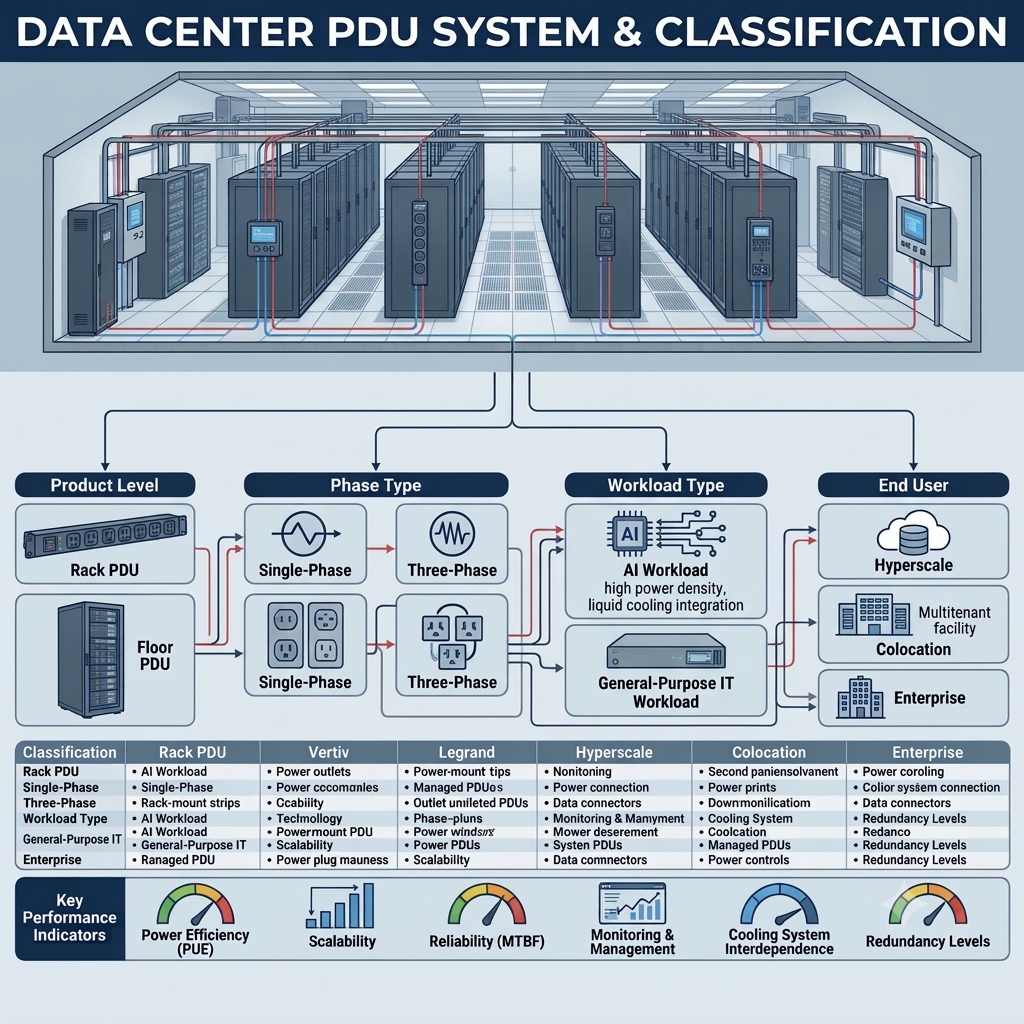
By product level, the market is categorized into rack PDUs and floor PDUs. Rack PDUs play an important role in distributing electricity directly to servers and networking equipment installed within individual racks.
The growing adoption of intelligent rack PDUs is further supporting this segment. Advanced products offer real-time power monitoring, outlet-level switching, remote management, and environmental sensing capabilities.
Floor PDUs also remain important, particularly in larger data center environments where centralized power distribution is required. These systems help distribute electrical power across multiple racks and support the broader electrical architecture of data center facilities.
However, increasing rack power densities and the growing need for detailed power monitoring are creating strong opportunities for advanced rack-mounted solutions.
Three-Phase PDUs Support High-Density Computing Infrastructure
The increasing power requirements of AI and HPC workloads are driving demand for three-phase power distribution systems. Compared with single-phase solutions, three-phase PDUs can deliver higher power capacity and support efficient electrical distribution in large-scale data center environments.
Three-phase PDUs are particularly important in hyperscale and colocation facilities where high-density server racks require substantial electrical power. They can also help reduce cabling complexity and improve power distribution efficiency.
According to MarketsandMarkets, the three-phase segment is expected to register a CAGR of 22.1% during the forecast period. Increasing investments in AI infrastructure, GPU-based computing, and high-performance servers are supporting this growth.
Single-phase PDUs continue to serve enterprise facilities and applications with comparatively lower power requirements. However, the growing deployment of high-density computing infrastructure is expected to strengthen the adoption of three-phase solutions.
Energy Efficiency and Sustainability Shape Industry Developments
Energy efficiency has become a major priority for data center operators because electricity consumption directly influences operational expenses and environmental performance. As facilities expand to accommodate AI workloads and cloud computing applications, improving power utilization is becoming increasingly important.
Modern PDUs support energy optimization by providing detailed information about electrical consumption across connected equipment. Operators can use this information to identify inefficient power usage, improve load distribution, and optimize infrastructure capacity.
Intelligent and metered PDUs also help organizations identify underutilized equipment and make better decisions about rack-level power allocation. These capabilities can contribute to lower operational costs and improved energy management.
Sustainability initiatives are encouraging manufacturers to develop advanced power distribution solutions that support efficient electrical infrastructure. Integration with DCIM platforms and energy management systems further helps organizations monitor power consumption and evaluate infrastructure performance.
The increasing focus on sustainable data center operations is therefore becoming an important contributor to Data Center PDU Market Growth.
Asia Pacific Emerges as a High-Growth Regional Market
Asia Pacific is expected to register the highest growth rate in the global Data Center PDU Market during the forecast period. Rapid digital transformation, increasing cloud adoption, and expanding hyperscale infrastructure are supporting regional demand.
Countries such as China, India, Japan, and those across Southeast Asia are witnessing growing investments in data center facilities. The expansion of digital services, e-commerce, telecommunications, financial technology, and AI applications is increasing the need for reliable power distribution infrastructure.
India is becoming an important market for data center investments as enterprises and cloud service providers expand their digital capabilities. Increasing internet penetration, demand for cloud services, and the development of AI infrastructure are creating opportunities for intelligent PDU manufacturers.
China and Japan are also investing in advanced computing infrastructure, while Southeast Asian countries are strengthening their positions as emerging data center destinations.
The growing adoption of edge computing and colocation services across the region is further supporting demand for scalable and remotely managed power distribution solutions. According to MarketsandMarkets, Asia Pacific is anticipated to register a CAGR of 21.9% between 2026 and 2032.
Key Challenges Affecting Data Center PDU Market Growth
Despite strong growth opportunities, the industry faces several challenges that may influence technology adoption and purchasing decisions.
High Initial Investment: Intelligent PDUs with advanced monitoring, outlet-level switching, and environmental sensing capabilities generally involve higher upfront costs than basic power distribution systems. This can create budget constraints for smaller enterprises and cost-sensitive facilities.
Increasing Power and Thermal Complexity: AI workloads and high-density computing environments create additional pressure on electrical and cooling infrastructure. Data center operators must coordinate power distribution and thermal management to maintain system reliability.
Cybersecurity Risks: Connected PDUs provide remote access and centralized monitoring capabilities. However, these features also introduce cybersecurity considerations. Manufacturers must strengthen authentication, access control, and network security to protect connected infrastructure.
Long Equipment Lifecycles: Data center power distribution equipment is designed for long-term operation. Consequently, operators may delay replacing existing systems, slowing demand for new installations and upgrades.
Addressing these challenges through improved product design, cost optimization, cybersecurity capabilities, and infrastructure integration will be important for market participants.
Competitive Landscape and Key Market Players
The competitive landscape is characterized by product innovation, strategic partnerships, portfolio expansion, and investments in intelligent power distribution technologies. Leading manufacturers are developing solutions designed to support high-density racks, AI workloads, and modern data center infrastructure.
Future Outlook: What Lies Ahead for the Data Center PDU Market?
The future of the Data Center PDU Market will be shaped by the convergence of AI, cloud computing, automation, and advanced power management technologies. As data centers become more power-intensive, operators will increasingly prioritize intelligent infrastructure capable of supporting higher electrical loads while maintaining operational efficiency.
The adoption of AI-ready rack PDUs, advanced metering, remote power management, and DCIM integration is expected to create new growth opportunities. Manufacturers that develop scalable, energy-efficient, and secure power distribution solutions will be better positioned to address changing customer requirements.
Furthermore, increasing investments in hyperscale facilities, colocation infrastructure, and edge computing will continue to expand the addressable market.
With the global market projected to reach USD 14.23 billion by 2032, the Data Center PDU Market Growth outlook remains promising. Technological innovation, increasing rack power density, and the transition toward intelligent power distribution will play important roles in shaping the next generation of data center infrastructure.
FAQ
Q1. What is the projected size of the Data Center PDU Market by 2032?
The Data Center PDU Market is projected to grow from USD 4.89 billion in 2026 to USD 14.23 billion by 2032, registering a CAGR of 19.5%.
Q2. What are the key factors driving Data Center PDU Market Growth?
The key growth drivers include increasing AI workloads, cloud computing adoption, hyperscale data center expansion, rising rack power density, and growing demand for intelligent power management solutions.
Q3. Which product segment dominates the Data Center PDU Market?
Rack PDUs dominate the market, accounting for a 62.0% share in 2025, driven by their widespread use in rack-level power distribution and monitoring.
Q4. Which region is expected to experience the highest growth in the Data Center PDU Market?
Asia Pacific is expected to register the highest growth, with a projected CAGR of 21.9% from 2026 to 2032, supported by expanding data center infrastructure and digital transformation.
Q5. Who are the key players in the Data Center PDU Market?
Major players include Schneider Electric, Eaton, Vertiv, Legrand, ABB, nVent, Rittal, Delta Electronics, CyberPower, and ATEN International.
