The global digital economy is becoming increasingly dependent on data centers to support cloud computing, artificial intelligence (AI), online banking, enterprise applications, telecommunications, and digital services. As organizations generate and process growing volumes of data, ensuring the reliability, security, energy efficiency, and operational resilience of data center infrastructure has become a major priority.
This growing demand for dependable digital infrastructure is accelerating the expansion of the Data Center Certification Market. Data center certification provides independent validation that facilities, infrastructure, and operational processes meet recognized industry standards for reliability, availability, cybersecurity, sustainability, and performance.
With increasing investments in hyperscale facilities, colocation infrastructure, and AI-ready data centers, certification is becoming an important requirement for operators seeking to establish customer confidence and maintain operational excellence.
According to MarketsandMarkets, The data center certification market is projected to reach USD 3.05 billion by 2032 from an estimated USD 1.16 billion in 2026, growing at a CAGR of 17.4%..
The increasing adoption of cloud computing, growing cybersecurity concerns, rising sustainability requirements, and expansion of AI infrastructure are among the major factors supporting this growth.
What Is Driving the Data Center Certification Market?
Several technological, operational, and regulatory developments are creating new opportunities for certification providers worldwide.
1. Increasing Investments in Hyperscale and Colocation Data Centers
The rapid expansion of hyperscale and colocation data centers is one of the primary factors driving the Data Center Certification Market.
Cloud service providers, technology companies, and enterprises are investing heavily in large-scale facilities to accommodate growing data storage and computing requirements.
These facilities require reliable power distribution, advanced cooling systems, redundant infrastructure, and standardized operational processes.
Certification helps data center operators independently validate infrastructure design, construction quality, commissioning procedures, and operational performance.
As hyperscale and colocation deployments increase, demand for recognized certification frameworks is expected to strengthen.
2. Growing Adoption of AI-Ready Data Centers
Artificial intelligence is transforming data center infrastructure by increasing demand for high-performance computing, advanced processors, and high-density server environments.
AI workloads require substantial computing power and generate significant heat, creating additional requirements for electrical infrastructure and cooling performance.
AI-ready data centers must maintain reliable power delivery, efficient thermal management, infrastructure redundancy, and operational resilience.
Certification providers are increasingly addressing these requirements through specialized assessment programs designed to evaluate infrastructure readiness and operational performance.
The growing deployment of AI infrastructure is therefore creating significant opportunities for the Data Center Certification Market.
Download PDF Brochure @ https://www.marketsandmarkets.com/pdfdownloadNew.asp?id=37943401
3. Rising Focus on Operational Reliability and Business Continuity
Modern businesses depend on uninterrupted access to digital services. Even short periods of data center downtime can result in financial losses, operational disruptions, and reputational damage.
Certification frameworks help operators assess infrastructure availability, fault tolerance, redundancy, maintenance procedures, and business continuity capabilities.
Facility and reliability certifications are particularly important for mission-critical environments where uninterrupted operations are essential.
The growing need to reduce downtime and improve infrastructure resilience is encouraging organizations to adopt internationally recognized certification standards.
4. Increasing Cybersecurity and Regulatory Compliance Requirements
As data centers manage sensitive financial, healthcare, government, and enterprise information, cybersecurity has become a critical operational priority.
Cyberattacks, data breaches, ransomware, and unauthorized access can create significant financial and regulatory consequences.
Organizations are increasingly seeking information security and cybersecurity certifications to demonstrate compliance with recognized standards and strengthen their security management practices.
The growing adoption of cloud computing, hybrid infrastructure, and interconnected digital platforms is further increasing the need for independent security assessments.
According to MarketsandMarkets, information security and cybersecurity certifications are projected to register the highest CAGR among certification types during the forecast period.
5. Growing Demand for Sustainable Data Center Operations
Energy consumption and environmental impact are becoming important considerations for data center operators.
Increasing electricity requirements, cooling demands, and sustainability commitments are encouraging organizations to adopt energy-efficient infrastructure and environmental management practices.
Sustainability and energy certifications help organizations evaluate energy management, environmental performance, and resource utilization.
The growing emphasis on renewable energy, efficient cooling systems, and environmental responsibility is creating additional opportunities for certification service providers.
Data Center Certification Market: Analysis by Certification Type
The Data Center Certification Market includes several certification categories designed to evaluate different aspects of facility performance and operational management.
Facility and Reliability Certifications
Facility and reliability certifications assess the physical infrastructure of data centers, including power systems, cooling infrastructure, redundancy, and availability.
These certifications help operators demonstrate that facilities are designed to support reliable and uninterrupted operations.
According to MarketsandMarkets, facility and reliability certifications are expected to account for the largest share of the market by 2032, supported by increasing demand for uptime assurance and operational resilience.
Operational Certifications
Operational certifications evaluate management processes, maintenance procedures, operational governance, and business continuity practices.
These certifications help data center operators improve operational consistency and reduce infrastructure-related risks.
Sustainability and Energy Certifications
Sustainability and energy certifications are gaining importance as organizations focus on reducing energy consumption and improving environmental performance.
These certifications assess energy management systems, resource utilization, and environmental practices.
Information Security and Cybersecurity Certifications
Cybersecurity certifications help organizations demonstrate their ability to protect sensitive information and manage security risks.
Increasing cyber threats, regulatory requirements, and cloud adoption are supporting rapid growth in this certification category.
Infrastructure Segment: Why Is Power Certification Important?
Data center infrastructure includes IT equipment, power systems, cooling technologies, and supporting physical facilities.
Among these categories, power infrastructure plays a particularly important role in maintaining operational continuity.
Data centers require dependable electrical distribution systems, backup generators, uninterruptible power supplies (UPS), and redundant power architectures.
AI-ready facilities are increasing the need for reliable electrical infrastructure capable of supporting high-density computing workloads.
According to MarketsandMarkets, the power infrastructure segment is expected to account for approximately 35%–40% of the Data Center Certification Market in 2032.
The IT infrastructure segment is also expected to experience strong growth, supported by increasing investments in AI servers, storage systems, networking equipment, and cloud computing infrastructure.
Cooling infrastructure certification is becoming increasingly important as operators adopt advanced thermal management technologies to support high-performance computing.
How AI and Cloud Computing Are Creating New Certification Opportunities
AI and cloud computing are changing the requirements for modern data center infrastructure.
Traditional data centers were primarily designed around conventional enterprise computing and storage requirements. However, AI workloads demand greater computing density, higher power capacity, advanced cooling, and sophisticated operational monitoring.
These changes are creating demand for certification programs that evaluate whether facilities can support next-generation computing environments.
Cloud service providers are particularly important in this transformation because they operate large-scale infrastructure supporting millions of users and enterprise applications.
Certification provides independent validation of operational reliability, cybersecurity, energy management, and infrastructure performance.
According to MarketsandMarkets, cloud service providers are projected to register the highest CAGR among end-user segments during the forecast period.
Five Key Trends Reshaping the Data Center Certification Market
The industry is evolving through several important trends that are changing certification requirements and service delivery models.
1. AI-Ready Data Center Certification
The expansion of AI infrastructure is increasing demand for specialized assessments covering power density, cooling performance, infrastructure reliability, and operational readiness.
2. Continuous Monitoring and Recertification
Organizations are increasingly moving beyond one-time certification toward continuous monitoring and periodic reassessment.
This approach helps operators maintain compliance, identify operational gaps, and respond to changing infrastructure requirements.
MarketsandMarkets identifies continuous monitoring and recertification as the fastest-growing certification delivery model.
3. Growing Importance of Cybersecurity Standards
Increasing cyber threats and regulatory requirements are encouraging data center operators to strengthen security governance and adopt recognized information security certification frameworks.
4. Sustainability and Energy Efficiency
Data center operators are prioritizing energy management, efficient cooling, renewable energy integration, and environmental performance.
This is increasing demand for sustainability-related certification services.
5. Expansion of Hyperscale and Colocation Facilities
The growing need for cloud infrastructure, digital services, and AI computing is accelerating hyperscale and colocation development.
As these facilities become more complex, independent certification is increasingly important for validating infrastructure reliability and operational performance.
Regional Outlook: Asia Pacific Emerging as a High-Growth Market
Asia Pacific is expected to register the highest CAGR in the global Data Center Certification Market during 2026–2032.
The region is experiencing increasing investments in hyperscale facilities, colocation infrastructure, cloud computing, and AI technologies.
Countries including China, India, Japan, Singapore, and Australia are strengthening their digital infrastructure to support growing enterprise and consumer demand.
Major regional growth factors include:
- Increasing investments in hyperscale data centers.
- Expansion of cloud computing and digital transformation.
- Rising adoption of AI and high-performance computing.
- Growing cybersecurity and regulatory requirements.
- Increasing focus on energy efficiency and sustainability.
North America is expected to account for the largest regional market share, approximately 32%–37% in 2032, supported by mature digital infrastructure, hyperscale investments, and established certification practices.
Challenges Affecting Market Expansion
Despite strong growth opportunities, the Data Center Certification Market faces several challenges.
High Certification Costs: Obtaining and maintaining certifications requires investments in audits, documentation, infrastructure improvements, and periodic assessments. These expenses can create barriers for smaller data center operators.
Fragmented Certification Frameworks: Different countries and certification organizations follow varying standards and assessment methodologies, making compliance more complex for multinational operators.
Changing Regulatory Requirements: Data center operators must continuously adapt to evolving cybersecurity, sustainability, and operational regulations.
Infrastructure Complexity: The integration of AI systems, advanced cooling technologies, and high-density computing infrastructure creates additional challenges for certification providers.
Addressing these challenges through standardized frameworks, continuous assessments, and advanced compliance management solutions will be important for industry development.
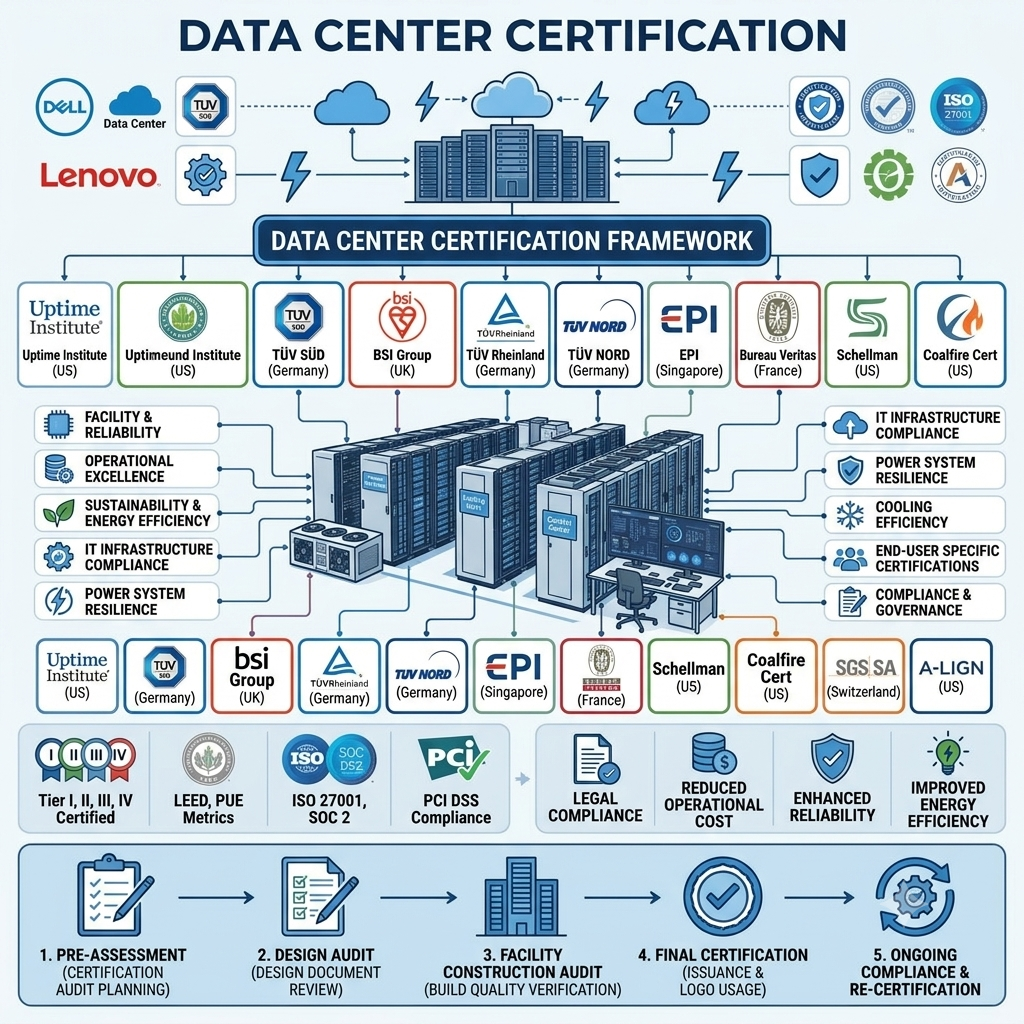
Competitive Landscape: Key Companies in the Data Center Certification Market
The global market includes specialized certification bodies, testing and inspection organizations, and compliance service providers.
Some prominent companies operating in the industry include:
- Uptime Institute
- TÜV SÜD
- TÜV Rheinland
- TÜV NORD
- BSI Group
- EPI
- Bureau Veritas
- SGS SA
- Schellman
- Coalfire
- A-LIGN
- Intertek Group
- UL Solutions
- DNV
- DEKRA
These companies are focusing on expanding certification portfolios, strengthening international presence, and developing services addressing cybersecurity, operational resilience, sustainability, and AI-ready infrastructure.
Strategic partnerships, accreditation expansion, and technology-driven assessment services are becoming important competitive strategies.
Future Outlook: What Lies Ahead for the Data Center Certification Market?
The future of the Data Center Certification Market will be closely connected to the expansion of AI, cloud computing, hyperscale infrastructure, and sustainable digital operations.
As data centers become increasingly important to global business operations, organizations will require stronger assurance regarding facility reliability, cybersecurity, energy efficiency, and regulatory compliance.
Continuous monitoring and recertification are expected to become increasingly important as operators seek to maintain certification throughout the infrastructure lifecycle.
AI-ready infrastructure assessments will also create opportunities for certification providers to develop specialized services covering high-density power systems, advanced cooling, and operational resilience.
Furthermore, increasing investments in emerging markets, particularly across Asia Pacific, are expected to expand demand for internationally recognized certification frameworks.
The Data Center Certification Market is gaining momentum as organizations increasingly recognize the importance of reliable, secure, sustainable, and compliant digital infrastructure.
The expansion of hyperscale and colocation facilities, increasing AI infrastructure investments, growing cybersecurity concerns, and rising sustainability requirements are creating significant opportunities for certification providers worldwide.
According to MarketsandMarkets, the global market is projected to reach USD 3.05 billion by 2032, growing at a CAGR of 17.4% from 2026 to 2032.
Facility and reliability certifications, power infrastructure assessments, cybersecurity validation, and continuous monitoring services will play important roles in shaping future market development.
Ultimately, data center certification is evolving beyond a compliance requirement into a strategic investment that supports operational excellence, customer confidence, infrastructure resilience, and sustainable digital transformation.
As the global digital economy continues expanding, certification will remain an essential component of building the next generation of trusted and future-ready data centers.
About MarketsandMarkets™
MarketsandMarkets™ has been recognized as one of America’s Best Management Consulting Firms by Forbes, as per their recent report.
MarketsandMarkets™ is a blue ocean alternative in growth consulting and program management, leveraging a man-machine offering to drive supernormal growth for progressive organizations in the B2B space. With the widest lens on emerging technologies, we are proficient in co-creating supernormal growth for clients across the globe.
Today, 80% of Fortune 2000 companies rely on MarketsandMarkets, and 90 of the top 100 companies in each sector trust us to accelerate their revenue growth. With a global clientele of over 13,000 organizations, we help businesses thrive in a disruptive ecosystem.
The B2B economy is witnessing the emergence of $25 trillion in new revenue streams that are replacing existing ones within this decade. We work with clients on growth programs, helping them monetize this $25 trillion opportunity through our service lines – TAM Expansion, Go-to-Market (GTM) Strategy to Execution, Market Share Gain, Account Enablement, and Thought Leadership Marketing.
Built on the ‘GIVE Growth’ principle, we collaborate with several Forbes Global 2000 B2B companies to keep them future-ready. Our insights and strategies are powered by industry experts, cutting-edge AI, and our Market Intelligence Cloud, KnowledgeStore™, which integrates research and provides ecosystem-wide visibility into revenue shifts.
To find out more, visit www.MarketsandMarkets™.com or follow us on Twitter , LinkedIn and Facebook .
Contact:
Mr. Rohan Salgarkar
MarketsandMarkets™ INC.
1615 South Congress Ave.
Suite 103, Delray Beach, FL 33445
USA: +1-888-600-6441
