The global Data Center Certification Market is gaining momentum as organizations place greater emphasis on infrastructure reliability, operational excellence, energy efficiency, and sustainability. Data centers have become essential to the digital economy, supporting cloud computing, artificial intelligence (AI), enterprise applications, financial services, telecommunications, and connected technologies.
At the same time, the rapid expansion of AI and high-density computing is changing the requirements for modern data center infrastructure. Operators are facing greater demands on power availability, cooling capacity, physical infrastructure, and operational resilience. Uptime Institute’s 2026 Global Data Center Survey notes that demand remains strong, increasingly driven by high-density and AI-related workloads, while operators face constraints involving power availability, grid reliability, costs, supply chains, and staffing. The data center certification market is projected to reach USD 3.05 billion by 2032 from an estimated USD 1.16 billion in 2026, growing at a CAGR of 17.4%
Against this backdrop, certification is becoming more than a compliance activity. It is increasingly viewed as a way to demonstrate that data center facilities can meet defined standards for availability, resilience, performance, sustainability, and operational capability.
What Is Data Center Certification?
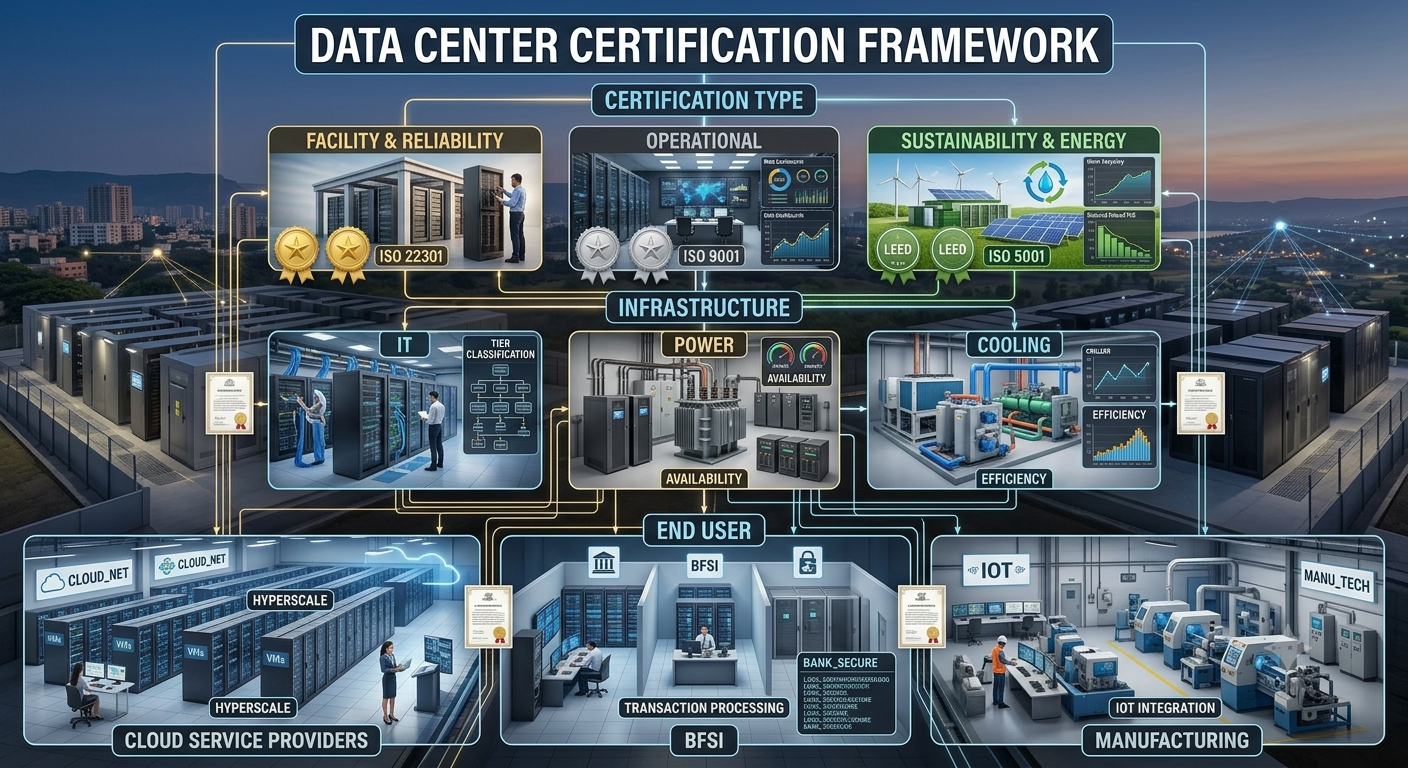
Data center certification involves assessing a facility’s infrastructure, design, construction, systems, and operational processes against established standards or certification frameworks.
Depending on the certification program, evaluations can cover:
- Power infrastructure
- Cooling systems
- IT infrastructure
- Physical security
- Fire protection
- Facility design
- Maintenance procedures
- Operational processes
- Energy efficiency
- Sustainability performance
- Business continuity and resilience
For example, Uptime Institute’s Tier Certification evaluates data center infrastructure according to four Tier classifications, ranging from basic capacity to fault-tolerant environments. Its certification process can assess design documents, constructed facilities, and operational sustainability.
This structured approach gives operators, customers, investors, and other stakeholders a clearer basis for evaluating infrastructure performance.
AI Is Reshaping Data Center Certification Requirements
The rapid adoption of generative AI, machine learning, and high-performance computing is one of the most significant factors influencing the data center ecosystem.
AI workloads can require substantially greater computing density than many traditional enterprise applications. As rack densities rise, operators must reconsider how power is delivered and how heat is removed from computing environments.
Uptime Institute’s 2026 research reports that peak rack densities of 30 kW or more are increasingly being reported by operators, while cooling constraints and legacy infrastructure remain challenges.
This creates new opportunities for certification and assessment services focused on AI readiness.
AI-ready certification and assessment may increasingly consider:
- High-density rack deployment
- Power redundancy
- Thermal management
- Advanced cooling technologies
- Electrical distribution
- Capacity planning
- Infrastructure scalability
- Operational readiness
- Monitoring and control systems
Certification providers that can adapt assessment frameworks to emerging high-density architectures will be positioned to benefit from this transformation.
Rising Importance of Reliability and Resilience
Data center outages can have significant financial and operational consequences. As organizations become increasingly dependent on digital services, expectations for continuous availability are rising.
Certification helps operators establish and validate infrastructure capabilities related to redundancy, maintainability, and fault tolerance.
For example, Uptime Institute’s Tier classifications distinguish infrastructure according to levels of redundancy and fault tolerance. Tier III facilities are designed to allow concurrent maintenance without affecting operations, while Tier IV facilities are designed to tolerate individual equipment failures or distribution-path interruptions without impacting operations.
This emphasis on measurable resilience is particularly important for:
- Cloud service providers
- Financial institutions
- Telecommunications companies
- Healthcare organizations
- Government agencies
- Manufacturing enterprises
- Hyperscale data center operators
As digital services become mission-critical, customers increasingly want evidence that infrastructure can support their availability requirements.
Download PDF Brochure @ https://www.marketsandmarkets.com/pdfdownloadNew.asp?id=37943401
Power Infrastructure Becomes a Strategic Priority
Power availability is becoming one of the most important considerations in data center development.
The growth of AI and high-performance computing is increasing electricity requirements, while some markets are facing constraints related to grid capacity and power availability. Uptime Institute’s 2026 survey identifies power availability and grid reliability among the growing concerns for data center operators.
Certification can help organizations evaluate whether power infrastructure aligns with intended performance requirements.
Areas of assessment can include:
- Utility power connections
- Backup generation
- UPS systems
- Battery systems
- Electrical distribution
- Redundant power paths
- On-site power generation
- Capacity management
The increasing complexity of power infrastructure is expected to create additional opportunities for certification, testing, inspection, and assessment providers.
Advanced Cooling Driving New Certification Opportunities
Cooling is another critical area being transformed by AI workloads.
Traditional air cooling remains important, but higher-density computing is encouraging operators to explore technologies such as liquid cooling and other advanced thermal-management approaches.
The objective is not simply to install new cooling equipment but to ensure that cooling systems operate reliably under expected workloads and environmental conditions.
Certification and assessment programs can help organizations evaluate:
- Cooling capacity
- Redundancy
- Thermal resilience
- Equipment performance
- Maintenance procedures
- Environmental conditions
- Water and energy efficiency
As AI infrastructure becomes more widespread, certification frameworks may increasingly incorporate criteria specifically designed for high-density thermal environments.
Sustainability and Energy Efficiency
Sustainability is becoming another major pillar of the Data Center Certification Market.
Data center operators face growing expectations from regulators, investors, customers, and local communities to improve energy efficiency and demonstrate environmental performance.
Sustainability-related certification and assessment can address areas such as:
- Energy consumption
- Power usage effectiveness
- Renewable energy
- Water consumption
- Carbon emissions
- Cooling efficiency
- Waste management
- Equipment lifecycle management
Uptime Institute reports that more than half of data center operators surveyed in 2026 track water use, while sustainability metrics continue to receive increasing attention.
The broader sustainability landscape is also becoming more complex. Industry standards increasingly address energy and water use, emissions, renewable energy procurement, equipment efficiency, and reporting requirements.
Consequently, sustainability certification is likely to become an increasingly important differentiator for data center operators.
Operational Certification Is Gaining Importance
A certified facility is only as resilient as its operating practices.
Poor maintenance, inadequate procedures, insufficient training, or operational errors can undermine otherwise robust infrastructure. This is why operational certification and assessment are becoming increasingly important.
Operational sustainability programs evaluate how facilities are managed and whether operational processes support expected performance levels. Uptime Institute, for example, describes its Tier Certification of Operational Sustainability as an assessment of operational practices, management, and risks associated with maintaining continuous production.
This creates opportunities for providers offering:
- Operational assessments
- Staff training
- Maintenance evaluations
- Risk assessments
- Process audits
- Capacity planning
- Emergency preparedness
- Continuous improvement programs
The growing shortage of qualified data center professionals further strengthens the need for standardized operational practices and training. Uptime Institute’s 2026 survey reports that more than half of respondents have difficulty finding qualified candidates for open positions.
Cloud and Hyperscale Data Centers Expand the Market
Cloud service providers and hyperscale operators are continuing to expand data center capacity to meet rising demand for digital services and AI computing.
These organizations require infrastructure that can be replicated across locations while maintaining consistent performance standards. Certification can provide a framework for demonstrating that facilities meet predefined requirements.
Certification is particularly valuable for:
- New data center developments
- Colocation facilities
- Hyperscale campuses
- Cloud infrastructure
- Enterprise data centers
- Edge facilities
As data center footprints become more geographically distributed, standardized certification can also help organizations maintain consistent infrastructure and operational practices across multiple sites.
Edge Data Centers Create New Requirements
Edge computing is expanding as organizations seek to process data closer to end users, machines, and connected devices.
Unlike large centralized facilities, edge data centers may operate in smaller, distributed environments with different power, cooling, security, and maintenance requirements.
Certification providers have an opportunity to develop assessment approaches suitable for these environments.
Potential certification considerations include:
- Remote monitoring
- Physical security
- Power resilience
- Environmental conditions
- Remote maintenance
- Network availability
- Modular infrastructure
- Disaster recovery
As edge deployments grow, certification could help organizations standardize performance across geographically dispersed facilities.
Regional Growth Opportunities
The Data Center Certification Market is expected to benefit from data center construction and digital infrastructure investment across major regions.
North America
North America remains a major data center market, supported by cloud adoption, hyperscale expansion, AI investment, and enterprise digital transformation.
The increasing deployment of AI infrastructure is expected to create demand for certification services focused on power, cooling, resilience, and operational readiness.
Europe
European markets are placing strong emphasis on energy efficiency, sustainability, and environmental reporting. These priorities are creating opportunities for certification providers offering energy and sustainability assessments.
Asia-Pacific
Asia-Pacific is becoming an important growth region due to expanding cloud infrastructure, digital services, telecommunications, and AI adoption. New data center construction is creating opportunities for certification during design, construction, commissioning, and operations.
Middle East and Africa
Investment in digital infrastructure, cloud services, smart cities, and connectivity is supporting data center development in several Middle Eastern and African markets.
Latin America
Growing cloud adoption, enterprise digitization, and regional data infrastructure investments are creating opportunities for data center certification and assessment services.
Key Trends Shaping the Market
Several trends are expected to influence the Data Center Certification Market over the coming years:
1. AI-Ready Certification
Certification frameworks will increasingly address high-density computing, advanced cooling, power requirements, and operational readiness for AI workloads.
2. Sustainability Certification
Energy, water, carbon, and renewable-energy considerations will become increasingly important components of data center assessments.
3. Greater Focus on Operational Resilience
Operators will increasingly seek certification that validates not only facility design but also day-to-day operating capabilities.
4. Digital Monitoring and Continuous Assessment
IoT sensors, automation, analytics, and digital infrastructure management platforms can enable more continuous approaches to facility assessment.
5. Standardization Across Global Facilities
Global cloud and colocation operators will increasingly seek consistent certification frameworks across geographically distributed sites.
Challenges Facing the Data Center Certification Market
Despite strong opportunities, certification providers and operators face several challenges.
Complexity of AI infrastructure: Rapid changes in computing architectures make it difficult for standards to remain current.
Certification costs: Testing, assessment, documentation, and infrastructure upgrades can increase the cost of certification.
Legacy infrastructure: Older data centers may require significant upgrades before they can meet modern performance requirements.
Skilled workforce shortages: Certification and compliance require specialized technical expertise, while the industry continues to face staffing challenges.
Evolving sustainability requirements: Operators must increasingly navigate changing environmental standards, reporting requirements, and customer expectations.
Future Outlook
The future of the Data Center Certification Market will be closely connected to the evolution of digital infrastructure itself.
AI will remain a major force, increasing demand for high-density computing and placing greater pressure on power and cooling systems. At the same time, sustainability requirements will encourage operators to improve energy and water efficiency.
Certification is therefore likely to evolve from a traditional infrastructure-validation process into a broader framework covering resilience, AI readiness, operational excellence, sustainability, and long-term performance.
The strongest opportunities will likely emerge for providers capable of combining technical certification with modern assessments of AI infrastructure, energy efficiency, operational risk, and sustainability.
The Data Center Certification Market is entering an important period of transformation. The rapid expansion of AI, cloud computing, edge infrastructure, and digital services is creating unprecedented demands for resilient and efficient facilities.
Certification can provide organizations with a structured way to validate infrastructure capabilities, demonstrate reliability, improve operational practices, and address growing sustainability expectations.
As data centers become more complex and mission-critical, the value of certification is moving beyond compliance. It is becoming a strategic mechanism for building trust, resilience, efficiency, and AI readiness.
The next generation of certified data centers will not simply be designed for uptime—they will be designed to support increasingly dense workloads, changing technologies, environmental expectations, and the evolving needs of the global digital economy.
About MarketsandMarkets™
MarketsandMarkets™ has been recognized as one of America’s Best Management Consulting Firms by Forbes, as per their recent report.
MarketsandMarkets™ is a blue ocean alternative in growth consulting and program management, leveraging a man-machine offering to drive supernormal growth for progressive organizations in the B2B space. With the widest lens on emerging technologies, we are proficient in co-creating supernormal growth for clients across the globe.
Today, 80% of Fortune 2000 companies rely on MarketsandMarkets, and 90 of the top 100 companies in each sector trust us to accelerate their revenue growth. With a global clientele of over 13,000 organizations, we help businesses thrive in a disruptive ecosystem.
The B2B economy is witnessing the emergence of $25 trillion in new revenue streams that are replacing existing ones within this decade. We work with clients on growth programs, helping them monetize this $25 trillion opportunity through our service lines – TAM Expansion, Go-to-Market (GTM) Strategy to Execution, Market Share Gain, Account Enablement, and Thought Leadership Marketing.
Built on the ‘GIVE Growth’ principle, we collaborate with several Forbes Global 2000 B2B companies to keep them future-ready. Our insights and strategies are powered by industry experts, cutting-edge AI, and our Market Intelligence Cloud, KnowledgeStore™, which integrates research and provides ecosystem-wide visibility into revenue shifts.
To find out more, visit www.MarketsandMarkets™.com or follow us on Twitter , LinkedIn and Facebook .
Contact:
Mr. Rohan Salgarkar
MarketsandMarkets™ INC.
1615 South Congress Ave.
Suite 103, Delray Beach, FL 33445
USA: +1-888-600-6441
