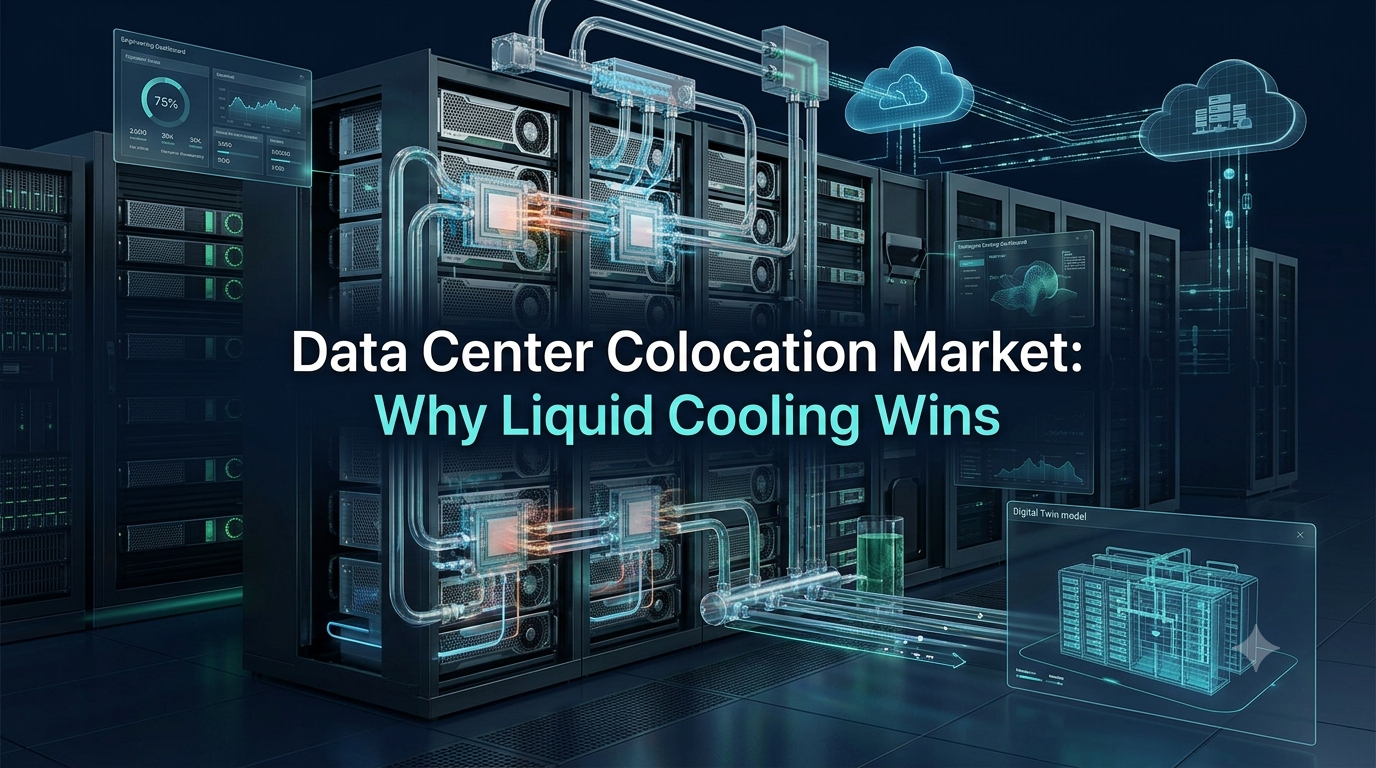
The Data Center Colocation Market is entering a decisive new phase. Artificial intelligence is changing what enterprises expect from infrastructure, and one assumption is becoming increasingly difficult to defend: that conventional air cooling can handle every generation of computing. As AI accelerators, high-performance computing and dense GPU deployments push rack power higher, cooling is moving from a background facility function to a strategic source of competitive advantage.
Markets research projects the global market to grow from USD 104.2 billion in 2025 to USD 204.4 billion by 2030, representing a 14.4% CAGR. Its liquid-cooling research projects that market to reach USD 27.65 billion by 2033, growing at 31.5% from 2026.
The Heat Problem AI Created
AI has fundamentally changed the relationship between computing power and physical infrastructure.
Traditional enterprise servers were generally designed around rack-density levels that air-cooling systems could manage. Modern AI infrastructure is different. GPUs and accelerators concentrate substantially more processing power into smaller physical footprints, creating intense thermal loads.
Schneider Electric’s figures cited in the source material show average rack density rising from approximately 16 kW in 2025 to 27 kW in 2026.
- More compute creates more concentrated heat.
- Higher density increases cooling and power requirements.
- Thermal capacity increasingly affects usable compute capacity.
- AI infrastructure requires a different approach to facility design.
The critical question for colocation buyers is therefore changing. Instead of asking how many racks a facility can accommodate, enterprises increasingly need to ask how much high-density compute those racks can safely and efficiently support.
Market research indicates strong trends Download the PDF to uncover business insights.
Why Air Cooling Is Reaching Its Limits
Air cooling is not obsolete. It remains practical for many conventional workloads and will continue supporting large portions of the installed data-center base.
The challenge is that computing density is advancing faster than many traditional cooling architectures.
Liquid has stronger heat-transfer characteristics than air. Direct-to-chip systems move coolant close to CPUs or GPUs, while immersion systems place servers or components inside specialized dielectric fluids. Rear-door heat exchangers provide another approach by capturing heat directly at the rack.
S&P Global research cited in the source material indicates that 21% of surveyed enterprise data-center decision-makers planned to shift toward liquid cooling within one year, while another 25% expected adoption within two to four years.
- Air cooling remains suitable for lower-density workloads.
- Liquid cooling addresses higher thermal loads.
- Direct-to-chip technology places cooling closer to heat sources.
- Adoption is increasingly becoming part of infrastructure planning.
This Sample Report is designed to fuel your business growth download it today.
What Liquid Cooling Changes for Colocation
Liquid cooling changes the value proposition of colocation.
Historically, enterprises evaluated facilities through power availability, security, connectivity, uptime and location. AI adds another decisive criterion: Can the facility support the required rack density?
MarketsandMarkets identifies direct-to-chip liquid cooling as a rapidly growing technology in AI data-center thermal management, while colocation is becoming an important application environment.
For providers, this creates a new competitive opportunity. A facility capable of supporting high-density GPU infrastructure can serve workloads that conventional environments may struggle to accommodate.
The product is no longer simply floor space and electricity.
It is AI-ready infrastructure capacity.
Why AI Needs Liquid Cooling
The answer is increasingly about density.
AI workloads place more computing power into increasingly concentrated infrastructure. The source material cites TrendForce’s outlook that liquid-cooling penetration among AI chips could reach 53% in 2026 and approach 60% in 2027, while high-end chips are moving beyond 1 kW of thermal design power.
- AI density is accelerating.
- Higher power produces greater thermal pressure.
- Liquid cooling supports high-density deployments.
- AI-ready colocation increasingly requires thermal readiness.
For enterprises planning AI expansion, cooling therefore becomes part of the technology roadmap rather than merely a facilities decision.
Is Liquid Cooling Better Than Air Cooling?
There is no universal answer.
Air cooling remains effective for many lower-density applications. An enterprise running conventional business applications may not need immediate conversion to liquid cooling.
For AI and HPC environments, however, the economics become different. A 2026 study cited in the source material found that liquid-to-chip cooling could reduce peak energy demand per unit of compute by 6–14%, with potential annual improvements in energy consumption, carbon emissions and PUE.
The IEA 4E programme also identifies potential energy savings while highlighting barriers including cost, standardization and reliability.
- Air cooling remains valuable for conventional workloads.
- Liquid cooling becomes more compelling as density rises.
- Energy efficiency can improve in appropriate deployments.
- The right choice depends on workload, facility and business requirements.
The strategic lesson is simple: liquid cooling does not need to replace air cooling everywhere. Its importance rises as compute density increases.
Can Existing Data Centers Be Retrofitted?
Yes, but retrofitting is rarely a simple equipment upgrade.
Liquid-cooling adoption can require coolant distribution systems, piping, heat exchangers, pumps, controls, rack modifications, leak detection and facility-level heat-rejection upgrades. Older facilities can face additional complexity when their architecture was never designed for liquid distribution.
- Retrofit projects may require new cooling infrastructure.
- Existing racks may need modification.
- Monitoring and leak detection become important.
- Operators may need new technical skills.
- Hybrid deployment can reduce transition risk.
For colocation providers, the strategic choice may involve retrofitting selected capacity, constructing AI-ready halls or adopting a hybrid model.
What Should Enterprises Look For?
Enterprises should stop evaluating colocation solely through rack pricing.
A stronger framework measures compute readiness.
- Evaluate supported rack densities.
- Check compatible liquid-cooling architectures.
- Assess power capacity and redundancy.
- Examine network and cloud interconnection.
- Review expansion timelines.
- Evaluate operational expertise.
- Examine sustainability performance.
- Determine whether the facility can support future hardware generations.
This is where Data Center Colocation Market analysis becomes strategically useful. The right provider can become an infrastructure partner rather than simply a hosting location.
Turning Cooling Into Competitive Advantage
The business value of advanced cooling ultimately comes down to what enterprises can accomplish with the infrastructure.
Financial institutions can use high-performance infrastructure for AI and analytics. Healthcare organizations can scale compute while meeting availability and data requirements. Technology companies can access GPU capacity without building entire facilities. Manufacturers can deploy AI for digital twins, robotics and industrial analytics. Retailers can support personalization, forecasting and supply-chain optimization.
Colocation provides the infrastructure pathway. Liquid cooling can strengthen that pathway by enabling higher-density workloads where conventional approaches become constrained.
- Colocation reduces the need to own every infrastructure layer.
- Liquid cooling can expand supported workload density.
- High-density infrastructure can improve compute utilization.
- Thermal management can support AI expansion.
The objective is not simply better cooling.
It is more usable compute, delivered reliably and at scale.
The Risks Behind the Opportunity
Liquid cooling introduces its own challenges.
Higher upfront investment can affect deployment economics. Standardization remains an issue, while maintenance differs from conventional air-cooled environments.
Coolant management adds operational requirements, and water availability can influence technology and location decisions.
Environmental scrutiny also matters. Sustainability strategies increasingly need to consider more than electricity consumption.
- Initial investment can be significant.
- Standardization and interoperability remain important.
- Maintenance requirements change.
- Coolant and environmental management require attention.
- Retrofit complexity can delay adoption.
The best technology is therefore not automatically the most advanced technology. It is the solution aligned with workload density, facility conditions, reliability requirements and long-term business objectives.
Market Intelligence: Size, Growth and Forecast
The market signals are compelling.
Market research forecasts the Data Center Colocation Market to reach USD 204.4 billion by 2030 from USD 104.2 billion in 2025, at a 14.4% CAGR.
Meanwhile, the global data center liquid cooling market is projected to grow from USD 4.07 billion in 2026 to USD 27.65 billion by 2033, representing a 31.5% CAGR.
- Colocation growth is accelerating.
- AI is increasing rack density.
- Liquid cooling is expanding rapidly.
- High-density infrastructure is becoming a strategic differentiator.
The combined signal is clear: colocation growth, AI density and liquid cooling are creating a new infrastructure investment cycle.
The Enterprise Strategy for AI-Ready Colocation
Organizations should approach their Data Center Colocation Market outlook through five questions.
1. What workloads are coming next?
Plan for future AI, analytics and HPC requirements—not only today’s servers.
2. What rack density will they require?
Measure infrastructure by usable compute, not physical rack count.
3. Can the facility evolve?
Future processors and accelerators may demand very different infrastructure.
4. Can the cooling architecture scale?
Hybrid cooling may be appropriate where workloads vary in density.
5. Can the provider grow with the business?
Infrastructure expansion should not automatically require a complete migration.
This approach turns a Data Center Colocation Market report into a strategic planning tool.
The Future: Cooling Becomes Infrastructure Strategy
The next era of colocation will be defined by a straightforward reality: compute cannot scale without thermal management.
AI is accelerating that reality. Liquid cooling is moving toward mainstream adoption for high-end AI infrastructure, while enterprise interest and research into efficiency gains continue to strengthen the business case.
The Data Center Colocation Market outlook is therefore becoming inseparable from the future of cooling.
For enterprises, the question is no longer whether liquid cooling sounds innovative. The real question is whether their infrastructure partner can support the compute density, efficiency, reliability and scalability required for the next phase of digital growth.
For colocation providers, the competitive battlefield is equally clear:
Power gets the rack running. Connectivity connects the workload. But cooling determines how much compute that rack can realistically sustain.