The digital economy is creating unprecedented demand for high-performance, resilient, and energy-efficient data centers. As artificial intelligence (AI), cloud computing, edge computing, and hyperscale infrastructure continue to expand, operators face increasing challenges in managing power systems, cooling networks, environmental controls, security infrastructure, and operational uptime.
This growing complexity has elevated the importance of Supervisory Control and Data Acquisition (SCADA) systems within modern facilities. The SCADA in Data Center Market is rapidly emerging as a critical segment of the broader digital infrastructure ecosystem, helping operators gain real-time visibility, automation, predictive intelligence, and centralized control over mission-critical assets.
According to MarketsandMarkets, the SCADA in Data Center Market is projected to grow from USD 3.90 billion in 2025 to USD 9.13 billion by 2032, registering a CAGR of 12.9% during the forecast period. The growth is being fueled by AI-ready infrastructure, increasing operational complexity, energy optimization requirements, and the need for predictive maintenance solutions.
Understanding the Role of SCADA in Modern Data Centers
SCADA systems were originally developed for industrial automation environments. Today, they have become an essential technology for managing modern data centers.
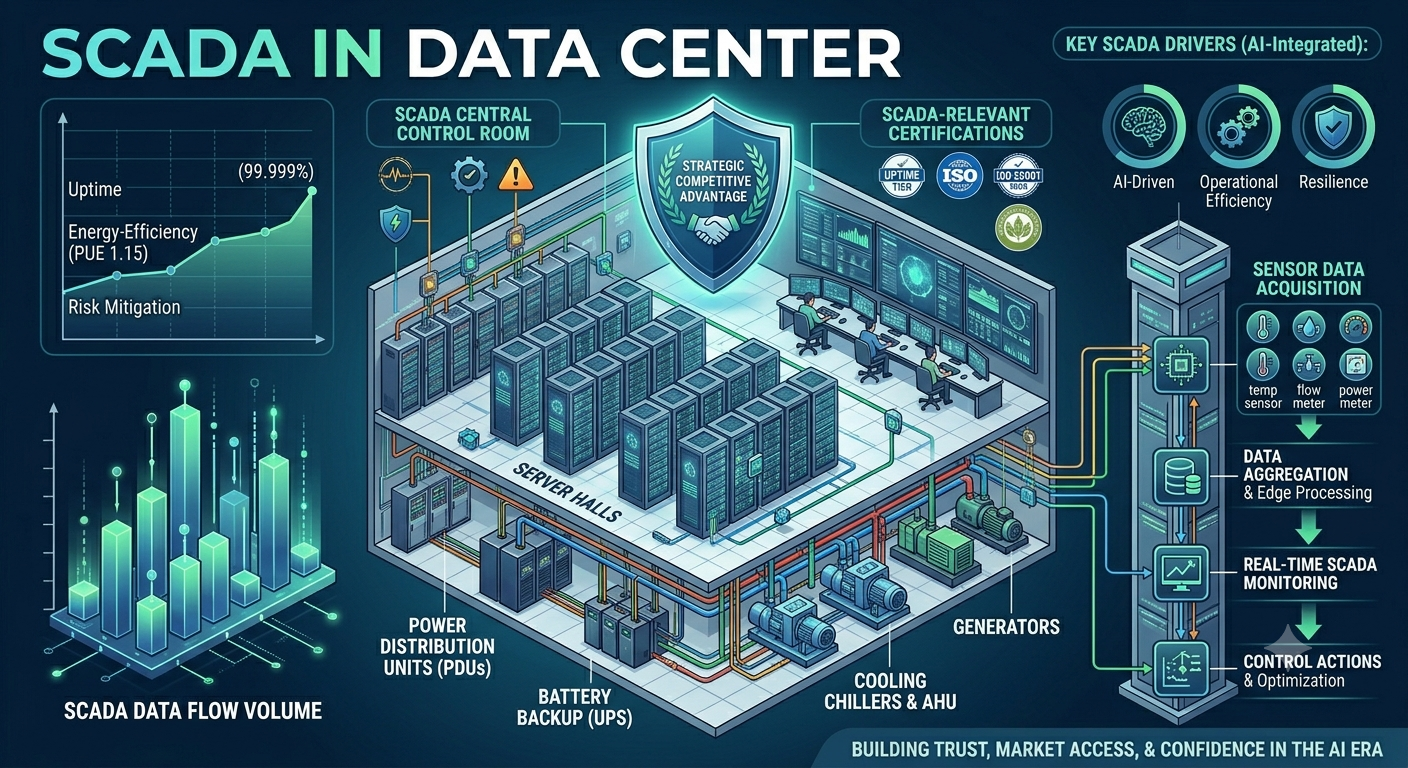
A SCADA platform enables operators to monitor, control, collect, and analyze data from various infrastructure components, including:
- Power distribution systems
- Uninterruptible Power Supply (UPS) systems
- Cooling and HVAC equipment
- Environmental sensors
- Fire detection systems
- Security and access control systems
- Backup generators
- Energy management systems
By integrating these functions into a centralized platform, SCADA helps data center operators make informed decisions, respond rapidly to incidents, and optimize facility performance.
As the SCADA in Data Center Market expands, organizations are increasingly adopting integrated supervisory systems that provide a unified operational view across all infrastructure layers.
Why the SCADA in Data Center Market Is Growing Rapidly
AI Infrastructure Expansion
Artificial intelligence is reshaping data center design and operations. AI workloads consume significantly more power and generate higher thermal densities than traditional computing environments.
To manage these challenges, operators require sophisticated monitoring and control capabilities that can continuously optimize power distribution, cooling performance, and infrastructure reliability.
The rapid deployment of AI-ready facilities is one of the strongest growth drivers for the SCADA in Data Center Market because intelligent supervisory systems help maintain operational efficiency while supporting high-density computing environments.
Increasing Need for Operational Resilience
Data centers now support critical workloads across industries including banking, healthcare, telecommunications, government, defense, and e-commerce.
Any interruption can result in significant financial losses, reputational damage, and regulatory consequences.
SCADA platforms enable operators to:
- Detect anomalies in real time
- Identify equipment failures before they occur
- Respond quickly to operational disruptions
- Improve infrastructure reliability
- Maintain business continuity
These capabilities are driving widespread adoption across hyperscale, colocation, and enterprise facilities.
Energy Efficiency and Sustainability Goals
Energy consumption remains one of the largest operational expenses for data center operators.
As governments and enterprises pursue sustainability initiatives and carbon reduction targets, energy optimization has become a strategic priority.
SCADA systems provide:
- Real-time power monitoring
- Energy consumption analytics
- Cooling optimization
- Load balancing capabilities
- Sustainability reporting support
This growing focus on efficiency is accelerating investments across the SCADA in Data Center Market.
Download PDF Brochure @ https://www.marketsandmarkets.com/pdfdownloadNew.asp?id=79684683
Key Trends Transforming the SCADA in Data Center Market
Convergence of SCADA, DCIM, and BMS Platforms
One of the most significant trends is the integration of SCADA systems with Data Center Infrastructure Management (DCIM) and Building Management Systems (BMS).
Instead of operating multiple disconnected platforms, organizations are adopting unified solutions that provide comprehensive visibility across facility operations.
Benefits include:
- Improved decision-making
- Reduced operational silos
- Enhanced automation
- Better resource utilization
- Faster incident response
This convergence is reshaping how next-generation facilities are managed.
AI-Powered Predictive Maintenance
Traditional maintenance strategies are often reactive, resulting in unnecessary downtime and increased operational costs.
Modern SCADA platforms now leverage AI and machine learning to predict equipment failures before they occur.
These systems can analyze:
- Temperature fluctuations
- Power consumption patterns
- Vibration signatures
- Equipment performance metrics
- Environmental conditions
Predictive maintenance capabilities are becoming a major differentiator in the SCADA in Data Center Market.
Growth of Edge Computing
The expansion of edge computing infrastructure is creating new opportunities for SCADA vendors.
Unlike centralized hyperscale facilities, edge sites are geographically distributed and often operate with minimal on-site personnel.
SCADA solutions enable centralized monitoring and remote management of these facilities, making them particularly valuable for:
- Telecommunications providers
- Cloud service operators
- Smart city projects
- Industrial IoT deployments
As edge infrastructure continues to expand, demand for cloud-native supervisory systems is expected to rise significantly.
Digital Twin Integration
Digital twin technology is increasingly being combined with SCADA platforms.
By integrating real-time operational data with virtual facility models, operators can simulate:
- Airflow behavior
- Energy distribution
- Cooling performance
- Capacity planning scenarios
- Infrastructure utilization
This capability enables more informed decision-making and proactive optimization of critical systems.
Applications Driving the SCADA in Data Center Market
Power Monitoring and Energy Management
Power monitoring remains the most important application segment.
Operators rely on SCADA systems to:
- Track power quality
- Monitor electrical distribution
- Manage backup systems
- Optimize energy utilization
- Reduce operational costs
With AI workloads increasing electricity demand, this segment will remain a major growth driver.
Cooling and HVAC Management
Cooling systems represent a significant portion of data center energy consumption.
SCADA platforms enable:
- Real-time thermal monitoring
- Automated cooling adjustments
- Airflow optimization
- Liquid cooling management
- Energy-efficient operations
As computing density rises, intelligent cooling management will become even more important.
Predictive Maintenance
Predictive maintenance is one of the fastest-growing applications in the SCADA in Data Center Market.
Operators can proactively identify potential issues involving:
- UPS systems
- Generators
- Cooling infrastructure
- Electrical equipment
- Environmental systems
This reduces downtime and extends equipment lifespan.
Security and Access Control
Data centers require stringent physical security measures.
SCADA systems increasingly integrate with:
- Surveillance systems
- Access control technologies
- Intrusion detection systems
- Environmental alarms
This integration improves facility protection and operational awareness.
Deployment Models Shaping Future Adoption
On-Premises Deployments
Many hyperscale operators continue to favor on-premises SCADA deployments because they offer:
- Greater control
- Enhanced security
- Regulatory compliance
- Customized configurations
These benefits remain important for mission-critical environments.
Cloud-Based Deployments
Cloud-based SCADA solutions are gaining momentum due to:
- Scalability
- Remote accessibility
- Lower deployment complexity
- Reduced infrastructure costs
This model is particularly attractive for distributed edge environments.
Hybrid Deployments
Hybrid architectures combine local operational control with cloud-based analytics.
As a result, many organizations view hybrid deployments as the optimal balance between security and flexibility.
Challenges Facing the SCADA in Data Center Market
Despite strong growth prospects, several challenges remain.
Cybersecurity Risks
As SCADA systems become increasingly connected, cybersecurity concerns continue to grow.
Research has highlighted the importance of protecting interconnected SCADA environments from evolving cyber threats and vulnerabilities.
Operators must implement:
- Network segmentation
- Secure remote access
- Threat monitoring
- Advanced authentication
- Continuous security assessments
Integration Complexity
Many facilities operate equipment from multiple vendors.
Integrating legacy infrastructure into modern supervisory platforms can be technically challenging and costly.
Skills Shortage
The convergence of operational technology (OT), information technology (IT), analytics, and cybersecurity requires specialized expertise that remains in short supply globally.
Competitive Landscape
The SCADA in Data Center Market features a mix of industrial automation leaders and digital infrastructure specialists.
Key companies include:
- Schneider Electric
- Siemens
- Vertiv
- ABB
- Honeywell
- Eaton
- Johnson Controls
Competition is increasingly focused on AI-powered analytics, sustainability optimization, cybersecurity capabilities, and integration of SCADA with DCIM and energy management platforms.
Future Outlook
The future of the SCADA in Data Center Market is closely tied to the evolution of AI, cloud computing, edge infrastructure, and sustainability initiatives.
By 2032, operators will increasingly rely on intelligent supervisory systems capable of autonomous decision-making, predictive maintenance, digital twin integration, and real-time energy optimization.
As infrastructure complexity continues to rise, SCADA will move beyond traditional monitoring and become a foundational technology supporting autonomous, resilient, and sustainable data center operations.
Know more info @ https://www.marketsandmarkets.com/Market-Reports/scada-in-data-center-market-79684683.html
Frequently Asked Questions (FAQs)
1. What is SCADA in a data center?
SCADA (Supervisory Control and Data Acquisition) is a system that enables centralized monitoring, control, and analysis of critical data center infrastructure, including power, cooling, environmental, and security systems.
2. How large is the SCADA in Data Center Market?
The SCADA in Data Center Market is projected to grow from USD 3.90 billion in 2025 to USD 9.13 billion by 2032, at a CAGR of 12.9%.
3. What is driving the growth of the SCADA in Data Center Market?
Major drivers include AI-ready data center expansion, increasing operational complexity, energy optimization requirements, predictive maintenance adoption, and growing demand for infrastructure resilience.
4. Which application segment is leading the market?
Power monitoring and energy management currently represent the most strategically important application area due to rising energy consumption and sustainability requirements.
5. Who are the major players in the SCADA in Data Center Market?
Leading companies include Schneider Electric, Siemens, Vertiv, ABB, Honeywell, Eaton, and Johnson Controls, all of which are expanding their data center automation and intelligent infrastructure portfolios.
