The Fab Automation Market Growth is accelerating as semiconductor manufacturers expand advanced-node production, increase 300 mm wafer capacity, and adopt intelligent manufacturing technologies. The growing complexity of semiconductor fabrication requires highly automated environments capable of handling wafers with extreme precision, minimizing contamination, optimizing equipment utilization, and maintaining consistent production quality.
According to MarketsandMarkets, the global Fab Automation Market was valued at USD 25.24 billion in 2025 and is projected to reach USD 41.44 billion by 2032, registering a CAGR of 7.3% from 2025 to 2032. The market is being driven by the expansion of 300 mm fabs, adoption of automated material handling systems (AMHS), robotics, AI-driven factory software, and the transition toward advanced-node and EUV-enabled semiconductor manufacturing.
Fab automation encompasses hardware, software, and services used to automate wafer movement, equipment control, process management, factory operations, and manufacturing analytics. Key technologies include AMHS, robotics, equipment control software, advanced process control (APC), manufacturing execution systems (MES), yield management systems (YMS), AI/ML analytics, and digital twins.
Advanced Semiconductor Manufacturing Drives Fab Automation Market Growth
The increasing complexity of semiconductor manufacturing is one of the primary factors driving Fab Automation Market Growth. Modern chips require increasingly sophisticated manufacturing processes, including advanced lithography, deposition, etching, metrology, inspection, and packaging.
As manufacturers move toward advanced nodes, production environments require greater precision and tighter process control. Automation enables fabs to coordinate equipment, move wafers efficiently, monitor production parameters, and reduce manual intervention.
MarketsandMarkets identifies the growing demand for advanced semiconductor manufacturing as a key market driver. Growth in AI chips, memory devices, advanced processors, automotive semiconductors, and other high-performance applications is encouraging manufacturers to invest in modern fabrication facilities and automation systems.
The shift toward AI and high-performance computing is particularly significant. Advanced processors used for AI training and inference require sophisticated semiconductor manufacturing processes, increasing demand for automated production environments capable of maintaining high yields and throughput.
300 mm Fabs Accelerate Automation Adoption
The rapid expansion of 300 mm semiconductor fabs is one of the most important drivers of the Fab Automation Market. Larger wafer sizes allow manufacturers to produce more chips per wafer, supporting high-volume semiconductor manufacturing.
However, 300 mm fabs also require sophisticated automation infrastructure. Automated material handling systems, overhead hoist transport, precision robotics, process-control software, and environmental systems help maintain efficient wafer movement and production consistency.
MarketsandMarkets reports that the expansion of 300 mm semiconductor fabs is significantly increasing demand for AMHS, precision robotics, and factory automation software. Investments in sub-7 nm and EUV-enabled manufacturing further strengthen the requirement for automated tool-to-tool coordination and optimized wafer flow.
The 300 mm segment held the largest market share in 2024 and is expected to remain dominant through 2032. The expansion of advanced logic, DRAM, and high-density packaging manufacturing is supporting continued investment in 300 mm automation infrastructure.
AI and Machine Learning Transform Fab Operations
Artificial intelligence and machine learning are becoming increasingly important components of modern fab automation. Semiconductor manufacturing generates enormous volumes of equipment, process, yield, and quality data. AI-based analytics can help manufacturers identify patterns and optimize operations using this information.
AI/ML technologies can support:
Predictive maintenance
Equipment health monitoring
Process optimization
Yield analysis
Defect detection
Production scheduling
Energy optimization
Real-time decision support
MarketsandMarkets identifies increasing adoption of AI/ML-driven predictive analytics and digital-twin platforms as an important driver of the market. These technologies can enable semiconductor manufacturers to monitor production conditions and optimize manufacturing processes.
AI is also contributing to the evolution of autonomous fabs. By integrating machine learning with MES, APC, YMS, equipment-control software, and factory data platforms, manufacturers can create increasingly intelligent production environments.
Robotics Improve Precision and Productivity
Robotics represents another critical component of Fab Automation Market Growth. Semiconductor manufacturing requires extremely precise handling of wafers, reticles, substrates, and other sensitive materials.
Robots designed for cleanroom environments can reduce manual handling and minimize contamination risks. Vacuum and atmospheric robots can perform wafer transfers between processing equipment, inspection systems, metrology tools, and other manufacturing stations.
Robotics can provide several operational advantages, including:
Consistent wafer handling
Reduced contamination risk
Higher throughput
Improved positioning accuracy
Lower manual intervention
Greater equipment utilization
Improved production consistency
Companies are also developing modular and collaborative robotics solutions that can be adapted to changing production requirements. MarketsandMarkets identifies modular AMHS and collaborative robotics as important opportunities for the market.
Download PDF Brochure @ https://www.marketsandmarkets.com/pdfdownloadNew.asp?id=219676619
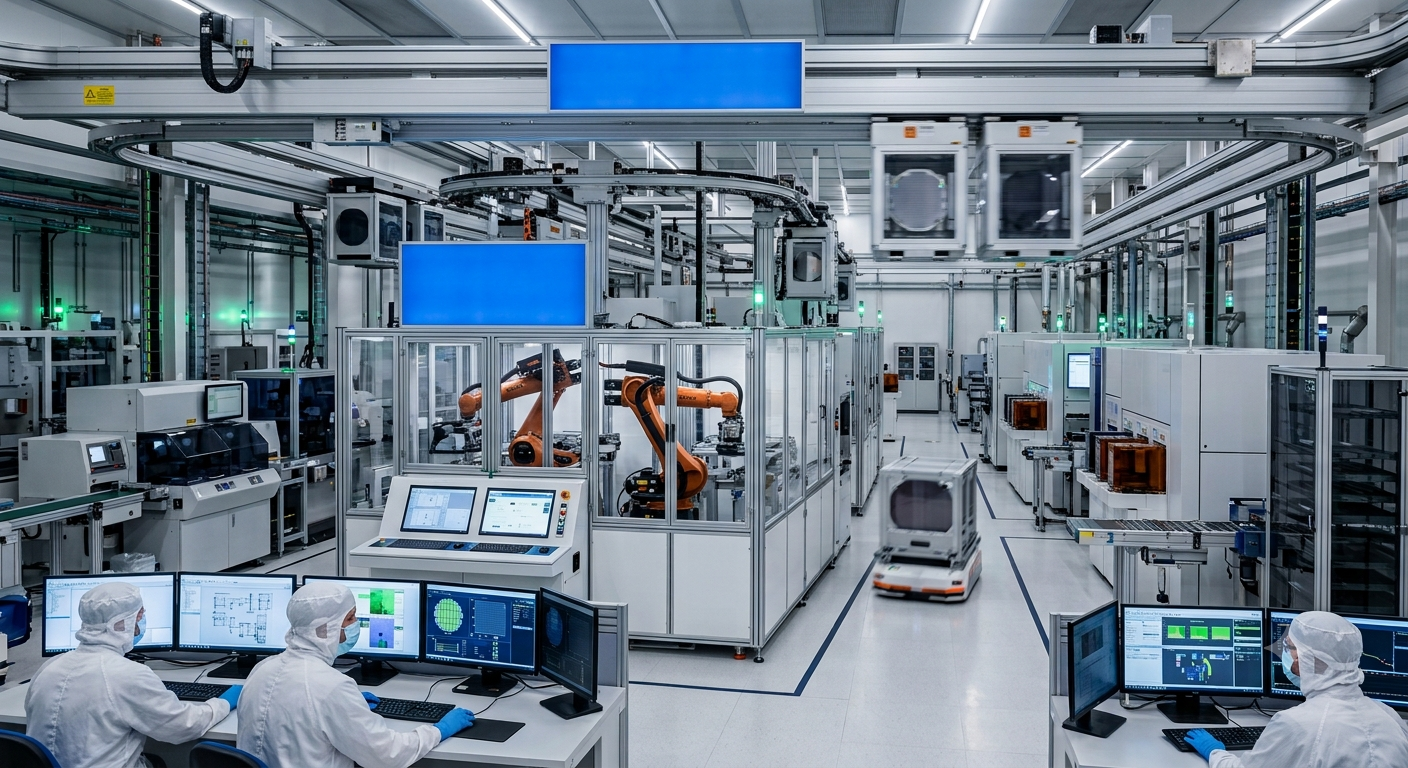
Automated Material Handling Systems Become Essential
Automated Material Handling Systems, or AMHS, are fundamental to modern semiconductor fabs. These systems automate the movement of wafers and materials between process tools and manufacturing areas.
As fabs increase production volumes, manual transportation becomes increasingly inefficient and difficult to manage. AMHS solutions can coordinate material movement while supporting cleanroom requirements and reducing cycle-time variability.
Overhead hoist transport systems, stockers, automated guided systems, and robotic handlers can work together to create integrated material-flow networks.
The growing deployment of 300 mm fabs and advanced-node manufacturing is increasing demand for high-performance AMHS. MarketsandMarkets identifies AMHS, robotics, and environmental-control systems as major contributors to the continued strength of the hardware segment.
Software Segment Gains Strategic Importance
Although hardware currently represents the largest offering segment, software is becoming increasingly important to the overall Fab Automation Market Growth story.
MarketsandMarkets expects the software segment to register the highest CAGR during the forecast period. Increasingly complex semiconductor manufacturing environments require software platforms capable of coordinating production, controlling equipment, analyzing data, and optimizing processes.
Important software technologies include:
Manufacturing Execution Systems
Equipment Control Software
Advanced Process Control
Yield Management Systems
AI/ML analytics
Digital twins
Predictive maintenance platforms
Production scheduling systems
These software technologies create a digital layer across the physical manufacturing environment, allowing fab operators to monitor production in real time and make data-driven decisions.
Digital Twins Enable Virtual Fab Optimization
Digital twin technology is emerging as an important trend in the Fab Automation Market. Digital twins create virtual representations of manufacturing equipment, production lines, or entire fab environments.
Manufacturers can use these models to simulate production scenarios, identify bottlenecks, test automation configurations, and evaluate process changes before implementing them physically.
Digital twins can also support predictive maintenance and production optimization. By connecting real-world equipment data with virtual models, fabs can better understand equipment behavior and identify potential issues.
MarketsandMarkets highlights digital-twin investments as part of the transformation of semiconductor manufacturing toward more intelligent and connected automation ecosystems.
EUV and Advanced Nodes Increase Automation Requirements
Extreme ultraviolet (EUV) lithography and advanced-node manufacturing are creating additional requirements for automation. Semiconductor production at sub-7 nm geometries requires highly controlled environments and extremely precise process coordination.
Even minor contamination, vibration, handling errors, or equipment instability can affect production yields. Automation therefore plays an important role in maintaining consistent wafer movement and process conditions.
MarketsandMarkets identifies the growth of EUV and advanced-node semiconductor production as a key driver. These manufacturing processes require precise tool coordination, contamination control, and reliable wafer transportation.
As semiconductor manufacturers continue developing advanced logic, memory, and AI processors, demand for automation capable of operating within increasingly sophisticated cleanroom environments is expected to rise.
Smart Manufacturing and Industry 4.0 Reshape Fabs
Industry 4.0 technologies are transforming traditional semiconductor fabs into connected and data-driven manufacturing environments.
IoT-enabled equipment can continuously collect information about machine performance, temperature, vibration, process conditions, and production status. This data can then be analyzed through AI, machine learning, and factory-management platforms.
Smart manufacturing enables fabs to move from reactive operations toward predictive and optimized production. Instead of responding to equipment failures after they occur, manufacturers can identify early warning signals and schedule maintenance proactively.
MarketsandMarkets identifies the adoption of Industry 4.0, smart manufacturing, IoT-enabled equipment, and AI-driven analytics as key factors supporting market expansion.
Brownfield Automation Creates New Opportunities
While greenfield fabs dominated the market in 2024, MarketsandMarkets expects brownfield fabs to overtake greenfield deployments by 2032. This shift is associated with increasing modernization and automation upgrades across existing semiconductor manufacturing facilities.
Brownfield automation involves upgrading existing fabs with newer technologies such as:
AMHS
Digital twins
Predictive analytics
Advanced process control
AI-based optimization
Modern equipment-control software
Automated inspection and handling systems
Modernization allows manufacturers to improve existing production capabilities without necessarily constructing entirely new facilities.
The increasing need to support 300 mm production and advanced manufacturing processes is expected to create significant opportunities for automation suppliers serving existing fabs.
Foundries Remain Major Automation Adopters
Foundries accounted for the largest share of the Fab Automation Market in 2024 and are expected to maintain their leading position through 2032.
Foundries serve multiple semiconductor markets, including AI, high-performance computing, automotive electronics, communications, and consumer devices. Their manufacturing environments require high wafer throughput, consistent quality, and flexible production capabilities.
Automation helps foundries manage diverse production requirements while maintaining process stability and manufacturing efficiency.
Integrated device manufacturers and outsourced semiconductor assembly and test providers are also important users. However, the scale and technological requirements of leading foundries make them a particularly important customer group for advanced automation technologies.
2.5D and 3D Packaging Creates Growth Opportunities
The growth of advanced semiconductor packaging is opening additional opportunities for fab automation. 2.5D and 3D packaging technologies are increasingly important for AI processors, high-performance computing, and advanced electronics.
These technologies involve complex handling and integration requirements, increasing the need for precision robotics, automated inspection, material handling, and process-control systems.
MarketsandMarkets identifies advanced automation for 2.5D/3D packaging and heterogeneous integration as an opportunity for the market.
As semiconductor manufacturers increasingly combine multiple dies and advanced packaging technologies, automation suppliers can address new requirements across both front-end and back-end manufacturing.
Skilled Workforce Shortages Remain a Restraint
Despite the increasing adoption of automation, the shortage of skilled automation and software specialists remains a significant restraint.
Modern fabs require professionals with expertise in robotics, MES, APC, AI/ML analytics, cleanroom automation, and equipment integration. The combination of semiconductor manufacturing knowledge and advanced software expertise can be difficult to find.
MarketsandMarkets notes that this talent shortage can slow modernization programs, increase implementation timelines, and create greater reliance on external system integrators.
As automation systems become more software-intensive, workforce development and specialized training will become increasingly important for semiconductor manufacturers.
Cleanroom Requirements Create Technical Challenges
Semiconductor manufacturing requires extremely stringent contamination control. Advanced-node fabs are particularly sensitive to particles, vibration, handling errors, and other environmental disturbances.
Automation equipment must therefore meet demanding cleanroom standards while maintaining reliable operation. Robots, AMHS components, sensors, and other equipment must operate with high precision without introducing contaminants.
MarketsandMarkets identifies stringent ultra-clean manufacturing requirements and contamination risks as significant challenges. Integration complexity across multi-vendor MES, APC, YMS, and AMHS ecosystems can further increase implementation difficulty.
Asia Pacific Leads Fab Automation Market Development
Asia Pacific represents a major center of semiconductor manufacturing and is expected to hold the largest share of the Fab Automation Market during the forecast period.
MarketsandMarkets attributes the region’s strong position to semiconductor capacity expansion across China, Taiwan, South Korea, and Japan, particularly in 300 mm manufacturing.
The region’s semiconductor ecosystem includes major foundries, integrated device manufacturers, equipment suppliers, and automation providers. Continued investments in advanced-node production and semiconductor infrastructure are creating sustained demand for automation.
India is also emerging as an important developing market. MarketsandMarkets estimates that India’s Fab Automation Market was valued at USD 174.8 million in 2025 and is projected to reach USD 559.4 million by 2030, representing a CAGR of 18.1%. Government initiatives, foreign investment, and semiconductor manufacturing development are supporting this expansion.
Competitive Landscape
The Fab Automation Market includes companies specializing in material handling, robotics, factory automation, equipment control, and semiconductor manufacturing technologies.
MarketsandMarkets identifies Daifuku, Murata Machinery, Atlas Copco, Rorze Corporation, Ebara, FANUC, Kawasaki Heavy Industries, Hirata Corporation, Yaskawa, and KUKA among the key companies operating in the market.
Competition is increasingly focused on automation precision, cleanroom compatibility, AI integration, software capabilities, modularity, interoperability, and system reliability.
Companies are also pursuing partnerships and technology development around AI-driven automation, digital twins, AMHS, robotics, and advanced process-control systems.
Future Outlook for Fab Automation Market Growth
The future of Fab Automation Market Growth will be closely connected to semiconductor industry expansion and the increasing complexity of chip manufacturing.
The combination of AI-powered analytics, robotics, AMHS, digital twins, advanced process control, and connected factory software is transforming semiconductor fabs into increasingly intelligent production environments.
The continued expansion of 300 mm capacity will remain an important growth driver, while advanced-node and EUV production will increase requirements for precision automation and contamination control. Brownfield modernization is also expected to create a growing opportunity as existing fabs upgrade their automation infrastructure.
Overall, advanced automation is becoming a fundamental element of next-generation semiconductor manufacturing. As chipmakers seek higher throughput, improved yield, greater equipment utilization, and increasingly sophisticated process control, automation technologies will play an expanding role across front-end fabrication, advanced packaging, inspection, and factory operations.
