The semiconductor industry is entering an era of unprecedented complexity. Artificial intelligence (AI), high-performance computing, 5G, electric vehicles, advanced electronics, and connected devices are driving demand for increasingly sophisticated chips. At the same time, semiconductor manufacturers must produce these devices with exceptional precision, consistency, throughput, and yield.
This is where fab automation is becoming essential.
The Fab Automation Market is transforming semiconductor manufacturing by integrating automated material handling systems, robotics, equipment control software, advanced process control, manufacturing execution systems, AI-driven analytics, and other smart-factory technologies. According to MarketsandMarkets,The fab automation market is expected to grow from USD 25.24 billion in 2025 to USD 41.44 billion by 2032, growing at a CAGR of 7.3%.
Top 10 Key Takeaways
- The Fab Automation Market is projected to reach USD 41.44 billion by 2032.
- The market is expected to grow at a 7.3% CAGR from 2025 to 2032.
- AI is transforming fab automation through predictive analytics and intelligent process control.
- Robotics is improving wafer handling, consistency, and contamination control.
- AMHS is becoming essential for efficient material movement in high-volume fabs.
- Industry 4.0 is connecting equipment, software, data, and factory operations.
- 300 mm fabs and advanced-node manufacturing are accelerating automation adoption.
- Digital twins can help optimize factory operations and production planning.
- Predictive maintenance can reduce unexpected equipment downtime.
- The future is moving toward AI-powered, connected, and increasingly autonomous semiconductor fabs
What Is Fab Automation?
Fab automation refers to the use of automated hardware and intelligent software to manage and optimize operations inside semiconductor fabrication facilities, or fabs.
Modern semiconductor manufacturing involves hundreds of highly controlled processes. Wafers must move between equipment while maintaining strict environmental and contamination requirements. Processes need to be monitored continuously, while production schedules and equipment utilization must be optimized.
Automation helps coordinate these activities with minimal manual intervention.
Key components of the fab automation ecosystem include automated material handling systems (AMHS), robotics and handling equipment, equipment control software, advanced process control (APC), manufacturing execution systems (MES), yield management systems, AI-powered analytics, and digital twins.
AI Is Creating Smarter Semiconductor Fabs
Artificial intelligence is becoming one of the most important technologies shaping Fab Automation Market Growth.
Traditional automation focuses on executing predefined instructions. AI-enabled automation can analyze large volumes of production data, identify patterns, detect anomalies, and support predictive decision-making.
In semiconductor manufacturing, AI can help with:
- Predictive maintenance
- Equipment health monitoring
- Defect detection
- Yield optimization
- Process optimization
- Production scheduling
- Anomaly detection
- Energy management
- Quality control
AI-powered analytics can help engineers identify subtle process variations before they result in significant production losses. This is particularly important as semiconductor processes become more complicated and tolerances become increasingly demanding.
MarketsandMarkets highlights AI-driven factory software and AI-powered analytics as important factors supporting the expansion of fab automation.
Robotics Transform Wafer Handling
Robotics is another fundamental component of modern fab automation.
Semiconductor wafers are extremely sensitive to contamination, vibration, and physical handling. Automated robotic systems can move wafers and carriers between manufacturing tools while reducing manual intervention.
Robotic handling can support:
Higher throughput: Automated systems can move materials efficiently between processing steps.
Improved consistency: Robots can perform repetitive operations with predictable precision.
Contamination control: Minimizing human interaction can help maintain controlled manufacturing environments.
24/7 operation: Automated systems can support continuous production schedules.
As semiconductor fabs increase their production capacity, particularly for advanced nodes and 300 mm wafers, automated material movement becomes increasingly important.
AMHS: The Circulatory System of a Smart Fab
Automated Material Handling Systems, or AMHS, are critical to the operation of modern semiconductor fabs.
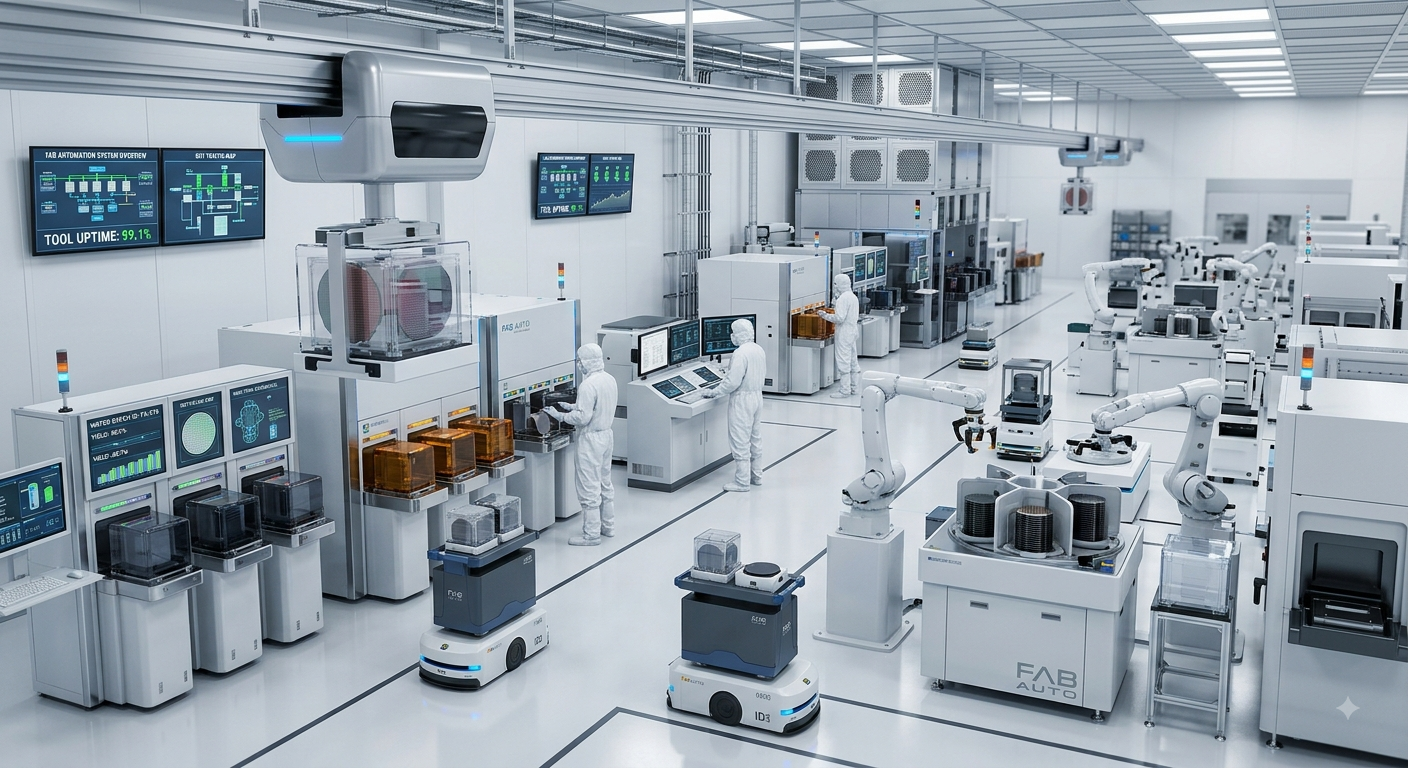
AMHS technologies transport wafer carriers between equipment and manufacturing areas using automated vehicles, overhead transport systems, conveyors, and related technologies.
In a high-volume fab, thousands of material movements can occur throughout the production process. Efficient transportation is therefore essential for maintaining production flow.
AMHS can help fabs reduce material movement time, improve equipment utilization, minimize human intervention, and coordinate complex production schedules.
As more semiconductor facilities adopt advanced automation, AMHS is becoming an increasingly important investment area.
Download PDF Brochure @ https://www.marketsandmarkets.com/pdfdownloadNew.asp?id=219676619
Industry 4.0 Is Connecting the Fab
The emergence of Industry 4.0 is taking fab automation beyond individual machines.
Industry 4.0 technologies connect equipment, sensors, software, data platforms, and production systems into an integrated manufacturing environment.
A smart semiconductor fab can continuously collect information from equipment and production processes. That information can then be analyzed to identify inefficiencies, predict equipment problems, and optimize manufacturing parameters.
MarketsandMarkets notes that fabs are increasingly adopting robotics, AMHS, MES, APC, AI-powered analytics, and digital twins to improve production efficiency and enable real-time monitoring.
This connected approach is helping transform fabs from automated facilities into data-driven smart factories.
Advanced Process Control Improves Yield
Yield is one of the most important performance indicators in semiconductor manufacturing.
A small process variation can potentially affect large numbers of devices when manufacturing thousands of wafers. Advanced Process Control (APC) can help manufacturers monitor process conditions and make adjustments to maintain consistency.
APC can combine equipment data, sensor information, historical production data, and statistical models to support real-time process optimization.
When combined with AI and machine learning, these systems can potentially identify relationships that are difficult to detect through conventional analysis.
The result is a shift from reactive quality control toward predictive and proactive manufacturing.
300 mm Fabs Accelerate Automation Demand
The expansion of 300 mm semiconductor fabs is another major driver of the market.
Larger wafers allow manufacturers to produce more semiconductor dies from each wafer, creating opportunities for higher productivity and improved manufacturing economics.
However, larger-scale production also increases the complexity of material handling, equipment coordination, scheduling, and process monitoring.
MarketsandMarkets identifies the rapid expansion of 300 mm fabs as one of the key factors supporting fab automation growth.
As manufacturers continue expanding advanced production capacity, automation will become increasingly important for maintaining throughput and consistency.
Advanced Nodes Require Greater Precision
The transition toward advanced semiconductor nodes is also strengthening the need for automation.
Modern chips contain extremely complex structures and require highly controlled manufacturing processes. As feature sizes become smaller, manufacturers have less tolerance for process variation.
Automation can help create repeatable manufacturing conditions by coordinating equipment, monitoring processes, and controlling material movement.
The expansion of advanced-node manufacturing and EUV-based production is therefore contributing to demand for sophisticated automation technologies.
Digital Twins Bring Virtual Manufacturing to the Fab
Digital twins are emerging as another important technology within the Industry 4.0 ecosystem.
A digital twin creates a virtual representation of a physical manufacturing system. In a semiconductor fab, it can be used to model equipment behavior, material movement, production schedules, and other operational characteristics.
Manufacturers can potentially use digital twins to test changes before implementing them on the production floor.
This could help optimize:
- Equipment utilization
- Material flow
- Production scheduling
- Maintenance strategies
- Factory layout
- Capacity planning
As semiconductor fabs become larger and more complex, digital twins could become valuable tools for operational planning and optimization.
AI and Predictive Maintenance
Unplanned equipment downtime can be extremely costly in semiconductor manufacturing.
AI-based predictive maintenance can analyze equipment signals to identify early indications of degradation or failure. Instead of waiting for a machine to fail, manufacturers can schedule maintenance based on predicted equipment conditions.
This can potentially improve equipment availability and reduce unexpected interruptions.
Predictive maintenance is particularly valuable in high-capital semiconductor fabs, where expensive manufacturing equipment must operate efficiently to support strong returns on investment.
The Role of Software Is Expanding
Fab automation is not only about robots and material handling equipment. Software is becoming equally important.
Manufacturing Execution Systems (MES) can coordinate production activities and track manufacturing processes.
Equipment control software enables communication between manufacturing equipment and automation platforms.
Yield management systems help manufacturers analyze production data and identify factors affecting semiconductor yield.
Advanced analytics can convert large amounts of manufacturing data into actionable insights.
Together, these systems create the digital foundation of the smart semiconductor fab.
AI Chip Demand Is Supporting Fab Investments
The rapid expansion of AI is creating another major opportunity for fab automation.
AI accelerators, high-performance processors, memory devices, and advanced networking chips require sophisticated manufacturing capabilities. Demand for these products is encouraging semiconductor manufacturers to expand production capacity.
The current AI infrastructure boom is also contributing to broader semiconductor manufacturing investment, increasing the importance of automation for new and upgraded fabs.
As fabs produce increasingly complex AI-related semiconductor devices, automated systems will be essential for maintaining quality and throughput.
Challenges Facing the Fab Automation Market
Despite strong growth opportunities, implementing fab automation can be challenging.
The initial investment required for sophisticated automation systems can be substantial. Semiconductor fabs already require enormous capital expenditure, and integrating automation adds further costs.
Integration is another challenge. New automation platforms must work with existing manufacturing equipment, software systems, communication protocols, and factory infrastructure.
Cybersecurity is also becoming increasingly important as fabs become more connected. A highly automated fab has a large digital footprint, creating additional requirements for secure communication, access management, monitoring, and data protection.
Finally, advanced automation requires specialized expertise across robotics, semiconductor manufacturing, software, data science, and industrial engineering.
Future of Fab Automation
The future of the Fab Automation Market is moving toward increasingly autonomous semiconductor manufacturing.
The next generation of fabs is likely to combine:
AI + Robotics + AMHS + Digital Twins + Advanced Process Control + Machine Vision + Predictive Analytics + Edge Computing
These technologies can work together to create manufacturing environments capable of continuously monitoring and optimizing operations.
The ultimate goal is not simply to reduce human intervention. It is to create fabs that can sense, analyze, predict, and respond to changing production conditions.
As semiconductor manufacturing becomes more complex, intelligent automation could become a competitive differentiator for manufacturers seeking higher yield, faster cycle times, greater equipment utilization, and improved operational efficiency.
Conclusion
The Fab Automation Market is becoming a critical enabler of next-generation semiconductor manufacturing. The combination of AI, robotics, Industry 4.0, automated material handling, advanced process control, and intelligent software is reshaping how semiconductor fabs operate.
The market’s projected growth from USD 25.24 billion in 2025 to USD 41.44 billion by 2032 reflects the increasing importance of automation in the semiconductor ecosystem.
As demand for AI chips, advanced processors, memory, automotive semiconductors, and high-performance computing continues to rise, manufacturers will need fabs capable of delivering greater precision and production efficiency at scale.
The future semiconductor factory will not simply be automated—it will be intelligent, connected, predictive, and increasingly autonomous.
AI may design the next generation of chips, but advanced fab automation will help build them at scale.
Top 5 FAQs – Fab Automation Market
- What is the Fab Automation Market?
The Fab Automation Market includes automation technologies used in semiconductor fabrication facilities, including automated material handling systems (AMHS), robotics, manufacturing execution systems (MES), advanced process control (APC), equipment control software, and AI-powered analytics.
- What is driving Fab Automation Market Growth?
Key growth drivers include the increasing complexity of semiconductor manufacturing, expansion of 300 mm fabs, advanced-node production, AI chip demand, Industry 4.0 adoption, and the need to improve production efficiency, yield, and equipment utilization.
- How is AI transforming semiconductor fab automation?
AI enables fabs to analyze large volumes of manufacturing data for predictive maintenance, defect detection, process optimization, anomaly detection, yield improvement, and intelligent production scheduling. This is helping manufacturers move toward more predictive and autonomous operations.
- What role does robotics play in fab automation?
Robotics automates wafer and material handling, reducing manual intervention and contamination risks while improving precision, throughput, consistency, and operational efficiency. Robotic systems are particularly important in high-volume semiconductor manufacturing environments.
- What is the future outlook for the Fab Automation Market?
The market is expected to increasingly adopt AI, robotics, digital twins, AMHS, advanced process control, machine vision, and predictive analytics. These technologies will support the development of connected, intelligent, and increasingly autonomous semiconductor fabs.
About MarketsandMarkets™
MarketsandMarkets™ has been recognized as one of America’s Best Management Consulting Firms by Forbes, as per their recent report.
MarketsandMarkets™ is a blue ocean alternative in growth consulting and program management, leveraging a man-machine offering to drive supernormal growth for progressive organizations in the B2B space. With the widest lens on emerging technologies, we are proficient in co-creating supernormal growth for clients across the globe.
Today, 80% of Fortune 2000 companies rely on MarketsandMarkets, and 90 of the top 100 companies in each sector trust us to accelerate their revenue growth. With a global clientele of over 13,000 organizations, we help businesses thrive in a disruptive ecosystem.
The B2B economy is witnessing the emergence of $25 trillion in new revenue streams that are replacing existing ones within this decade. We work with clients on growth programs, helping them monetize this $25 trillion opportunity through our service lines – TAM Expansion, Go-to-Market (GTM) Strategy to Execution, Market Share Gain, Account Enablement, and Thought Leadership Marketing.
Built on the ‘GIVE Growth’ principle, we collaborate with several Forbes Global 2000 B2B companies to keep them future-ready. Our insights and strategies are powered by industry experts, cutting-edge AI, and our Market Intelligence Cloud, KnowledgeStore™, which integrates research and provides ecosystem-wide visibility into revenue shifts.
To find out more, visit www.MarketsandMarkets™.com or follow us on Twitter , LinkedIn and Facebook .
Contact:
Mr. Rohan Salgarkar
MarketsandMarkets™ INC.
1615 South Congress Ave.
Suite 103, Delray Beach, FL 33445
USA: +1-888-600-6441
