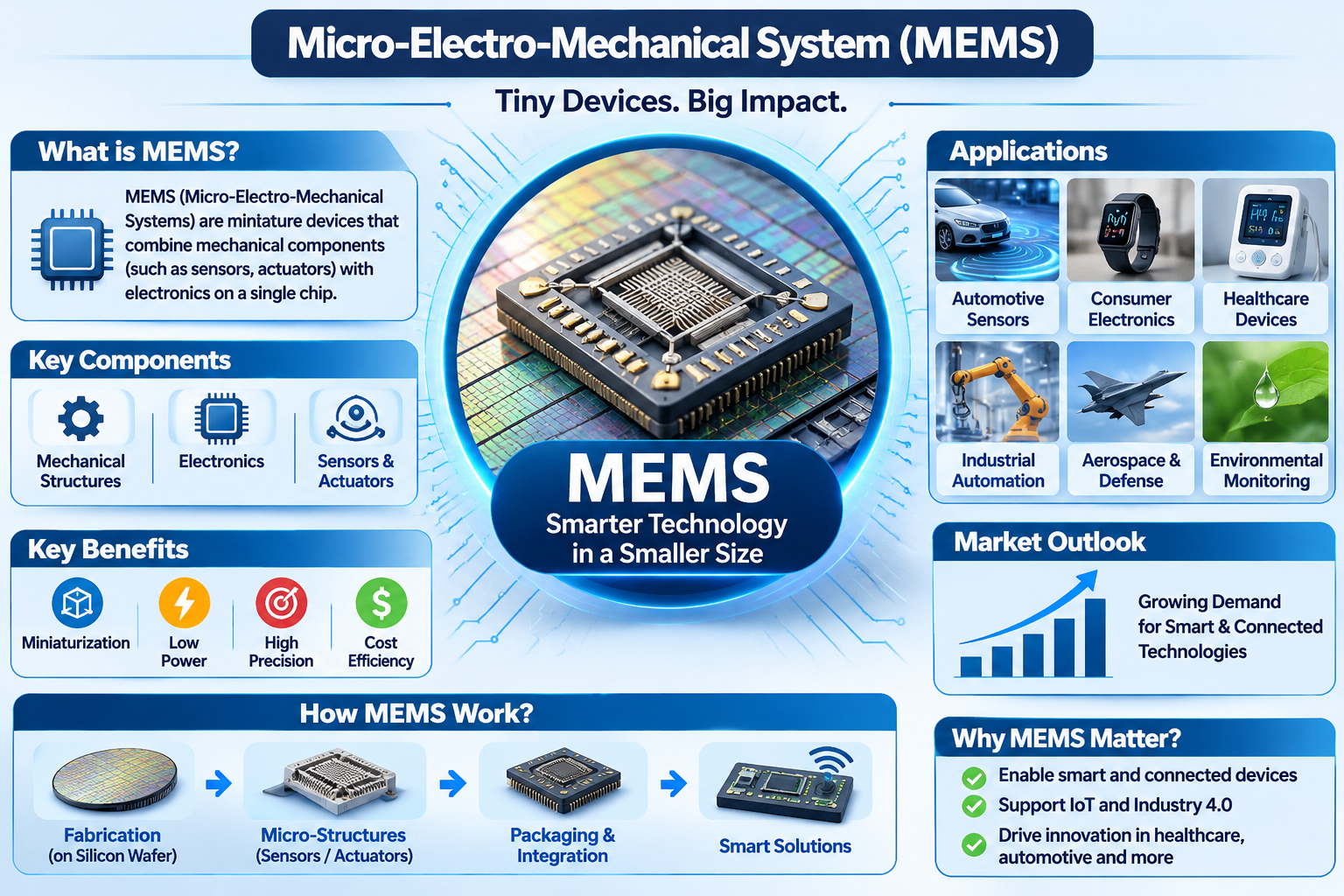
The micro-electro-mechanical system (MEMS) market is projected to reach USD 19.06 billion in 2026 and USD 25.03 billion by 2032, registering a CAGR of 4.6% during the forecast period. The key factor propelling the micro-electro-mechanical system (MEMS) market is the increasing adoption of miniaturized sensing and actuation technologies across automotive, consumer electronics, healthcare, industrial, aerospace & defense, and telecommunications applications. MEMS devices combine small form factors, low power consumption, high sensitivity, and fast response, making them suitable for applications such as smartphones, wearables, vehicle safety systems, navigation, medical devices, industrial equipment, and communication systems. Furthermore, the growing integration of MEMS sensors into ADAS, smartphones, hearables, smartwatches, IoT devices, and connected vehicles is increasing the demand for accelerometers, gyroscopes, pressure sensors, microphones, environmental sensors, and other MEMS components. The increasing adoption of sensor fusion and multi-sensor systems is further supporting the demand as manufacturers seek to combine motion, pressure, environmental, and other sensing capabilities within compact devices. In addition, advances in MEMS fabrication, wafer-level packaging, advanced materials, and semiconductor integration are improving device performance, reliability, and scalability, while the growing use of optical and RF MEMS is creating additional applications in AR/VR, telecommunications, and advanced sensing systems.
Download PDF Brochure @ https://www.marketsandmarkets.com/pdfdownloadNew.asp?id=13689179
“Inertial sensors segment to hold the largest share of the micro-electro-mechanical system (MEMS) market in 2032”
By sensor type, the inertial sensors segment is expected to hold the largest market share in 2032, primarily due to the widespread use in smartphones, wearables, automotive systems, industrial equipment, navigation systems, and other electronic devices. Accelerometers and gyroscopes enable precise measurement of motion, orientation, vibration, and acceleration, making them essential for applications such as vehicle stability and safety systems, navigation, image stabilization, activity tracking, and motion control. Increasing adoption of ADAS, autonomous and connected vehicles, smartphones, smartwatches, hearables, and industrial automation is further expanding the demand for MEMS-based inertial sensors. In addition, advancements in low-power designs, higher sensing accuracy, sensor fusion, miniaturization, and advanced packaging are improving MEMS inertial sensor performance and enabling their integration into increasingly compact and multifunctional devices, supporting wider adoption across consumer, automotive, industrial, healthcare, aerospace, and defense applications.
“Microfluidics segment to exhibit a significant CAGR in the micro-electro-mechanical system (MEMS) market between 2026 and 2032”
By actuator type, the microfluids segment is anticipated to be the second-fastest-growing during the forecast period, driven by the mounting adoption of compact, automated, and high-throughput analytical platforms across healthcare, life sciences, and industrial applications. Rising demand for point-of-care diagnostics, lab-on-a-chip systems, and portable medical devices is accelerating the integration of MEMS-based microfluidic components that enable precise fluid handling, mixing, pumping, and sensing within miniaturized platforms. Increasing emphasis on rapid diagnostics and decentralized testing is further supporting adoption by reducing sample volumes, processing time, and system footprint. In parallel, advancements in MEMS fabrication, microfluidic channel design, and sensor integration are improving device performance and enabling greater functional integration. The expansion of precision medicine, molecular diagnostics, drug discovery, and cell analysis is also creating opportunities for microfluidic MEMS solutions, while continued miniaturization and automation are strengthening their value proposition for next-generation analytical systems.
“Asia Pacific to be the fastest-growing in the micro-electro-mechanical system (MEMS) market from 2026 to 2032”
By region, Asia Pacific is expected to witness the highest CAGR during the forecast period, driven by the strong presence of consumer electronics, semiconductor manufacturing, automotive production, telecommunications, and industrial automation across major economies including China, Japan, South Korea, Taiwan, and India. Increasing adoption of smartphones, wearables, connected vehicles, ADAS, IoT devices, and advanced industrial equipment is augmenting the demand for MEMS accelerometers, gyroscopes, pressure sensors, microphones, environmental sensors, and other MEMS devices. Expanding semiconductor and electronics manufacturing capabilities, investments in advanced packaging and sensor technologies, and growing localization of component production are further supporting regional demand. In addition, increasing deployment of 5G infrastructure, automotive sensing, robotics, medical devices, and smart industrial systems, together with the presence of major MEMS and semiconductor manufacturers and established electronics supply chains, is accelerating the adoption of MEMS technologies across the region.
Key Players
The micro-electro-mechanical system (MEMS) market includes several major players, including Robert Bosch GmbH (Germany), Broadcom Inc. (US), STMicroelectronics N.V. (Switzerland), Texas Instruments Incorporated (US), TDK Corporation (Japan), Infineon Technologies AG (Germany), Analog Devices, Inc. (US), Honeywell International Inc. (US), TE Connectivity Ltd. (Switzerland), and NXP Semiconductors N.V. (Netherlands), among others. These players have a strong market presence across various countries in North America, Europe, Asia Pacific, and RoW.
For more info: https://www.marketsandmarkets.com/Market-Reports/mems-market-13689179.html
