The home automation system market is undergoing significant transformation as consumers increasingly adopt connected technologies to improve convenience, energy efficiency, security, and residential comfort. The integration of Internet of Things (IoT) devices, artificial intelligence (AI), cloud platforms, voice assistants, and wireless connectivity is expanding the role of automation beyond individual smart devices toward integrated residential ecosystems. According to MarketsandMarkets, the global home automation system market is projected to reach USD 80.73 billion by 2032, growing from USD 57.71 billion in 2026, at a CAGR of 5.8% from 2026 to 2032.
Home Automation System Market Growth Driven by Connected Living and Energy Efficiency
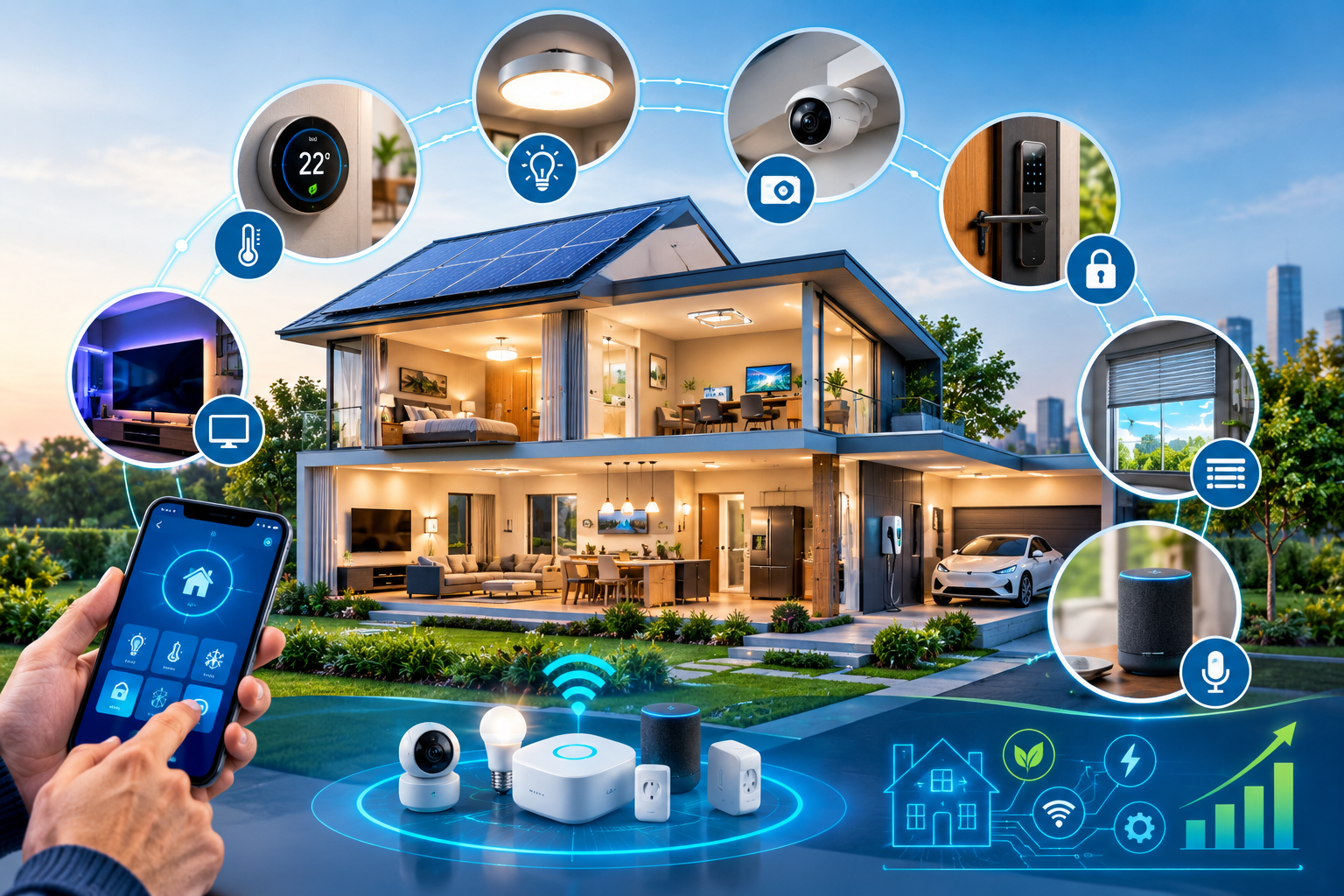
Growing consumer preference for connected living is a major factor supporting the expansion of the home automation system market. Smart lighting, thermostats, security cameras, smart locks, entertainment systems, and automated appliances can be connected through centralized platforms, allowing homeowners to monitor and control residential environments remotely.
Energy management is another important growth driver. Rising electricity costs and increasing awareness of sustainability are encouraging consumers to adopt smart thermostats, lighting controls, energy monitoring systems, and automated HVAC solutions. These technologies can optimize energy consumption by adjusting residential systems according to occupancy, schedules, environmental conditions, and user preferences.
The growing penetration of smartphones and high-speed wireless connectivity is also making home automation more accessible. Technologies such as Wi-Fi, Bluetooth, Zigbee, Z-Wave, and Thread enable communication among different residential devices, while cloud connectivity allows users to control systems remotely through mobile applications and web-based platforms.
Download PDF Brochure @ https://www.marketsandmarkets.com/pdfdownloadNew.asp?id=469
Leading Home Automation System Companies Expand Connected Ecosystems
The competitive landscape of the home automation system market includes global technology companies, electrical and electronics manufacturers, security solution providers, and specialized smart-home technology developers. Leading companies are increasingly competing through ecosystem development rather than individual products.
Major participants include Google, Amazon, Apple, Samsung Electronics, Schneider Electric, Honeywell International, Johnson Controls, ABB, Siemens, Legrand, Resideo Technologies, ASSA ABLOY, and Robert Bosch, among others. These companies are investing in smart-home platforms, connected devices, interoperability, AI-enabled features, and cloud-based services.
Technology companies are leveraging their established digital ecosystems to connect smart speakers, displays, cameras, appliances, and other devices. At the same time, electrical and building technology companies are focusing on smart lighting, energy management, HVAC controls, electrical safety, and residential automation infrastructure.
Interoperability is becoming increasingly important as consumers seek seamless communication between products from different manufacturers. Industry initiatives and standards designed to improve device compatibility are therefore expected to influence competitive positioning across the market.
Home Automation System Market Mergers and Acquisitions Reshape Competition
Mergers and acquisitions are an important component of the competitive strategy in the home automation system market. Companies are using acquisitions to obtain complementary technologies, software capabilities, connected-device portfolios, engineering expertise, and established customer relationships.
Strategic consolidation is particularly relevant in areas such as smart security, connected lighting, energy management, access control, and residential building management. Established players can accelerate their entry into emerging technology segments by acquiring specialized companies rather than developing every capability internally.
The competitive environment is also encouraging partnerships between device manufacturers, technology providers, telecommunications companies, utilities, and property developers. Such collaborations can create integrated offerings combining connectivity, security, energy management, and automation within a single residential ecosystem.
As the market evolves, future M&A activity is likely to focus increasingly on AI, edge computing, cybersecurity, interoperability, energy optimization, and connected-home software platforms.
AI and IoT Accelerate Home Automation System Market Innovation
Artificial intelligence is becoming a key technology differentiator within the home automation system market. AI-enabled systems can analyze behavioral patterns and environmental conditions to automate household functions with limited user intervention. For example, smart systems can learn preferred lighting schedules, temperature settings, appliance usage patterns, and security requirements.
IoT connectivity provides the foundation for these capabilities by allowing multiple devices and sensors to exchange information. Motion sensors, door and window sensors, cameras, environmental sensors, smart meters, and connected appliances can generate data that automation platforms use to optimize residential operations.
Edge computing is also gaining relevance because processing information closer to the device can reduce latency and improve responsiveness. This can be particularly valuable for security applications where immediate detection and response are important.
Smart Security Remains a Key Application Area
Residential security represents one of the most important application areas in the home automation system market. Increasing demand for connected cameras, video doorbells, smart locks, alarm systems, access-control solutions, and motion sensors is encouraging homeowners to integrate security functions with broader automation platforms.
Modern systems increasingly provide remote monitoring through smartphones and cloud platforms. AI-based video analytics can further improve security by distinguishing between people, vehicles, animals, and other movements, potentially reducing false alerts.
Integration between security and other home automation functions is also expanding. For example, a security event can trigger automated lighting, door locking, notifications, or changes to connected appliances. This convergence is increasing the value proposition of integrated smart-home platforms.
Energy Management and Smart HVAC Support Market Expansion
Energy management is expected to remain a significant growth opportunity. Smart thermostats and HVAC controls can automatically adjust heating and cooling based on occupancy, temperature, schedules, and user preferences. Similarly, automated lighting can reduce unnecessary electricity consumption by responding to occupancy and ambient light conditions.
The integration of home automation with distributed energy resources is creating additional opportunities. Solar power systems, battery storage, electric vehicle charging equipment, and smart energy meters can increasingly be connected to residential automation platforms. This enables homeowners to monitor consumption and coordinate energy use across multiple systems.
The growing adoption of electric vehicles is particularly relevant because residential EV chargers can become part of broader home energy management ecosystems.
Regional Outlook for the Home Automation System Market
Regional growth is influenced by technology adoption, household income, construction activity, connectivity infrastructure, energy costs, and consumer awareness. North America remains an important market because of high adoption of smart speakers, connected security products, smart appliances, and home energy technologies.
Europe is benefiting from increasing emphasis on energy efficiency, smart buildings, sustainability, and connected residential infrastructure. Regulatory initiatives and consumer demand for efficient energy use are supporting investments in intelligent residential systems.
Asia Pacific represents a significant long-term opportunity as urbanization, rising disposable incomes, expanding digital infrastructure, and increasing adoption of connected consumer electronics support smart-home deployment. Countries such as China, Japan, South Korea, and India are contributing to the region’s growing technology ecosystem.
Future Outlook for the Home Automation System Market
The future of the home automation system market will be shaped by the convergence of AI, IoT, cloud computing, edge technologies, cybersecurity, energy management, and interoperable connectivity standards. Instead of operating as isolated devices, smart-home products are increasingly becoming components of integrated digital ecosystems.
The competitive landscape is therefore shifting toward companies capable of combining hardware, software, connectivity, data analytics, and services. Vendors that can deliver secure, interoperable, energy-efficient, and easy-to-use solutions are likely to strengthen their market positions.
As residential consumers continue to prioritize convenience, safety, sustainability, and personalized experiences, demand for intelligent automation is expected to increase. With the market projected to grow from USD 57.71 billion in 2026 to USD 80.73 billion by 2032 at a CAGR of 5.8%, opportunities will continue to emerge across smart security, lighting, HVAC, energy management, entertainment, access control, and connected appliances.
Find More Information on Home Automation System Market Innovation @ https://www.marketsandmarkets.com/Market-Reports/home-automation-control-systems-market-469.html
