The Humanoid Robot Actuators Market Growth is closely connected to the rapid expansion of humanoid robotics, artificial intelligence (AI), physical AI, and human-centric automation. Actuators are fundamental components of humanoid robots because they convert electrical or other forms of energy into controlled mechanical movement, enabling robots to walk, balance, rotate joints, manipulate objects, and interact with their surroundings. As humanoid robots transition from research prototypes to commercial systems, demand for compact, lightweight, high-torque, and highly responsive actuation technologies is increasing.
According to MarketsandMarkets, the global humanoid robot market is estimated to reach USD 5.41 billion in 2026 from USD 1.95 billion in 2025 and is projected to reach USD 50.27 billion by 2035, registering a CAGR of 28.1% from 2026 to 2035. The report identifies linear and rotary actuators among the key components of humanoid robots, alongside motors, cameras and vision sensors, harmonic and planetary reducers, encoders, accelerometers, torque sensors, and motion and joint controllers.
This rapid expansion provides a strong foundation for Humanoid Robot Actuators Market Growth, as robot manufacturers increasingly focus on improving mobility, dexterity, energy efficiency, payload capacity, and precision.
AI and Physical Intelligence Accelerate Humanoid Robot Actuator Demand
AI is transforming humanoid robots from pre-programmed machines into increasingly adaptable systems capable of responding to dynamic environments. Advances in robot foundation models, computer vision, machine learning, simulation-based training, and physical AI are improving robots’ ability to perceive their surroundings, plan movements, manipulate objects, and perform complex tasks.
Actuators provide the physical execution layer for these AI-driven decisions. When an AI system determines that a robot should walk, bend, grasp, lift, or rotate its arm, actuator systems translate those instructions into controlled physical movement. Consequently, improvements in AI capabilities are increasing requirements for actuators with faster response times, higher positional accuracy, greater torque density, and improved feedback capabilities.
MarketsandMarkets identifies advancements in AI and robot foundation models, improved sensors, actuators, batteries, and mobility systems as important factors supporting humanoid robot market expansion.
As a result, Humanoid Robot Actuators Market Growth is expected to benefit from the convergence of AI intelligence and advanced electromechanical motion systems.
Download PDF Brochure @ https://www.marketsandmarkets.com/pdfdownloadNew.asp?id=99567653
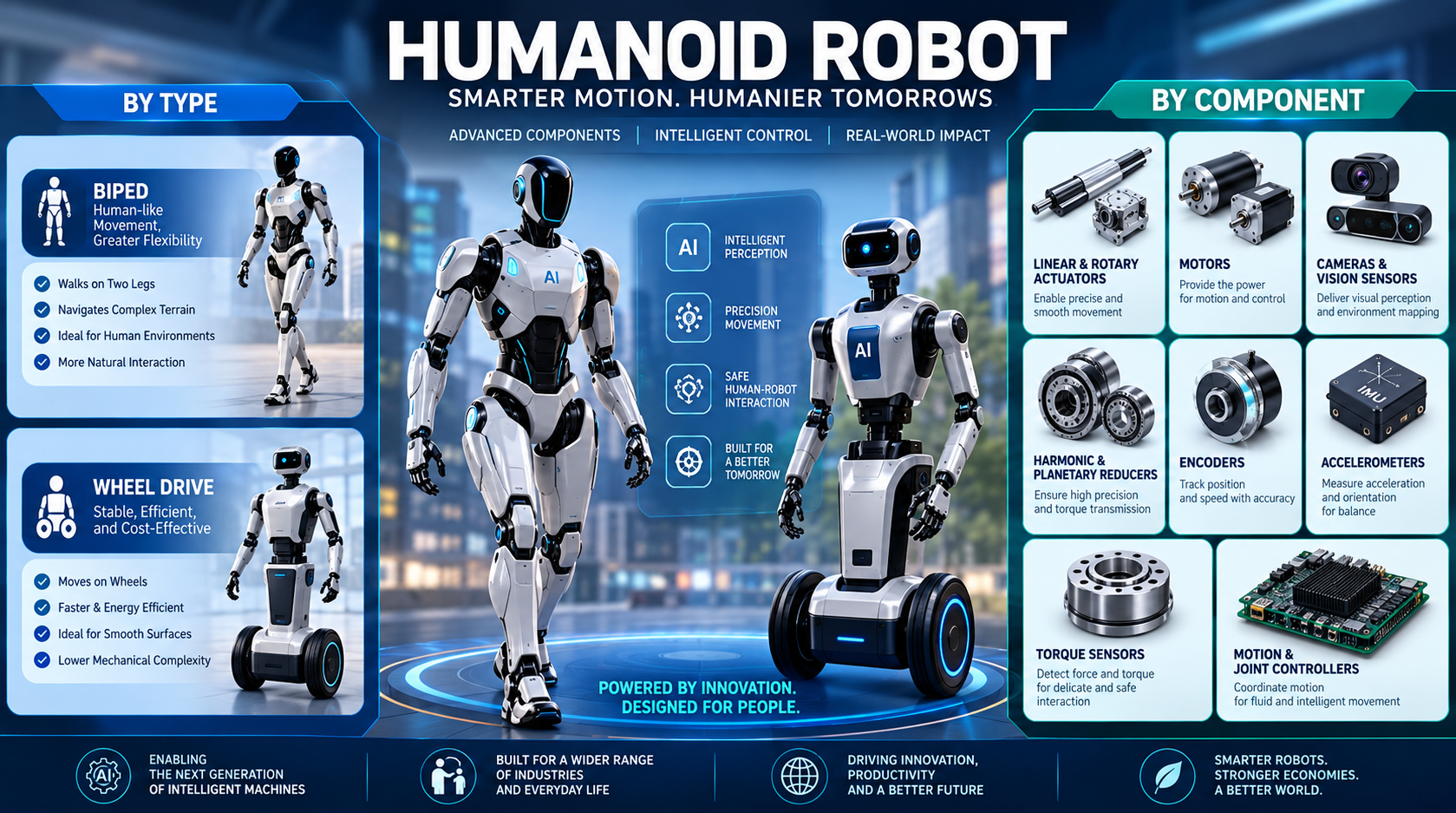
Linear and Rotary Actuators Form the Motion Foundation
Linear and rotary actuators perform different but complementary functions within humanoid robots. Rotary actuators are particularly important for joints that require rotational movement, including shoulders, elbows, wrists, hips, knees, and ankles. Linear actuation systems can support specific mechanical movements where controlled linear displacement is required.
Humanoid robots require multiple degrees of freedom to reproduce human-like movement. Each additional joint increases the need for coordinated actuator operation, sensors, controllers, and feedback mechanisms. Therefore, actuator architecture has a direct influence on a robot’s mobility, balance, manipulation capability, and overall mechanical design.
Advanced actuator systems are increasingly being engineered around requirements such as:
- High torque-to-weight ratio
- Compact mechanical architecture
- Precise position and force control
- Low backlash
- Fast response
- Energy efficiency
- Thermal management
- High reliability
- Integrated sensing and control
These requirements are contributing to Humanoid Robot Actuators Market Growth as developers seek to build robots capable of operating safely and efficiently in environments originally designed for humans.
High-Torque and Lightweight Actuators Improve Robot Mobility
Humanoid robots must manage their own body weight while performing dynamic movements. Walking, climbing, crouching, carrying objects, and maintaining balance can require significant instantaneous torque. At the same time, excessive actuator weight can increase the robot’s energy consumption and make dynamic movement more difficult.
This creates a critical engineering requirement for high-performance actuators that provide substantial torque while maintaining low weight and compact dimensions.
The development of integrated motor-actuator units, high-efficiency electric motors, advanced gear reduction mechanisms, and improved control electronics is therefore becoming increasingly important. Harmonic and planetary reducers can be integrated into humanoid joint architectures to increase torque output while maintaining precise motion.
The relationship between actuators, motors, reducers, encoders, torque sensors, and motion controllers is particularly important because humanoid movement requires multiple components to operate as a coordinated system. MarketsandMarkets specifically includes these components within its humanoid robot market analysis.
Actuator Innovation Supports Human-Centric Automation
The primary value proposition of humanoid robots is their ability to operate in environments designed for humans. Unlike specialized industrial robots that may require dedicated production cells, humanoid robots can potentially navigate facilities, use existing equipment, manipulate objects, and collaborate with human workers.
This capability is expanding opportunities across manufacturing, warehousing and distribution centers, healthcare, education, hospitality, entertainment, retail, and personal assistance.
In manufacturing environments, actuators enable robots to perform repetitive assembly, material handling, inspection, and machine-assistance activities. In warehouses, coordinated joint actuation can support walking, lifting, carrying, and object manipulation. In healthcare environments, actuators may support mobility and physical interaction for applications such as patient assistance and hospital logistics.
MarketsandMarkets expects manufacturing to register a growth rate of approximately 27%–30% during the forecast period, highlighting the increasing importance of humanoid robots in industrial automation.
This expansion across end-use industries is a major contributor to Humanoid Robot Actuators Market Growth.
Biped Humanoids Create Advanced Actuation Requirements
Biped humanoid robots represent one of the most demanding architectures for actuator technology. Walking on two legs requires continuous balance control and coordinated movement across the hips, knees, ankles, torso, and upper body.
Small changes in actuator output can affect stability and gait. As a result, biped systems require precise feedback from encoders, accelerometers, torque sensors, and other sensing technologies.
MarketsandMarkets expects the biped segment to grow at approximately 28%–30% during the forecast period, making advanced motion and joint technologies increasingly important to the humanoid robotics ecosystem.
The development of more efficient joint modules can enable smoother walking, improved balance, greater payload capability, and better energy utilization. These improvements can further support Humanoid Robot Actuators Market Growth as biped robots move toward broader commercial deployment.
AI-Powered Motion Control Enhances Actuator Performance
Actuators do not operate independently. Their performance depends heavily on motion and joint controllers that interpret commands and continuously adjust motor output.
AI-powered control systems can improve the coordination of multiple actuators by processing information from cameras, force sensors, encoders, accelerometers, and torque sensors. This enables humanoid robots to make real-time adjustments when walking on uneven surfaces, interacting with objects, or responding to changes in their environment.
Simulation-based training and digital twins are also becoming important in humanoid robotics. Developers can simulate movement patterns, actuator loads, joint trajectories, and environmental conditions before deploying robots in real-world environments. MarketsandMarkets identifies simulation-based training and digital twins as factors accelerating humanoid robot development.
The combination of AI-based control, simulation, and high-performance actuators is therefore creating new opportunities for Humanoid Robot Actuators Market Growth.
Energy Efficiency Becomes a Critical Market Requirement
Power consumption is one of the key technical considerations in humanoid robot design. Robots performing continuous movement can consume substantial energy, particularly when walking, lifting, or carrying loads.
Actuator efficiency directly affects battery runtime. Efficient motors, optimized gear systems, regenerative mechanisms, lightweight materials, and intelligent control algorithms can help reduce unnecessary energy consumption.
Improving energy efficiency also contributes to thermal management. Actuators generate heat during operation, and excessive heat can affect reliability and performance. Manufacturers therefore increasingly need to balance torque output, speed, efficiency, size, weight, and thermal characteristics.
As humanoid robots move from demonstrations toward longer operating cycles, energy-efficient actuation is expected to become increasingly important to Humanoid Robot Actuators Market Growth.
Manufacturing and Logistics Drive Commercial Opportunities
Manufacturing and logistics are among the most important application areas for humanoid robots because these environments contain many repetitive, physically demanding, and labor-intensive activities.
In factories, humanoid robots can potentially assist with assembly, inspection, material movement, and machine interaction. In warehouses, they can support picking, transportation, sorting, and handling activities.
MarketsandMarkets reports growing demand for humanoid robots across manufacturing and warehousing and distribution centers, supported by the need for flexible automation and productivity improvements.
For actuator suppliers, this creates opportunities to develop motion systems optimized for industrial workloads. Industrial applications can require high cycle life, high torque, precise positioning, impact resistance, and predictable maintenance requirements.
Consequently, the industrialization of humanoid robots can become a major catalyst for Humanoid Robot Actuators Market Growth.
Robotics-as-a-Service Opens New Deployment Models
High upfront investment remains a challenge for humanoid robotics. Developing and deploying humanoid robots requires spending on hardware, actuators, sensors, AI systems, batteries, software, testing, integration, and safety validation.
MarketsandMarkets identifies significant capital investment and extensive R&D expenditure as restraints in the humanoid robot market. At the same time, the report identifies Robotics-as-a-Service (RaaS) and fleet-management models as opportunities for broader deployment.
RaaS models can allow businesses to access robotic capabilities without purchasing and maintaining complete systems outright. As deployment expands, actuator manufacturers may benefit from recurring demand for replacement components, maintenance, upgrades, and higher-performance joint modules.
This shift from one-time hardware sales toward lifecycle-based robotics services could influence the future trajectory of Humanoid Robot Actuators Market Growth.
Asia Pacific Emerges as a Major Humanoid Robotics Hub
Asia Pacific is expected to account for more than 50% of the humanoid robot market share throughout the forecast period, according to MarketsandMarkets. The region benefits from strong manufacturing capabilities, robotics expertise, AI investment, electronics supply chains, and growing automation demand.
China, Japan, and South Korea are important markets within the broader robotics ecosystem, while other Asian economies are also increasing investments in automation and intelligent manufacturing.
The concentration of robot manufacturers and component suppliers in Asia Pacific can encourage the development of localized actuator supply chains. It can also support innovation in motors, reducers, sensors, control electronics, and integrated joint modules.
The region’s strong position in humanoid robotics therefore creates substantial opportunities for Humanoid Robot Actuators Market Growth.
Key Challenges Affecting Humanoid Robot Actuator Development
Despite significant technological progress, actuator manufacturers face several challenges. Cost remains important because humanoid robots require numerous actuators, and each joint adds mechanical and electronic complexity.
Reliability is another major consideration. Actuators used in humanoid robots must withstand repeated movement cycles while maintaining precise performance. Failures in critical joints can affect robot stability and safety.
Safety is particularly important because humanoid robots are designed to work in close proximity to people. MarketsandMarkets identifies safety concerns as a key challenge limiting humanoid robot adoption.
Manufacturers must therefore focus on force control, collision detection, torque monitoring, mechanical durability, thermal management, and fail-safe operation.
Competitive Landscape and Technology Development
The broader humanoid robot market includes companies such as Unitree Robotics, AGIBOT Innovation, UBTECH Robotics, Leju Robotics, EngineAI, Fourier, Figure AI, Agility Robotics, Tesla, and Boston Dynamics.
Although these companies primarily develop complete humanoid robot systems, their product development creates downstream demand for actuator, motor, reducer, sensor, controller, and power-system technologies.
The competitive environment is increasingly focused on improving robot mobility, dexterity, autonomy, energy efficiency, and commercial scalability. As manufacturers move toward mass production, component standardization and integrated actuator modules could become increasingly important.
For actuator suppliers, opportunities may emerge through partnerships with humanoid robot OEMs, joint-module development, customized actuator architectures, and integration of sensing and control electronics.
Future Outlook for Humanoid Robot Actuators Market Growth
The future of Humanoid Robot Actuators Market Growth will depend on the ability of manufacturers to deliver motion systems that combine high torque, low weight, precision, reliability, energy efficiency, and safety.
AI is likely to remain a major technology catalyst. As robot foundation models and physical AI improve, robots will require increasingly responsive hardware capable of translating complex decisions into accurate physical movements.
The growing commercialization of humanoid robots is also likely to encourage actuator innovation. Manufacturing, logistics, healthcare, retail, hospitality, education, and personal assistance applications each present different requirements for speed, torque, payload, precision, and operating duration.
MarketsandMarkets projects the broader humanoid robot market to reach USD 50.27 billion by 2035, compared with USD 5.41 billion in 2026, representing a CAGR of 28.1%. This expansion provides a strong market environment for the development and adoption of advanced actuator technologies.
The Humanoid Robot Actuators Market Growth is being shaped by the rapid evolution of AI-powered robotics, physical AI, advanced motion control, and human-centric automation. Actuators are becoming increasingly important as humanoid robots require precise, powerful, lightweight, and energy-efficient movement across multiple degrees of freedom.
The expansion of humanoid robots into manufacturing, logistics, healthcare, retail, hospitality, education, and personal assistance is creating new requirements for high-performance actuation systems. Meanwhile, innovations in electric motors, reducers, sensors, controllers, AI-based motion planning, and simulation are improving the capabilities of complete robotic platforms.
As humanoid robotics moves toward commercial-scale deployment, actuator technologies will remain a critical foundation for mobility, manipulation, safety, and dexterity. Continued innovation in integrated joint systems, intelligent control, high-torque motors, lightweight designs, and energy-efficient architectures is expected to remain central to the next phase of Humanoid Robot Actuators Market Growth.
Frequently Asked Questions
What is driving Humanoid Robot Actuators Market Growth?
Humanoid Robot Actuators Market Growth is driven by increasing adoption of AI-powered humanoid robots, demand for human-centric automation, advancements in electric motors and joint systems, and the need for precise, lightweight, and energy-efficient motion technologies.
What is the projected size of the humanoid robot market?
According to MarketsandMarkets, the humanoid robot market is projected to grow from USD 5.41 billion in 2026 to USD 50.27 billion by 2035, at a CAGR of 28.1%, creating opportunities for the development of advanced actuator technologies.
Which actuator technologies are important for humanoid robots?
Linear and rotary actuators are important actuator technologies for humanoid robots, supporting movement across joints such as the arms, legs, hips, knees, shoulders, elbows, and wrists.
Which region is expected to offer significant opportunities for Humanoid Robot Actuators Market Growth? Asia Pacific is expected to offer significant opportunities for Humanoid Robot Actuators Market Growth, supported by strong robotics manufacturing capabilities, AI investments, automation demand, and established electronics and component supply chains.
Which industries are driving demand for humanoid robot actuators?
Manufacturing, logistics and warehousing, healthcare, retail, hospitality, education, and personal assistance are among the key industries contributing to demand for humanoid robot actuators as automation expands into human-centric environments.
