The Humanoid Robot Market Key Trends are increasingly centered on the convergence of artificial intelligence, computer vision, advanced sensors, motion control, actuators, and physical AI. As humanoid robots move from research environments toward commercial and industrial applications, their ability to understand surroundings and execute precise movements is becoming a critical measure of real-world performance.
Humanoid robots are designed to operate in environments created for humans, including factories, warehouses, healthcare facilities, retail stores, and other service environments. This makes advanced perception and motion control particularly important. According to MarketsandMarkets,The humanoid robot market size is estimated to be USD 5.41 billion in 2026 and is projected to reach USD 50.27 billion by 2035, expanding at a CAGR of 28.1% from 2026 to 2035.
Advanced Vision Is Becoming the Eyes of Humanoid Robots
One of the most important Humanoid Robot Market Key Trends is the rapid improvement of robotic vision. Humanoid robots need to identify objects, understand their surroundings, recognize obstacles, estimate distances, and interact safely with people.
Modern humanoid platforms increasingly combine cameras and vision sensors with AI-based perception systems. These technologies enable robots to interpret visual information rather than simply responding to pre-programmed instructions.
Vision systems can help robots identify objects on a workstation, determine where an item is located, recognize changes in their environment, and plan appropriate movements. This is particularly important in manufacturing and warehouse environments where objects, workers, and operating conditions can change continuously.
MarketsandMarkets identifies improvements in computer vision and sensor technologies as a key growth driver for the humanoid robot market.
Multimodal Perception Improves Environmental Awareness
Humanoid robots cannot rely on vision alone. Real-world environments require multiple sources of information.
Advanced systems can combine visual information with data from accelerometers, gyroscopes, torque sensors, position sensors, depth sensing, and other technologies. This creates a more comprehensive understanding of the robot’s surroundings and physical state.
For example, vision can identify an object, while force and torque information can help determine how the robot is interacting with it. Accelerometers and gyroscopes can provide information about body movement and balance.
The integration of these sensors is helping humanoid robots move toward more sophisticated multimodal perception, an important trend in the evolution of physical AI.
Download PDF Brochure @ https://www.marketsandmarkets.com/pdfdownloadNew.asp?id=99567653
AI Is Connecting Vision With Action
Seeing an object is only the first step. A useful humanoid robot must also determine what to do with the information it receives.
This is where AI-based perception, motion planning, and manipulation software become important. The robot can interpret its environment, identify a task, determine an appropriate sequence of movements, and execute those movements through its actuators and controllers.
MarketsandMarkets highlights advancements in AI-based perception, motion planning, manipulation software, sensors, actuators, power systems, and robot control platforms as technologies improving humanoid mobility, task execution, and human–robot interaction.
This transition from perception to action represents one of the most important Humanoid Robot Market Key Trends because it moves robots beyond simple automation toward adaptive task execution.
Motion Control Is Improving Robot Dexterity
Motion control is another critical area shaping the Humanoid Robot Market Key Trends landscape.
Humanoid robots have multiple degrees of freedom across their arms, legs, hands, torso, neck, and other joints. Coordinating these movements requires sophisticated control systems.
Motion and joint controllers must continuously process information from sensors and adjust movement accordingly. This helps robots maintain balance, position their limbs accurately, manipulate objects, and coordinate multiple movements simultaneously.
Better motion control can allow robots to perform increasingly complex tasks such as picking, placing, assembling, walking, navigating, and interacting with equipment.
Actuators Are Critical to Physical Performance
Actuators convert control signals into physical movement. Consequently, improvements in actuators directly influence the strength, speed, precision, and mobility of humanoid robots.
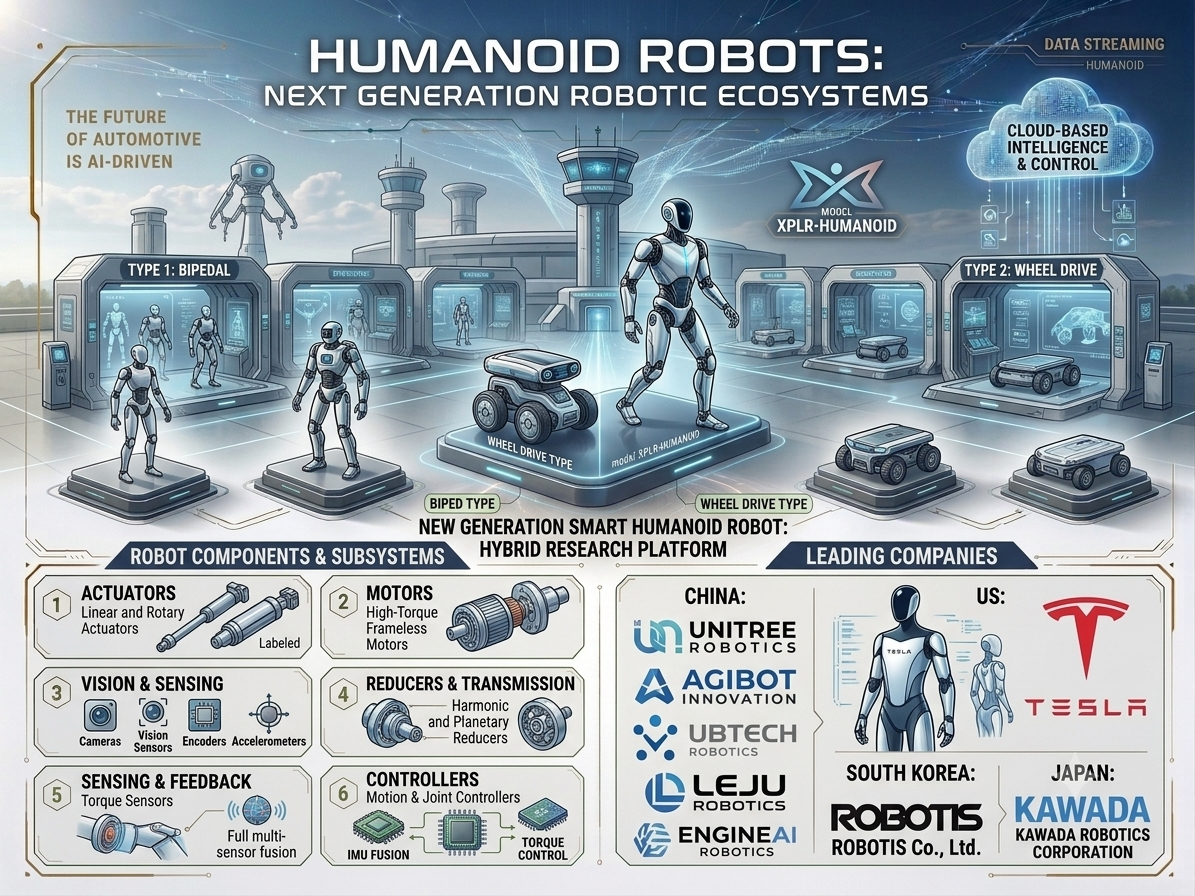
The current market includes linear and rotary actuators, motors, harmonic and planetary reducers, encoders, accelerometers, torque sensors, and motion and joint controllers.
Advanced actuator technologies are enabling manufacturers to develop robots capable of smoother and more controlled movements. At the same time, designers must balance performance with weight, energy consumption, durability, and cost.
This makes actuator development an important technological battleground for humanoid robot manufacturers.
Balance and Walking Are Becoming More Sophisticated
Bipedal movement presents a particularly difficult engineering challenge. Humans naturally adjust their posture and balance while walking, turning, reaching, and carrying objects.
Humanoid robots must reproduce similar capabilities using sensors, control algorithms, motors, actuators, and real-time feedback.
Advanced motion-control systems can continuously adjust a robot’s posture based on sensor inputs. This can help humanoids navigate uneven surfaces, change direction, maintain stability, and respond to unexpected disturbances.
MarketsandMarkets expects biped humanoid robots to account for the largest share and register the highest CAGR during the forecast period. Their ability to operate in human-designed environments is a major reason for this growth.
Manipulation Is Moving Beyond Simple Pick-and-Place
Another major development among the Humanoid Robot Market Key Trends is improved manipulation.
Humanoid robots are increasingly expected to handle objects of different sizes, shapes, weights, and materials. This requires more than mechanical movement. Robots need to understand an object’s location and orientation and determine how much force should be applied.
Vision sensors can help identify the object, while torque and position sensors provide feedback during manipulation. AI-based software can then coordinate the movement.
This combination of perception, sensing, and motion control is helping humanoid robots perform tasks that previously required dedicated robotic systems or human workers.
Physical AI Is Changing Robot Intelligence
The emergence of physical AI is becoming one of the most significant trends in humanoid robotics. Physical AI refers broadly to AI systems designed to perceive and act within the physical world.
Traditional AI can generate text, analyze images, or make predictions. Physical AI adds the ability to connect intelligence with physical actions.
For humanoid robots, this means integrating perception, reasoning, navigation, manipulation, and motion control into a unified system.
MarketsandMarkets identifies rapid progress in physical AI, robot foundation models, and simulation tools as an important market driver.
As these technologies mature, humanoid robots could become increasingly capable of learning and executing different tasks rather than being designed for only one narrowly defined operation.
Foundation Models Could Expand Robot Capabilities
Robot foundation models are another emerging element of the Humanoid Robot Market Key Trends landscape.
These models are designed to provide more general-purpose intelligence that can potentially be adapted to different robotic tasks. Instead of programming each action independently, developers can use AI models to help robots interpret instructions, understand environments, and generate appropriate actions.
This could reduce the development effort required to adapt humanoid robots to new tasks.
However, deploying foundation models on physical robots also introduces challenges involving computational requirements, latency, safety, reliability, and real-time control.
Simulation and Digital Twins Accelerate Development
Training physical robots entirely in real-world environments can be expensive and time-consuming. Simulation provides an alternative approach.
Humanoid robots can be trained in virtual environments to practice navigation, object manipulation, balance, and task execution. Digital twins can further help developers replicate physical environments and test robot behavior before deployment.
MarketsandMarkets identifies simulation-based robot training and digital twins as important trends supporting commercialization.
Simulation can also help reduce the risk of damaging hardware during early-stage training and allow robots to encounter thousands of virtual scenarios before performing tasks in real-world environments.
Manufacturing Is Becoming a Major Adoption Area
Manufacturing is expected to be one of the most important application areas for humanoid robots.
Factories contain many repetitive and labor-intensive activities, including material handling, inspection, assembly assistance, and movement of components. Humanoid robots can potentially perform some of these tasks while operating alongside existing infrastructure designed for human workers.
MarketsandMarkets expects the manufacturing segment to register a growth rate of approximately 27–30% during the forecast period.
Advanced vision and motion control are particularly valuable in factories because production environments require robots to recognize objects, navigate workspaces, manipulate components, and coordinate movement safely.
Warehousing Creates Demand for Flexible Robots
Warehouses and distribution centers represent another important opportunity.
Modern logistics facilities must handle large numbers of products with different dimensions and weights. Robots with advanced vision and manipulation capabilities can potentially perform picking, sorting, movement, and other repetitive tasks.
Unlike traditional fixed automation, humanoid robots could potentially work across multiple areas of a facility and use infrastructure already designed for humans.
MarketsandMarkets identifies warehousing and distribution centers as a key application within the humanoid robot market.
Healthcare Requires Precision and Safety
Healthcare is also emerging as an important application area. Humanoid robots could support activities involving patient assistance, facility operations, logistics, and caregiving.
However, healthcare environments require exceptionally reliable perception and movement because robots may interact closely with patients and medical personnel.
Advanced vision, force sensing, motion control, and safety systems will therefore be essential for building trust in healthcare applications.
MarketsandMarkets identifies rising demand for humanoid robots from the healthcare sector as a significant market driver. M
Human–Robot Collaboration Is Increasing
Humanoid robots are increasingly being designed to work alongside humans rather than operate in isolated environments.
This requires robots to understand human movement, detect obstacles, respond to changing situations, and maintain safe distances.
Vision systems can help robots identify people and monitor their movements, while motion-control systems can modify robot behavior accordingly.
Workplace safety is consequently becoming an important factor in the development of next-generation humanoid robots.
Robotics-as-a-Service Can Accelerate Adoption
The high cost of advanced robotic hardware can be a barrier for some organizations. Robotics-as-a-Service (RaaS) provides an alternative model in which customers can access robotic capabilities without purchasing the entire system upfront.
MarketsandMarkets identifies growing adoption of RaaS and fleet-management models as an important opportunity for the humanoid robot industry.
RaaS could make humanoid robots more accessible to businesses while creating recurring revenue opportunities for robot manufacturers and service providers.
Key Challenges for Advanced Humanoid Robots
Despite rapid innovation, several challenges could influence future Humanoid Robot Market Key Trends.
The first is cost. Advanced sensors, actuators, processors, batteries, and control systems require significant investment. MarketsandMarkets identifies substantial capital and R&D requirements as a restraint.
Safety is another major issue. Humanoid robots operate in environments designed for humans, making collision avoidance, predictable movement, emergency response, and reliable task execution essential.
Performance limitations in untested environments also remain a challenge. A robot that performs well in a controlled factory environment may behave differently when exposed to unexpected obstacles or unfamiliar conditions.
Asia Pacific Is a Major Growth Hub
Asia Pacific is expected to maintain a dominant position in the humanoid robot market, accounting for more than 50% of market share throughout the forecast period, according to MarketsandMarkets.
The region benefits from strong robotics manufacturing ecosystems and increasing investments in embodied AI. China, Japan, South Korea, India, and other regional markets are developing capabilities across robotics hardware, AI software, sensors, actuators, and manufacturing.
This ecosystem could help accelerate the commercialization of humanoid robots and supporting technologies.
Competitive Landscape
The competitive environment includes both established technology companies and specialized humanoid robotics manufacturers. MarketsandMarkets identifies Unitree Robotics, AGIBOT Innovation, UBTECH Robotics, Leju Robotics, EngineAI, Fourier, Figure AI, Agility Robotics, Tesla, and Boston Dynamics among the major companies operating in the market.
Competition is increasingly focused on more than robot hardware. Companies are developing integrated ecosystems encompassing AI models, perception systems, motion planning, simulation, controllers, sensors, actuators, fleet management, and deployment services.
This shift is likely to make software and intelligent control increasingly important sources of differentiation.
Future Outlook
The future of the Humanoid Robot Market Key Trends landscape will be shaped by the convergence of advanced vision, AI, motion control, sensors, actuators, simulation, and physical intelligence.
Humanoid robots are gradually moving toward systems that can perceive their surroundings, understand tasks, plan actions, and execute physical movements with increasing autonomy.
The market’s projected expansion from USD 5.41 billion in 2026 to USD 50.27 billion by 2035 illustrates the scale of opportunity expected from this transition
The next generation of humanoid robots will likely be distinguished by their ability to operate reliably in dynamic environments rather than simply demonstrating impressive movements in controlled settings.
Advanced vision and motion control are becoming foundational technologies for the next phase of humanoid robotics. Vision gives robots greater awareness of their surroundings, while sensors, actuators, controllers, and AI-powered motion planning allow them to translate that awareness into physical action.
Together, these technologies are enabling humanoid robots to become more mobile, dexterous, adaptive, and capable of interacting with humans.
As manufacturing, logistics, healthcare, retail, and other industries explore human-centric automation, the Humanoid Robot Market Key Trends will increasingly revolve around intelligent perception, precise movement, physical AI, simulation, and safe human–robot collaboration.
Frequently Asked Questions
1. What are the key trends shaping the Humanoid Robot Market?
Key trends include the integration of AI, advanced computer vision, motion control, physical AI, sophisticated sensors, actuators, simulation, and digital twins. These technologies are improving humanoid robots’ ability to perceive environments, navigate spaces, manipulate objects, and perform complex tasks.
2. How is advanced vision improving humanoid robots?
Advanced vision enables humanoid robots to identify objects, recognize people and obstacles, estimate distances, and understand changing environments. When combined with AI, vision systems help robots make better decisions and execute tasks with greater accuracy.
3. Why is motion control important for humanoid robots?
Motion control coordinates the movement of a robot’s joints, arms, legs, hands, and torso. Advanced control systems improve balance, walking, manipulation, precision, and safety, allowing humanoid robots to perform increasingly complex tasks in dynamic environments.
4. Which industries are adopting humanoid robots?
Major application areas include manufacturing, warehousing and logistics, healthcare, retail, hospitality, and other service industries. Manufacturing and logistics are particularly promising because humanoid robots can potentially perform repetitive and labor-intensive activities in environments already designed for humans.
5. What is the future outlook for the Humanoid Robot Market?
The market is expected to grow rapidly as AI, robotics hardware, perception technologies, and physical intelligence advance. Future humanoid robots are likely to become more autonomous, adaptable, and capable of working alongside humans, creating new opportunities for industrial automation, RaaS, healthcare, logistics, and service applications.
About MarketsandMarkets™
MarketsandMarkets™ has been recognized as one of America’s Best Management Consulting Firms by Forbes, as per their recent report.
MarketsandMarkets™ is a blue ocean alternative in growth consulting and program management, leveraging a man-machine offering to drive supernormal growth for progressive organizations in the B2B space. With the widest lens on emerging technologies, we are proficient in co-creating supernormal growth for clients across the globe.
Today, 80% of Fortune 2000 companies rely on MarketsandMarkets, and 90 of the top 100 companies in each sector trust us to accelerate their revenue growth. With a global clientele of over 13,000 organizations, we help businesses thrive in a disruptive ecosystem.
The B2B economy is witnessing the emergence of $25 trillion in new revenue streams that are replacing existing ones within this decade. We work with clients on growth programs, helping them monetize this $25 trillion opportunity through our service lines – TAM Expansion, Go-to-Market (GTM) Strategy to Execution, Market Share Gain, Account Enablement, and Thought Leadership Marketing.
Built on the ‘GIVE Growth’ principle, we collaborate with several Forbes Global 2000 B2B companies to keep them future-ready. Our insights and strategies are powered by industry experts, cutting-edge AI, and our Market Intelligence Cloud, KnowledgeStore™, which integrates research and provides ecosystem-wide visibility into revenue shifts.
To find out more, visit www.MarketsandMarkets™.com or follow us on Twitter , LinkedIn and Facebook .
Contact:
Mr. Rohan Salgarkar
MarketsandMarkets™ INC.
1615 South Congress Ave.
Suite 103, Delray Beach, FL 33445
USA: +1-888-600-6441
