The LiDAR Market Analysis highlights a rapidly evolving technology landscape driven by the growing need for accurate three-dimensional sensing, mapping, navigation, and environmental perception. LiDAR, or Light Detection and Ranging, uses laser pulses to measure distances and generate highly detailed 3D representations of physical environments.
Originally concentrated in surveying, mapping, and geographic information systems, LiDAR technology is now expanding into automotive, robotics, smart infrastructure, agriculture, construction, mining, defense, and industrial automation. The increasing adoption of autonomous systems and intelligent machines is creating new opportunities for LiDAR manufacturers, component suppliers, software providers, and service companies. The LiDAR market is projected to reach USD 12.79 billion by 2030 from USD 3.27 billion in 2025, at a CAGR of 31.3% during the forecast period
A comprehensive LiDAR Market Analysis shows that technological improvements are making LiDAR sensors smaller, faster, more affordable, and increasingly suitable for mass-market applications. The transition from traditional mechanical LiDAR toward solid-state and advanced scanning architectures is further accelerating market development.
What Is LiDAR?
LiDAR is a remote-sensing technology that emits laser pulses toward an object or surface and measures the time required for the reflected light to return to the sensor.
The collected information can be used to determine:
- Distance
- Object position
- Surface characteristics
- Elevation
- Shape
- Movement
- Environmental conditions
LiDAR systems can generate highly accurate point clouds that provide detailed information about physical environments.
Depending on the application, LiDAR can be installed on vehicles, aircraft, drones, robots, mobile mapping systems, or fixed infrastructure.
LiDAR Market Analysis: Key Growth Drivers
1. Rising Demand for Autonomous Vehicles
The expansion of autonomous and advanced driver-assistance systems is one of the most important factors influencing the LiDAR Market Analysis.
Autonomous vehicles need to perceive their surroundings accurately to detect vehicles, pedestrians, road boundaries, obstacles, and other objects.
LiDAR can provide precise depth information that complements cameras and radar.
Its ability to generate 3D environmental maps makes it valuable for applications such as:
- Object detection
- Distance measurement
- Lane and road-edge identification
- Obstacle detection
- Free-space mapping
- Autonomous navigation
As automakers and technology companies continue developing higher levels of vehicle automation, demand for automotive-grade LiDAR solutions is expected to increase.
2. Expansion of Robotics and Autonomous Systems
Robotics is another major growth area.
Autonomous mobile robots, warehouse robots, delivery robots, agricultural machines, and service robots require reliable perception systems to navigate dynamic environments.
LiDAR can help robots understand their surroundings and determine their position relative to objects and structures.
Applications include:
- Simultaneous localization and mapping
- Obstacle avoidance
- Navigation
- Warehouse mapping
- Object detection
- Autonomous movement
The growing use of robots in logistics, manufacturing, healthcare, and commercial environments is therefore creating additional demand for LiDAR.
3. Growth of Smart Cities and Infrastructure
Cities are increasingly adopting digital technologies to improve transportation, infrastructure planning, public safety, and resource management.
LiDAR can support smart-city initiatives by creating accurate 3D maps of roads, buildings, bridges, utilities, and public spaces.
Potential applications include:
- Traffic management
- Infrastructure inspection
- Urban planning
- Digital mapping
- Road condition assessment
- Smart transportation
The development of digital twins for cities and infrastructure is also creating opportunities for LiDAR-based data collection.
4. Increasing Demand for High-Precision Mapping
Mapping and surveying remain important LiDAR applications.
LiDAR can capture large areas quickly and produce detailed elevation and terrain information.
The technology is used in:
- Topographic mapping
- Forestry
- Mining
- Construction
- Agriculture
- Flood modeling
- Infrastructure planning
As organizations increasingly rely on high-resolution spatial data, demand for advanced LiDAR mapping solutions continues to expand.
Download PDF Brochure @ https://www.marketsandmarkets.com/pdfdownloadNew.asp?id=1261
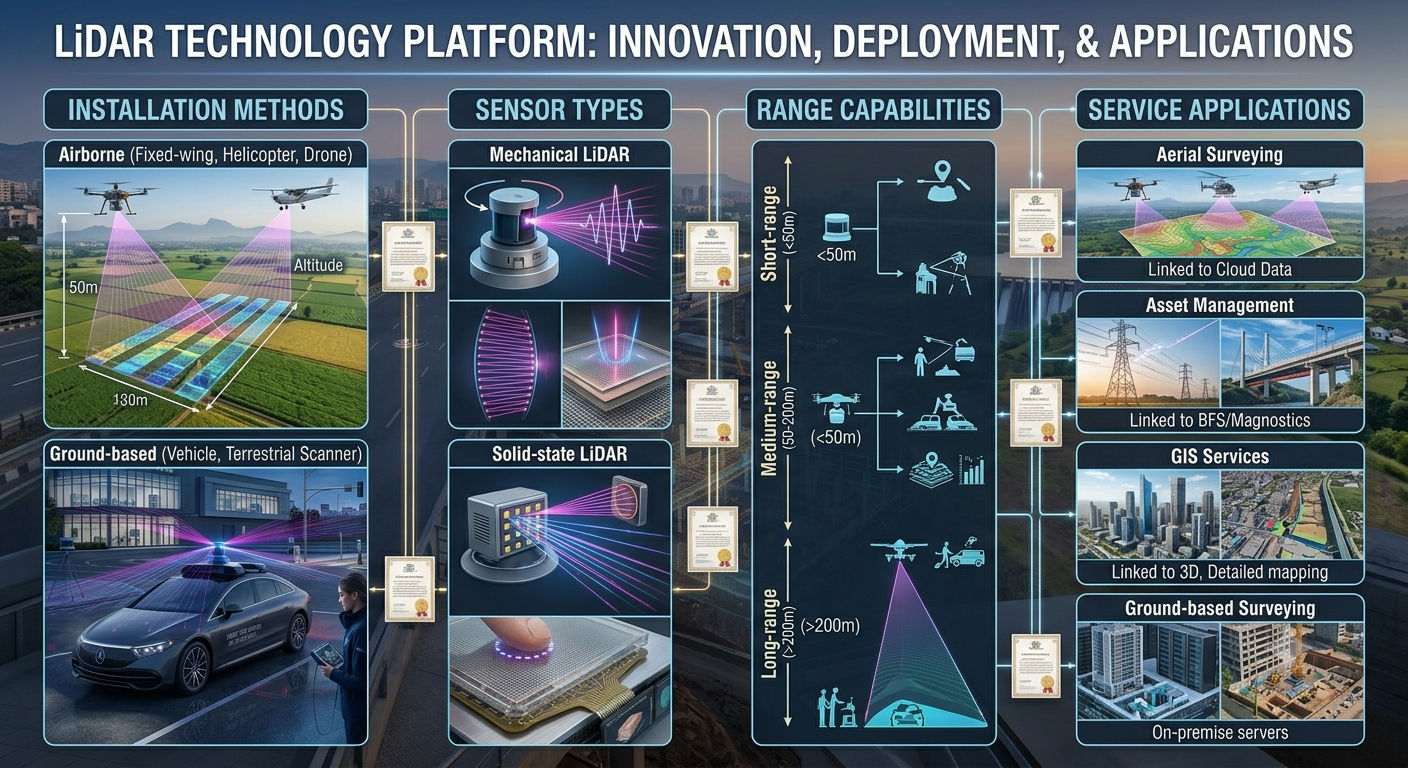
Emerging Technologies Transforming the LiDAR Market
Solid-State LiDAR
Solid-state LiDAR is one of the most significant technology developments in the market.
Traditional mechanical LiDAR systems use moving components to scan an environment. Solid-state approaches reduce or eliminate mechanical movement, potentially improving reliability and enabling smaller form factors.
Potential advantages include:
- Reduced size
- Lower maintenance requirements
- Improved durability
- Greater scalability
- Potential cost reductions
These characteristics make solid-state LiDAR particularly attractive for automotive and robotics applications.
Flash LiDAR
Flash LiDAR illuminates an entire scene rather than scanning point-by-point in the traditional manner.
This approach can provide rapid 3D imaging and may be useful in applications requiring fast environmental perception.
Potential applications include autonomous vehicles, robotics, industrial automation, and security systems.
MEMS-Based LiDAR
Micro-electromechanical systems can provide compact scanning mechanisms suitable for applications where size and cost are important.
MEMS-based LiDAR solutions can potentially combine relatively small form factors with effective scanning capabilities.
The technology is being explored for automotive, robotics, and industrial applications.
FMCW LiDAR
Frequency-modulated continuous-wave LiDAR is an emerging approach that can provide both distance and velocity information.
Unlike conventional time-of-flight systems, FMCW LiDAR can potentially detect the speed of objects directly.
This capability could be valuable for autonomous driving and advanced perception applications.
AI-Enhanced LiDAR
Artificial intelligence is increasingly being integrated with LiDAR data processing.
AI algorithms can analyze point clouds and identify objects, classify environments, and support autonomous decision-making.
AI-powered LiDAR systems can contribute to:
- Object classification
- Pedestrian detection
- Road recognition
- 3D scene understanding
- Point-cloud segmentation
- Autonomous navigation
The combination of LiDAR and AI is expected to be a major driver of future innovation.
LiDAR Applications Across Industries
Automotive
The automotive sector is one of the most closely watched application areas.
LiDAR can enhance the perception capabilities of autonomous and semi-autonomous vehicles.
Automotive LiDAR is being developed for applications ranging from advanced driver-assistance systems to higher levels of automated driving.
As sensor costs decline and performance improves, LiDAR could become more widely integrated into passenger vehicles and commercial fleets.
Robotics
Robots need accurate perception to safely navigate and interact with their environments.
LiDAR enables robots to build maps, estimate their position, detect obstacles, and navigate complex spaces.
Warehouse automation is a particularly promising application because robots must operate around shelves, workers, vehicles, and changing inventory.
Surveying and Mapping
Surveying remains a core LiDAR application.
Airborne and ground-based LiDAR systems can collect high-resolution information across large areas.
The resulting data can support infrastructure development, land management, environmental monitoring, and engineering projects.
Agriculture
Precision agriculture uses sensing technologies to optimize farming operations.
LiDAR can help analyze crop structure, plant height, terrain, and field characteristics.
Combined with drones and AI analytics, LiDAR could contribute to more efficient crop monitoring and agricultural planning.
Construction
Construction companies can use LiDAR to capture accurate 3D information about buildings and construction sites.
Applications include:
- Site surveying
- Progress monitoring
- Building inspection
- Structural measurement
- BIM integration
- As-built documentation
LiDAR can improve project visibility and reduce the need for manual measurements.
Mining
Mining companies can use LiDAR to map mines, monitor terrain, calculate stockpile volumes, and improve operational planning.
Its ability to collect detailed 3D information makes it valuable in both open-pit and underground environments.
Forestry and Environmental Monitoring
LiDAR can measure vegetation structure and canopy characteristics.
It can support:
- Forest inventory
- Biomass estimation
- Terrain modeling
- Habitat analysis
- Environmental monitoring
The technology can provide information that is difficult to obtain using conventional surveying methods.
LiDAR Market Analysis: Installation and Platform Trends
LiDAR systems can be deployed across multiple platforms, including airborne, ground-based, mobile, and vehicle-mounted systems.
Airborne LiDAR
Airborne LiDAR uses aircraft or drones to collect large-scale geographic data.
It is widely applicable to mapping, forestry, environmental studies, infrastructure planning, and disaster management.
Ground-Based LiDAR
Ground-based systems are used for detailed surveying and inspection.
They can generate highly accurate 3D representations of buildings, roads, industrial facilities, and other structures.
Mobile LiDAR
Mobile LiDAR systems can be mounted on vehicles to collect data while moving.
This makes them valuable for road surveys, transportation infrastructure, urban mapping, and asset management.
Growth Opportunities
Autonomous Driving
The long-term development of autonomous driving represents a major opportunity for LiDAR suppliers.
Higher automation levels require increasingly sophisticated environmental perception, creating demand for sensors that can deliver accurate depth information under diverse conditions.
Drone-Based Mapping
The growing adoption of drones is opening new applications for compact and lightweight LiDAR systems.
Drone-mounted LiDAR can efficiently survey difficult-to-access areas and provide detailed 3D data.
Digital Twins
Digital twins require accurate information about physical assets and environments.
LiDAR can provide the 3D data needed to create and update digital representations of buildings, factories, cities, infrastructure, and industrial facilities.
Smart Infrastructure
Governments and infrastructure operators are increasingly investing in intelligent monitoring systems.
LiDAR can support inspection and condition assessment for bridges, roads, railways, power infrastructure, and other assets.
Industrial Automation
Factories are becoming increasingly automated, creating demand for advanced perception systems.
LiDAR can help autonomous machines navigate industrial environments, monitor assets, and improve operational safety.
Regional Outlook
North America
North America represents an important market for LiDAR due to strong investment in autonomous vehicles, robotics, aerospace, mapping, and infrastructure technologies.
The region’s advanced technology ecosystem supports innovation in solid-state LiDAR, AI-powered perception, and autonomous systems.
Europe
Europe has a strong automotive and industrial manufacturing base, creating opportunities for LiDAR technologies.
Investment in autonomous mobility, smart transportation, and infrastructure modernization is expected to support market development.
Asia-Pacific
Asia-Pacific is a major growth region due to expanding automotive production, smart-city initiatives, manufacturing automation, and infrastructure development.
The region’s large electronics and semiconductor ecosystem also supports LiDAR component development and production.
Middle East and Africa
Large infrastructure, smart-city, transportation, and energy projects are creating emerging opportunities for 3D mapping and LiDAR-based inspection.
Latin America
Mining, agriculture, forestry, infrastructure, and urban development are creating opportunities for LiDAR adoption across Latin America.
Challenges Facing the LiDAR Market
Despite strong growth potential, several challenges remain.
High Costs
Advanced LiDAR sensors can be expensive compared with conventional perception technologies. Reducing component and manufacturing costs remains important for mass adoption.
Environmental Conditions
Rain, fog, snow, dust, and other environmental conditions can affect LiDAR performance.
Developers are therefore working on improved signal processing, sensor design, and multi-sensor fusion.
Data Processing Requirements
LiDAR generates large volumes of point-cloud data.
Organizations need powerful computing platforms and advanced algorithms to process this information efficiently.
Integration Complexity
LiDAR is often combined with cameras, radar, GPS, inertial sensors, and other technologies.
Ensuring effective sensor fusion and system integration can be challenging.
Future Outlook
The future LiDAR Market Analysis points toward continued innovation in sensor architecture, miniaturization, AI integration, and cost reduction.
The transition toward solid-state and software-defined LiDAR is expected to improve scalability and expand potential applications.
AI-powered point-cloud processing will also allow LiDAR systems to extract more useful information from increasingly complex environments.
Future LiDAR systems are expected to become:
- Smaller
- More affordable
- More accurate
- More energy efficient
- More intelligent
- Easier to integrate
These developments could expand LiDAR from specialized mapping applications into broader automotive, robotics, industrial, and consumer markets.
The LiDAR Market Analysis demonstrates that LiDAR is evolving from a specialized surveying technology into a critical sensing platform for the emerging era of autonomous and intelligent systems.
The growth of autonomous vehicles, robotics, smart cities, infrastructure modernization, precision agriculture, and 3D mapping is creating strong demand for advanced LiDAR solutions.
At the same time, innovations such as solid-state LiDAR, MEMS-based systems, flash LiDAR, FMCW LiDAR, AI-powered perception, and sensor fusion are improving performance while supporting new applications.
Cost reduction, miniaturization, environmental robustness, and data-processing capabilities will remain important factors influencing future adoption.
As industries increasingly require machines and infrastructure to understand the physical world with greater accuracy, LiDAR is positioned to become an important component of next-generation sensing ecosystems.
Ultimately, the LiDAR Market Analysis points toward a future where high-precision 3D perception enables safer autonomous vehicles, smarter cities, more efficient industrial operations, and increasingly intelligent machines.
FAQs
1. What is driving the growth of the LiDAR Market?
The LiDAR Market is being driven by increasing demand for autonomous vehicles, advanced driver-assistance systems, robotics, 3D mapping, smart infrastructure, surveying, and precision agriculture. The need for accurate real-time environmental perception is encouraging organizations to adopt LiDAR-based sensing technologies.
2. What are the key technologies shaping the LiDAR Market?
Key technologies include solid-state LiDAR, MEMS-based LiDAR, flash LiDAR, FMCW LiDAR, and AI-powered LiDAR. These innovations are focused on improving sensor accuracy, reducing size and cost, increasing reliability, and enabling faster 3D perception.
3. Which industries are the major users of LiDAR technology?
Major application areas include automotive, robotics, surveying and mapping, construction, mining, agriculture, forestry, infrastructure, and smart cities. Automotive and autonomous systems are emerging as particularly important areas for future LiDAR adoption.
4. What are the major challenges facing the LiDAR Market?
Key challenges include the relatively high cost of advanced sensors, performance limitations in certain environmental conditions, large volumes of point-cloud data, processing requirements, and the complexity of integrating LiDAR with cameras, radar, GPS, and other sensing technologies.
5. What is the future outlook for the LiDAR Market?
The future outlook is positive, with opportunities arising from autonomous mobility, robotics, drone-based mapping, smart infrastructure, digital twins, and industrial automation. Continued advances in solid-state architectures, AI, miniaturization, sensor fusion, and cost reduction are expected to expand LiDAR adoption across new applications.
About MarketsandMarkets™
MarketsandMarkets™ has been recognized as one of America’s Best Management Consulting Firms by Forbes, as per their recent report.
MarketsandMarkets™ is a blue ocean alternative in growth consulting and program management, leveraging a man-machine offering to drive supernormal growth for progressive organizations in the B2B space. With the widest lens on emerging technologies, we are proficient in co-creating supernormal growth for clients across the globe.
Today, 80% of Fortune 2000 companies rely on MarketsandMarkets, and 90 of the top 100 companies in each sector trust us to accelerate their revenue growth. With a global clientele of over 13,000 organizations, we help businesses thrive in a disruptive ecosystem.
The B2B economy is witnessing the emergence of $25 trillion in new revenue streams that are replacing existing ones within this decade. We work with clients on growth programs, helping them monetize this $25 trillion opportunity through our service lines – TAM Expansion, Go-to-Market (GTM) Strategy to Execution, Market Share Gain, Account Enablement, and Thought Leadership Marketing.
Built on the ‘GIVE Growth’ principle, we collaborate with several Forbes Global 2000 B2B companies to keep them future-ready. Our insights and strategies are powered by industry experts, cutting-edge AI, and our Market Intelligence Cloud, KnowledgeStore™, which integrates research and provides ecosystem-wide visibility into revenue shifts.
To find out more, visit www.MarketsandMarkets™.com or follow us on Twitter , LinkedIn and Facebook .
Contact:
Mr. Rohan Salgarkar
MarketsandMarkets™ INC.
1615 South Congress Ave.
Suite 103, Delray Beach, FL 33445
USA: +1-888-600-6441
