The Nano Biosensors Market Trends 2026 landscape is being shaped by rapid advances in nanotechnology, miniaturization, wearable electronics, artificial intelligence (AI), microfluidics, and connected healthcare. Nano biosensors are emerging as important tools for detecting biological and chemical analytes with high sensitivity and supporting faster, more personalized healthcare decisions. Their growing application in point-of-care (POC) diagnostics, glucose monitoring, wearable health devices, research, and remote patient monitoring is creating new opportunities across the healthcare ecosystem.
According to MarketsandMarkets, the global biosensors market was valued at USD 34.5 billion in 2025 and is projected to reach USD 54.37 billion by 2030, growing at a CAGR of 9.5% from 2025 to 2030. The report identifies the emergence of nanotechnology-based biosensors, technological advancements, increasing glucose monitoring, and growing demand for rapid diagnostics as important market drivers.
While the broader biosensors market encompasses multiple technologies, the increasing integration of nanotechnology is particularly relevant to next-generation sensing platforms. The Nano Biosensors Market Trends 2026 reflect a movement toward smaller, faster, more sensitive, connected, and increasingly intelligent diagnostic systems.
Nanotechnology Accelerates Biosensor Innovation
One of the defining Nano Biosensors Market Trends 2026 is the increasing use of nanotechnology to improve biosensor performance. MarketsandMarkets identifies the emergence of nanotechnology-based biosensors as a driver of the broader biosensors market.
Nanomaterials can provide properties that are useful for biosensing, including high surface-area-to-volume ratios and enhanced interactions with target biological molecules. These characteristics can support the development of compact sensors capable of detecting biological signals with high sensitivity.
The incorporation of nanotechnology also supports miniaturization, which is essential for portable diagnostic equipment and wearable devices. As healthcare moves toward decentralized testing and continuous monitoring, smaller sensing platforms can enable devices that are easier to deploy in clinical, home, and remote environments.
Consequently, the Nano Biosensors Market Trends 2026 are closely linked to the broader movement toward miniaturized and highly integrated healthcare technologies.
Point-of-Care Diagnostics Create New Opportunities
Point-of-care diagnostics represent one of the most important application areas for biosensor technologies. MarketsandMarkets reports that POC applications account for the largest share of the biosensors market throughout the forecast period. These applications include glucose monitoring, cardiac markers, infectious disease detection, and coagulation monitoring.
Nano biosensors can support the development of compact diagnostic platforms that require small sample volumes and can potentially deliver rapid results. This is particularly valuable where laboratory infrastructure is limited or immediate information is required for healthcare decisions.
The increasing demand for rapid diagnostic testing is supported by aging populations, rising chronic diseases, cardiovascular conditions, cancer, infectious diseases, and the need to manage healthcare expenditures. MarketsandMarkets also highlights increasing demand for improved healthcare in emerging markets such as China and India.
For the Nano Biosensors Market Trends 2026, the continued development of portable POC technologies is therefore expected to remain a major innovation pathway.
Download PDF Brochure @ https://www.marketsandmarkets.com/pdfdownloadNew.asp?id=798
Wearable Biosensors Reshape Continuous Monitoring
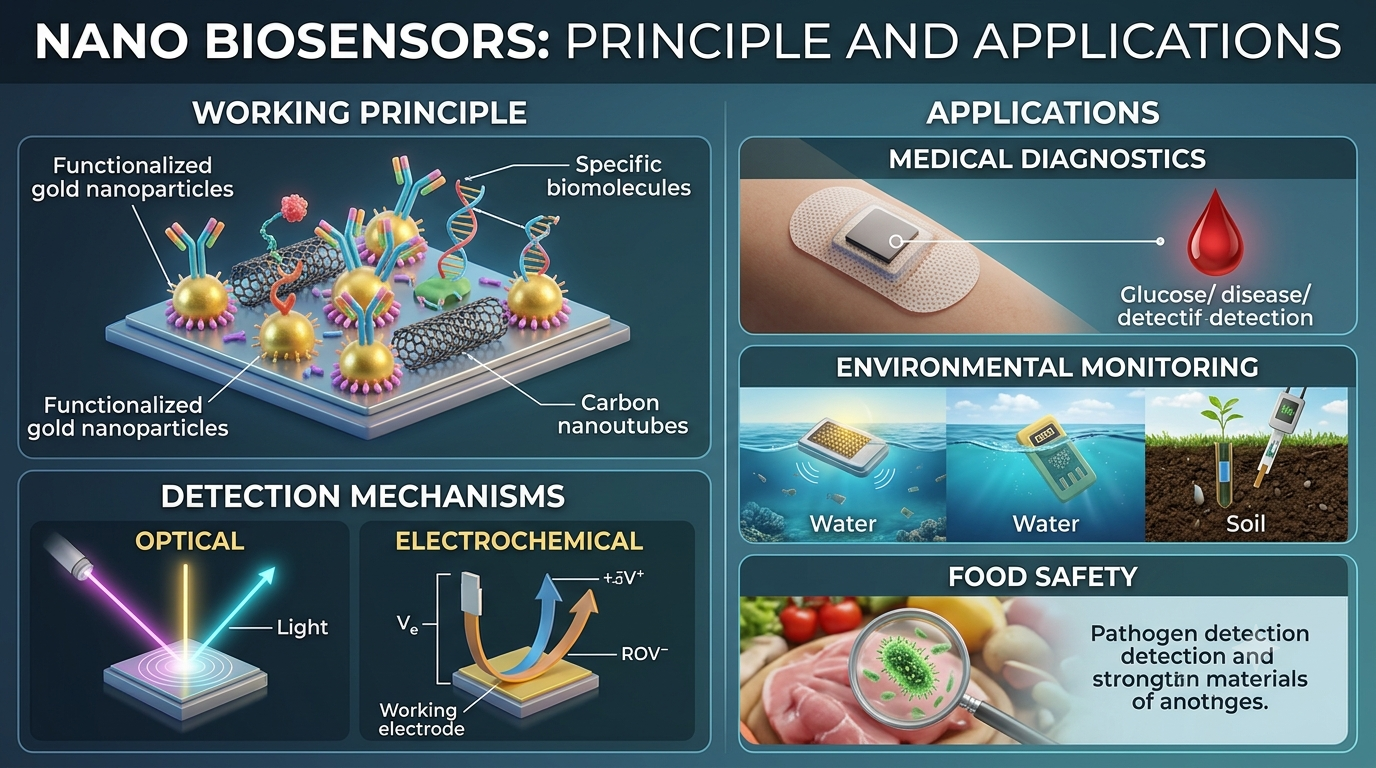
Wearable technology is another major component of the Nano Biosensors Market Trends 2026. MarketsandMarkets reports that wearable biosensors are expected to grow at a higher rate than non-wearable biosensors during 2025–2030. Wearable biosensors are attracting attention because they can support continuous health monitoring and contribute to a shift from centralized, hospital-based care toward home-based and personalized healthcare.
Wearable biosensors can be incorporated into patches, wrist-worn devices, body-worn systems, smart textiles, and other compact formats. Nano-enabled sensing technologies can contribute to the miniaturization and functionality required for these products.
MarketsandMarkets notes that wearable biosensors can support continuous monitoring of vital signs in patients, premature infants, children, athletes, and people in remote areas. Biosensor patches and sensor-integrated textiles can also support long-term monitoring and data collection.
This trend is important because continuous monitoring generates health information over time rather than relying exclusively on occasional measurements.
AI and Biosensors Create Intelligent Diagnostic Platforms
Artificial intelligence is increasingly being integrated with biosensor technologies. MarketsandMarkets identifies the integration of AI, IoT, and cloud-based platforms as a trend accelerating biosensor market growth and enabling continuous monitoring and smart diagnostics.
For nano biosensors, AI can add an analytical layer to sensing hardware. A sensor can collect biological data, while AI algorithms can process large datasets, identify patterns, and support automated interpretation.
This convergence can be particularly valuable in wearable healthcare applications, where sensors continuously generate physiological or biochemical information. AI-enabled systems can help organize this data and identify changes that may require additional attention.
The combination of nanosensing, AI, and connected platforms therefore represents an important direction for the Nano Biosensors Market Trends 2026.
Glucose Monitoring Remains a Core Application
Glucose monitoring is one of the strongest drivers of biosensor adoption. MarketsandMarkets identifies the increasing use of biosensors to monitor glucose levels in individuals with diabetes as a major market driver. Glucose biosensors are widely used to detect and monitor glucose concentrations, while the increasing prevalence of diabetes is supporting demand for glucose monitoring technologies.
The development of smaller, connected, and wearable glucose sensors is contributing to the transformation of diabetes management. Continuous glucose monitoring systems can collect data throughout the day and provide users with a more detailed understanding of glucose patterns.
Nano-enabled technologies can potentially support further miniaturization and sensitivity improvements in glucose sensing. When combined with wireless communication, smartphones, cloud platforms, and AI-based analytics, glucose biosensors can become part of broader digital healthcare ecosystems.
This makes glucose monitoring an important application to watch within the Nano Biosensors Market Trends 2026.
Microfluidics Supports Miniaturized Biosensing
Microfluidics is another technology contributing to the evolution of biosensors. MarketsandMarkets identifies miniaturization, nanotechnology, and microfluidics as technological developments supporting market growth.
Microfluidic systems manipulate very small volumes of fluids and can be integrated with compact diagnostic platforms. This can support portable testing and reduce sample requirements.
When combined with nanomaterials, microfluidic channels, biological recognition elements, and advanced transducers, these systems can create highly integrated biosensing platforms. Such architectures are particularly relevant to POC diagnostics and wearable applications.
The combination of nanotechnology and microfluidics is therefore expected to remain an important innovation area as developers seek to make biosensors smaller and more practical for decentralized healthcare.
Optical and Nanomechanical Technologies Expand Sensing Capabilities
The broader biosensors market includes electrochemical, optical, piezoelectric, thermal, and nanomechanical technologies. MarketsandMarkets expects optical biosensors to register the highest CAGR during the forecast period.
Optical biosensors can analyze biomolecular interactions in real time and can be used in applications such as drug discovery, target identification, assay development, and quality control.
Nanotechnology can complement optical and other sensing approaches by enabling highly sensitive interfaces and miniaturized structures. These developments can broaden the application of biosensors from conventional diagnostic instruments to advanced research and analytical platforms.
For the Nano Biosensors Market Trends 2026, technology convergence will be particularly important as manufacturers combine different sensing principles with nanomaterials, electronics, and software.
Home Diagnostics Drive Decentralized Healthcare
Home diagnostics is expected to register the highest growth rate among biosensor applications during the forecast period, according to MarketsandMarkets. The report attributes this growth to healthcare developments, adoption of new diagnostic methods, and the convenience offered by home-based medical devices.
Nano biosensors can contribute to this shift by enabling smaller diagnostic platforms that can potentially be used outside traditional healthcare facilities.
Home-based testing can also be connected to smartphones and cloud platforms, allowing health information to be transmitted to healthcare providers. This creates an ecosystem in which sensing, connectivity, data analysis, and remote healthcare delivery work together.
As consumers increasingly seek convenient health monitoring technologies, home diagnostics is likely to remain an important opportunity within the Nano Biosensors Market Trends 2026.
Remote Patient Monitoring Expands Wearable Opportunities
Remote patient monitoring is closely connected to the growth of wearable biosensors. MarketsandMarkets highlights the ability of wearable and connected biosensors to support remote monitoring and telemedicine. Such technologies can enable physiological data to be collected outside hospitals and transmitted to healthcare professionals.
Nano-enabled wearable sensors could support this transition by enabling compact and potentially conformable sensing systems. Sensor patches, smart textiles, and other wearable formats can help collect data for extended periods.
This approach may be particularly relevant for chronic disease management, elderly care, rehabilitation, and patients living in areas with limited access to healthcare facilities.
Asia Pacific Offers Significant Growth Potential
Asia Pacific is expected to experience the highest growth rate in the global biosensors market during the forecast period. MarketsandMarkets attributes regional growth to the large population base, increasing incidence of lifestyle diseases, healthcare-system development, healthcare investments, and technological advancements.
China, Japan, and India are among the major markets contributing to the regional biosensor ecosystem. Increasing adoption of POC devices and growing healthcare investments are supporting demand.
For nano biosensor developers, Asia Pacific offers opportunities across diagnostics, wearable healthcare, research, and remote monitoring. The region’s combination of large patient populations and expanding healthcare infrastructure can support broader deployment of compact and cost-efficient biosensing technologies.
Regulatory Requirements Remain a Key Challenge
Despite technological progress, regulatory requirements remain an important challenge for the Nano Biosensors Market Trends 2026. MarketsandMarkets identifies government regulations and long certification and approval cycles as key challenges for biosensor manufacturers.
For POC devices in the US, manufacturers need to submit performance information to the FDA demonstrating that devices can be used appropriately and provide results comparable with relevant clinical laboratory testing. MarketsandMarkets notes that stringent standards and guidelines can make the approval process time-consuming.
Nano biosensors may also require extensive validation because their performance depends on factors such as material characteristics, biological recognition elements, sensor stability, and manufacturing consistency.
As a result, commercial success will depend not only on technological performance but also on regulatory compliance, reliability, scalability, and cost.
High R&D Costs Influence Commercialization
Research and development costs are another factor affecting the adoption of advanced biosensing technologies. MarketsandMarkets identifies the high costs involved in biosensor R&D as a market restraint.
Developing nano biosensors requires expertise across nanomaterials, biology, chemistry, electronics, microfabrication, data analytics, and medical-device engineering. Moving from laboratory prototypes to commercially scalable products can therefore be complex.
Manufacturers are increasingly required to demonstrate reproducibility, durability, accuracy, manufacturability, and user safety. Strategic collaborations between technology companies, research institutions, healthcare organizations, and device manufacturers can help address some of these development requirements.
Future Outlook for Nano Biosensors in 2026 and Beyond
The Nano Biosensors Market Trends 2026 point toward a future in which sensing technologies become smaller, more connected, more automated, and more integrated into everyday healthcare.
Nanotechnology will remain important for improving sensor architectures, while AI and IoT can provide advanced data processing and connectivity. Wearable biosensors can support continuous monitoring, while POC and home diagnostics can bring testing closer to patients.
The broader biosensors market is expected to grow from USD 34.5 billion in 2025 to USD 54.37 billion by 2030, representing a CAGR of 9.5%. This expansion provides a broader commercial environment for nanotechnology-enabled biosensing solutions.
The strongest opportunities are likely to emerge where several technologies converge. Nano biosensors combined with wearable electronics, microfluidics, wireless connectivity, AI analytics, and cloud platforms can support increasingly integrated healthcare solutions.
Conclusion
The Nano Biosensors Market Trends 2026 demonstrate how nanotechnology is contributing to the evolution of point-of-care and wearable diagnostics. The combination of miniaturized sensing structures, advanced materials, microfluidics, AI, IoT, and cloud connectivity is creating opportunities for more portable, connected, and data-driven healthcare technologies.
MarketsandMarkets identifies the emergence of nanotechnology-based biosensors as a growth driver for the broader biosensors industry, alongside technological advancements and rising demand for rapid diagnostics. Wearable biosensors are expected to grow at a higher rate than non-wearable products, while POC applications maintain the largest share and home diagnostics records the highest growth rate among applications.
As healthcare continues to move toward decentralized diagnostics, continuous monitoring, and personalized care, nano-enabled biosensors can play an increasingly important role. The convergence of nanotechnology and digital healthcare is therefore likely to remain a central theme in the Nano Biosensors Market Trends 2026, creating opportunities across wearable monitoring, glucose management, POC testing, home diagnostics, remote patient monitoring, and advanced biomedical research.
Frequently Asked Questions (FAQs)
1. What are the key Nano Biosensors Market Trends 2026?
Key Nano Biosensors Market Trends 2026 include the adoption of nanotechnology, AI-powered diagnostics, wearable biosensors, point-of-care testing, microfluidics, IoT connectivity, and miniaturized sensing technologies.
2. How is AI transforming the Nano Biosensors Market?
AI can analyze large volumes of biosensor-generated data, identify patterns, support automated interpretation, and enable more personalized and continuous healthcare monitoring.
3. What role do nano biosensors play in point-of-care diagnostics?
Nano biosensors can enable compact, sensitive, and rapid detection platforms for applications such as glucose monitoring, infectious disease detection, cardiac testing, and other diagnostic applications.
4. Are wearable devices driving the Nano Biosensors Market?
Yes. Wearable biosensors are an important growth area because they support continuous health monitoring. Nano-enabled sensing technologies can contribute to smaller and more integrated wearable diagnostic and monitoring devices.
About MarketsandMarkets™
MarketsandMarkets™ is a blue ocean alternative in growth consulting and program management, leveraging a man-machine offering to drive supernormal growth for progressive organizations in the B2B space. We have the widest lens on emerging technologies, making us proficient in co-creating supernormal growth for clients.
The B2B economy is witnessing the emergence of $25 trillion of new revenue streams that are substituting existing revenue streams in this decade alone. We work with clients on growth programs, helping them monetize this $25 trillion opportunity through our service lines – TAM Expansion, Go-to-Market (GTM) Strategy to Execution, Market Share Gain, Account Enablement, and Thought Leadership Marketing.
Built on the ’GIVE Growth’ principle, we work with several Forbes Global 2000 B2B companies – helping them stay relevant in a disruptive ecosystem. Our insights and strategies are molded by our industry experts, cutting-edge AI-powered Market Intelligence Cloud, and years of research. The KnowledgeStore™ (our Market Intelligence Cloud) integrates our research, facilitates an analysis of interconnections through a set of applications, helping clients look at the entire ecosystem and understand the revenue shifts happening in their industry.
To find out more, visit www.MarketsandMarkets™.com or follow us on Twitter, LinkedIn and Facebook.
Contact:
Mr. Rohan Salgarkar
MarketsandMarkets™ INC.
630 Dundee Road
Suite 430
Northbrook, IL 60062
USA : 1-888-600-6441