The global organic acids market is witnessing steady expansion as industries increasingly shift toward sustainable, bio-based, and high-performance ingredients. The market is estimated to be valued at USD 15.15 billion in 2025 and is projected to reach USD 19.54 billion by 2030, growing at a CAGR of 5.2% during the forecast period.
Organic acids have become indispensable across numerous industries, including food & beverages, animal feed, pharmaceuticals, chemicals, and industrial manufacturing. Their ability to improve product safety, enhance flavor, extend shelf life, and maintain product stability has positioned them as critical ingredients in modern manufacturing processes.
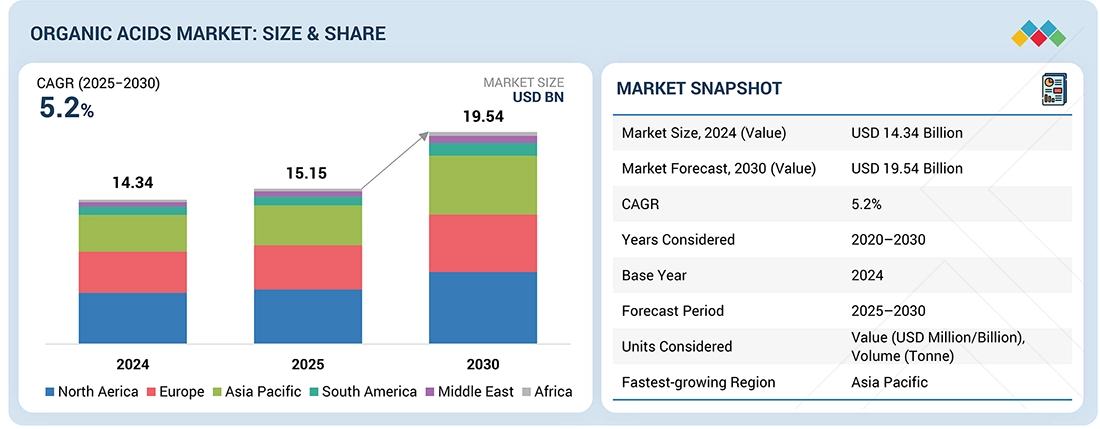
Rising Demand for Natural and Sustainable Ingredients Fuels Market Growth
One of the primary drivers of the organic acids market is the growing consumer preference for natural, clean-label, and environmentally sustainable products. Food and beverage manufacturers are increasingly incorporating organic acids as natural preservatives and acidity regulators to reduce dependence on synthetic chemical additives.
Advancements in fermentation technologies and biotechnology are further supporting market growth by enabling more efficient production methods and expanding the availability of bio-based organic acids. Regulatory encouragement for sustainable production practices and increasing awareness regarding health-conscious food choices are also accelerating adoption across industries.
As companies focus on improving product quality while meeting sustainability goals, organic acids are expected to remain at the forefront of innovation in food processing, pharmaceuticals, and industrial applications.
Download PDF Brochure: https://www.marketsandmarkets.com/pdfdownloadNew.asp?id=30190158
Synthetic Organic Acids Continue to Lead the Market by Source
Based on source, the synthetic segment is expected to account for the largest share of the global organic acids market throughout the forecast period.
Synthetic organic acids are primarily produced through petrochemical and chemical synthesis processes. Their market dominance can be attributed to several factors, including:
- Cost-effective production methods
- Consistent product quality and purity
- Large-scale manufacturing capabilities
- Reliable supply chains
- Established production infrastructure
Key organic acids such as acetic acid, formic acid, and adipic acid are predominantly manufactured through synthetic routes due to their economic advantages and scalability.
Although sustainability concerns are encouraging investments in bio-based alternatives, synthetic organic acids continue to offer superior production efficiency and technological maturity. However, fermentation-derived acids such as citric acid and lactic acid are gaining traction, particularly in clean-label food and beverage applications.
Despite growing competition from bio-based sources, synthetic organic acids are expected to maintain a leading market position due to their extensive industrial usage and cost competitiveness.
Acetic Acid Dominates the Market by Type
Among various product types, acetic acid is projected to account for the largest share of the global organic acids market.
Acetic acid is one of the most widely produced and consumed organic acids worldwide due to its broad application portfolio across multiple industries.
Food and Beverage Applications
In the food industry, acetic acid is widely utilized as:
- A preservative
- A flavoring ingredient
- An acidity regulator
- A shelf-life enhancer
It is commonly found in processed foods, sauces, condiments, pickled products, and beverages.
Industrial Significance
Acetic acid’s market leadership is further reinforced by its role as a key raw material in manufacturing:
- Vinyl Acetate Monomer (VAM)
- Acetic Anhydride
- Ester Derivatives
- Adhesives
- Paints and Coatings
- Packaging Materials
Its versatility, strong downstream demand, and established production ecosystem make acetic acid the most commercially significant organic acid globally.
While bio-based acetic acid production is gradually expanding, synthetic production through methanol carbonylation remains dominant due to its scalability and economic advantages.
Request Sample Pages: https://www.marketsandmarkets.com/requestsampleNew.asp?id=30190158
Asia Pacific Emerges as the Largest Regional Market
The Asia Pacific region is expected to hold the largest share of the global organic acids market during the forecast period.
The region’s leadership is driven by:
- Rapid industrialization
- Expanding food and beverage manufacturing
- Growing processed food consumption
- Increasing pharmaceutical production
- Strong agricultural and animal feed industries
China Leads Regional Production
China remains the largest producer of organic acids in Asia Pacific, supported by extensive manufacturing capabilities for acetic acid, citric acid, and lactic acid. Competitive production costs and export-oriented operations have strengthened the country’s position in the global market.
India’s Growing Market Potential
India is emerging as a significant growth market due to expanding food processing, pharmaceutical manufacturing, and increasing adoption of organic acids as preservatives, acidulants, and processing aids.
Southeast Asia Strengthens Demand
Growing livestock production and feed preservation requirements across Southeast Asian countries continue to drive demand for propionic acid and formic acid, particularly in the animal nutrition sector.
Furthermore, increasing investments in fermentation-based production technologies and supportive regulatory frameworks for sustainable ingredients are reinforcing Asia Pacific’s leadership in the global organic acids value chain.
As urbanization, industrial development, and consumer demand for packaged foods continue to rise, the region is expected to remain the dominant market for organic acids through 2030.
Leading Organic Acids Companies
The organic acids market is characterized by the presence of several global and regional manufacturers focused on capacity expansion, technological innovation, sustainable production, and strategic partnerships.
Key companies operating in the market include:
- BASF SE
- Cargill, Incorporated
- ADM
- Celanese Corporation
- Eastman Chemical Company
- Corbion
- Tate & Lyle PLC
- Henan Jindan Lactic Acid Technology Co., Ltd.
- Myriant Corporation
- Jungbunzlauer Suisse AG
These companies are actively investing in research and development, fermentation technologies, and sustainable manufacturing processes to strengthen their market positions and meet evolving industry requirements.
