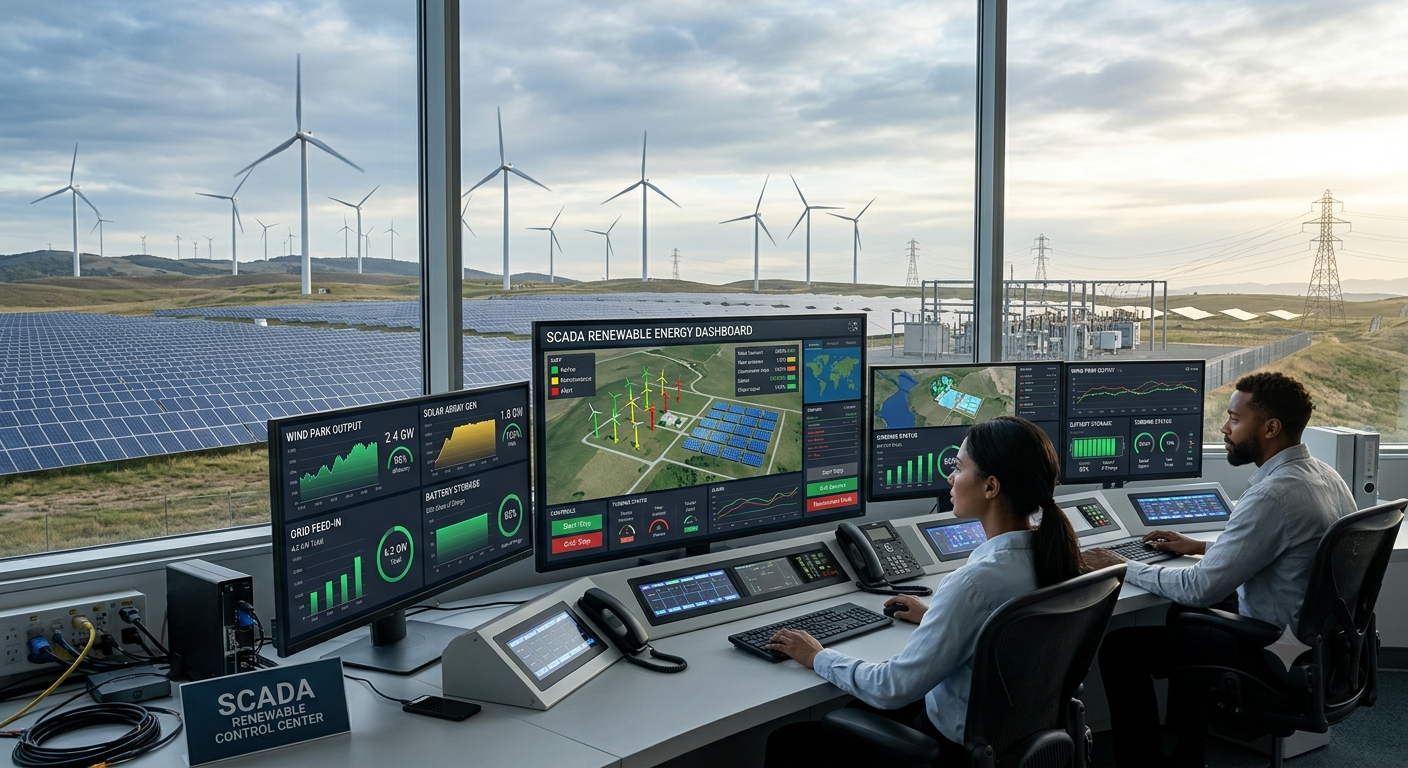
The SCADA in Renewable Energy Market Growth Trends are being shaped by the rapid expansion of solar, wind, hydropower, smart grids, and digitally connected energy infrastructure. As renewable energy projects become larger, more distributed, and more complex to operate, utilities, independent power producers, and renewable energy developers are increasingly adopting Supervisory Control and Data Acquisition (SCADA) systems to monitor assets, manage energy production, identify faults, and improve operational efficiency.
According to MarketsandMarkets, the global SCADA in renewable energy market was valued at USD 1.96 billion in 2025 and is projected to reach USD 3.56 billion by 2030, registering a CAGR of 12.7% from 2025 to 2030. The growth is supported by increasing installations of solar, wind, and hydropower assets, investments in grid modernization, and rising demand for real-time monitoring and control.
One of the most important SCADA in Renewable Energy Market Growth Trends is the integration of artificial intelligence (AI), machine learning, IoT, cloud computing, and predictive analytics into conventional monitoring and control platforms. These technologies are transforming SCADA from a primarily supervisory system into an intelligent operational platform capable of identifying performance anomalies, forecasting equipment failures, optimizing energy generation, and supporting data-driven decision-making.
SCADA in Renewable Energy Market Growth Trends Driven by Renewable Energy Expansion
The global transition toward cleaner energy is creating a substantial requirement for advanced monitoring and automation technologies. Solar farms, wind farms, hydropower facilities, and distributed renewable assets generate large volumes of operational data that need to be continuously monitored and analyzed.
SCADA systems provide centralized visibility into equipment performance, power generation, voltage, current, temperature, environmental conditions, alarms, and other operational parameters. This enables operators to identify abnormal conditions quickly and take corrective action before they affect energy production or grid stability.
The rapid deployment of renewable energy assets is therefore one of the major SCADA in Renewable Energy Market Growth Trends. MarketsandMarkets identifies the unprecedented scale of renewable deployment as a key driver, while the distributed and remote nature of many renewable assets further increases the need for remote monitoring and control.
Large utility-scale solar farms can contain thousands or even millions of individual components. Similarly, wind farms can include turbines spread across large geographical areas, while hydropower facilities often operate in remote locations. SCADA allows operators to monitor these assets from centralized control centers, reducing the need for manual inspections and improving operational visibility.
AI-Powered Monitoring Transforming Renewable Energy SCADA
AI-powered monitoring is emerging as one of the most significant SCADA in Renewable Energy Market Growth Trends. Traditional SCADA systems primarily collect and display operational data, whereas AI-enabled SCADA platforms can analyze large datasets to identify patterns and potential problems.
AI and machine learning algorithms can evaluate historical and real-time data from turbines, solar panels, inverters, transformers, generators, substations, and other equipment. These systems can identify deviations from normal operating conditions and generate alerts when equipment performance deteriorates.
For example, an AI-enabled SCADA platform can analyze temperature, vibration, power output, and historical failure patterns to identify early indications of equipment degradation. Operators can then schedule maintenance before a component fails completely.
This approach helps renewable energy operators reduce unplanned downtime, improve asset availability, extend equipment life, and maximize energy generation.
MarketsandMarkets highlights AI-driven analytics as an important factor supporting predictive maintenance, efficient energy management, scalability, and operational reliability in the market.
Download PDF Brochure @ https://www.marketsandmarkets.com/pdfdownloadNew.asp?id=18400746
Predictive Analytics Creating New Opportunities
Predictive analytics is another major component of SCADA in Renewable Energy Market Growth Trends. Renewable energy operators increasingly need to move from reactive maintenance toward predictive and condition-based maintenance.
Traditional maintenance schedules may require equipment to be inspected or serviced at fixed intervals. Predictive analytics enables operators to determine when maintenance is actually required based on equipment condition and performance data.
SCADA systems collect information continuously, creating a valuable data foundation for predictive models. Advanced analytics can evaluate historical trends, equipment behavior, environmental conditions, and real-time operational parameters to predict potential failures.
In wind energy, predictive analytics can help identify abnormal turbine behavior before gearbox, generator, bearing, or blade-related problems become severe. In solar installations, analytics can help identify inverter issues, abnormal power output, temperature variations, and underperforming panels.
The result is a more proactive approach to renewable asset management. Operators can reduce maintenance costs, minimize downtime, improve workforce utilization, and increase the overall return on renewable energy investments.
Cloud-Based SCADA Accelerating Market Growth
The movement toward cloud-based infrastructure is another important SCADA in Renewable Energy Market Growth Trends. Cloud-based SCADA allows renewable energy operators to access operational information from multiple locations and manage geographically distributed assets through centralized platforms.
MarketsandMarkets identifies the development of cloud-based SCADA systems as an important opportunity in the market.
Cloud deployment can provide scalability as renewable portfolios expand. Instead of maintaining separate monitoring infrastructure for every facility, operators can integrate data from multiple solar farms, wind parks, and hydropower facilities into centralized platforms.
Cloud-based platforms also support advanced analytics, remote diagnostics, centralized dashboards, data storage, and collaboration between engineering and operations teams.
For independent power producers managing renewable assets across different regions, cloud-enabled SCADA can provide a unified operational view while supporting faster decision-making.
IoT Integration Strengthening Real-Time Monitoring
The convergence of SCADA and the Internet of Things (IoT) is significantly influencing SCADA in Renewable Energy Market Growth Trends. IoT-enabled sensors can collect detailed information from renewable assets and transmit this information to SCADA platforms for analysis.
Sensors can monitor temperature, pressure, vibration, humidity, voltage, current, wind conditions, solar radiation, equipment status, and other operational parameters. This creates a continuous stream of information that can be used for asset optimization.
IoT integration is particularly valuable for distributed renewable energy infrastructure. Operators can monitor geographically dispersed assets without requiring physical personnel at every site.
The combination of IoT, SCADA, AI, and cloud technologies can therefore create an intelligent monitoring ecosystem in which renewable assets continuously generate operational data, SCADA platforms process the information, and analytics systems identify actionable insights.
Solar Energy Remains a Major Growth Area
Solar is expected to remain a major contributor to SCADA in Renewable Energy Market Growth Trends. MarketsandMarkets indicates that the solar segment is expected to account for the largest share of the market, with a 62.6% share in 2025.
The rapid development of utility-scale solar farms and distributed solar installations is increasing the need for centralized monitoring and automated control.
Solar SCADA systems can monitor photovoltaic panels, inverters, trackers, transformers, weather stations, substations, and grid connections. Operators can use these systems to compare expected and actual energy output, identify underperforming equipment, and optimize plant performance.
AI-powered analytics can further improve solar asset management by analyzing weather forecasts, historical generation patterns, irradiance data, and equipment performance.
Floating solar represents another emerging opportunity. MarketsandMarkets identifies floating solar SCADA solutions as an opportunity because these systems can monitor power generation, environmental conditions, water-related parameters, and grid connections.
Wind Energy Increasing Demand for Intelligent SCADA
Wind power is also contributing to SCADA in Renewable Energy Market Growth Trends. Modern wind farms contain numerous turbines distributed across large geographical areas, creating significant monitoring and maintenance requirements.
SCADA platforms can collect operational information from individual turbines and provide centralized visibility into turbine performance. Parameters such as rotor speed, generator temperature, wind speed, power output, vibration, and gearbox conditions can be monitored continuously.
AI-powered predictive analytics can identify subtle changes in turbine behavior that may indicate component degradation. This allows operators to schedule maintenance more efficiently and reduce unexpected shutdowns.
Offshore wind projects are expected to further increase the importance of remote monitoring because physical access to offshore turbines can be difficult and expensive. Advanced SCADA systems can help operators manage these assets remotely while supporting predictive maintenance and operational optimization.
Hydropower Modernization Supporting SCADA Adoption
Hydropower is another important sector covered by the market. Aging hydropower infrastructure is increasingly being upgraded with digital monitoring, automation, and control technologies.
SCADA systems can monitor turbines, generators, gates, pumps, water levels, electrical systems, and other critical infrastructure. Modern SCADA platforms can integrate operational data with analytics tools to improve plant efficiency and reliability.
Digital modernization can also help hydropower operators detect abnormal conditions, optimize generation schedules, and coordinate output with broader grid requirements.
As renewable portfolios increasingly combine solar, wind, hydropower, and energy storage, SCADA systems can provide an integrated operational layer for managing diverse assets.
Software Segment Becomes Increasingly Important
Software is becoming a central component of SCADA in Renewable Energy Market Growth Trends because advanced functionality increasingly depends on analytics, visualization, automation, and data management.
MarketsandMarkets reports that the software segment held a 40.0% share in 2024.
Modern SCADA software can provide real-time dashboards, alarm management, historical data analysis, predictive maintenance, remote control, reporting, and integration with other enterprise systems.
The evolution of SCADA software is also helping operators manage increasingly complex renewable portfolios. Advanced platforms can integrate information from multiple facilities and provide a unified view of operational performance.
Smart Grids and Grid Modernization
Smart grid development is another fundamental factor supporting SCADA in Renewable Energy Market Growth Trends. As renewable energy penetration increases, electricity grids must accommodate variable generation and distributed power sources.
SCADA systems provide real-time visibility into generation, transmission, and distribution infrastructure. This information can help grid operators maintain system stability, balance power flows, and respond to changing supply and demand.
The integration of renewable generation with smart grid technologies creates opportunities for automated control, advanced forecasting, demand management, and improved grid resilience.
SCADA therefore plays an important role in connecting renewable generation with increasingly digital electricity networks.
Asia Pacific to Lead Market Growth
Asia Pacific is expected to be the fastest-growing regional market for SCADA in renewable energy, with MarketsandMarkets projecting a 13.9% CAGR during the forecast period.
The region’s growth is supported by rapid solar and wind deployment, hydropower modernization, smart grid investments, and government initiatives supporting renewable energy and digital infrastructure.
China, India, Japan, and South Korea are investing heavily in renewable energy capacity and grid modernization. The expansion of utility-scale solar, offshore wind, hydropower, and distributed energy resources is creating strong demand for monitoring and automation technologies.
The increasing adoption of 5G and advanced communication networks can further support real-time monitoring of geographically distributed renewable assets.
Cybersecurity Becomes a Strategic Priority
While digitalization creates opportunities, cybersecurity remains a major challenge for SCADA in Renewable Energy Market Growth Trends.
As renewable energy systems become increasingly connected to communication networks, cloud platforms, IoT devices, and external systems, their exposure to cyber threats increases. SCADA infrastructure can become a target for malware, ransomware, unauthorized access, and other cyberattacks.
A successful cyberattack against critical renewable infrastructure could potentially disrupt energy production or grid operations. Consequently, renewable energy operators are increasing their focus on secure communications, access controls, network segmentation, authentication, monitoring, and cybersecurity compliance.
MarketsandMarkets identifies cybersecurity threats as a key challenge for the market.
High Initial Investment Remains a Restraint
Despite strong growth prospects, high initial investment costs can limit SCADA adoption, particularly among smaller renewable operators.
SCADA deployment can require investment in PLCs, remote terminal units, HMIs, communication infrastructure, software platforms, integration, cybersecurity, and professional services. MarketsandMarkets identifies high initial investment costs and system complexity as important restraints.
However, the long-term benefits of improved asset availability, lower maintenance costs, remote monitoring, and higher operational efficiency can support the business case for SCADA investment.
Cloud-based deployment and managed services may also help reduce upfront infrastructure requirements for some operators.
Competitive Landscape
The competitive landscape is evolving as established automation companies and specialized software providers develop solutions for renewable energy applications.
MarketsandMarkets identifies companies including Siemens, ABB, Honeywell International, Rockwell Automation, Schneider Electric, and Emerson among the prominent participants in the broader competitive landscape. Specialized companies such as COPA-DATA, Power Factors, and Inductive Automation are also developing strong positions in niche areas.
Competition is increasingly centered on AI capabilities, cloud integration, cybersecurity, interoperability, predictive analytics, remote operations, and scalable architectures.
Future Outlook for SCADA in Renewable Energy Market Growth Trends
The future of SCADA in Renewable Energy Market Growth Trends will be closely linked to the continued digitalization of energy infrastructure. As renewable generation expands, operators will require more sophisticated technologies to monitor assets, predict failures, optimize output, and maintain grid stability.
AI and machine learning will increasingly transform SCADA systems into predictive and autonomous operational platforms. Instead of simply displaying equipment data, next-generation SCADA solutions will increasingly analyze information, identify anomalies, recommend actions, and support automated responses.
Cloud computing will enable centralized management of geographically distributed renewable assets, while IoT will expand the volume and granularity of operational data. Digital twins, advanced forecasting, edge computing, and cybersecurity technologies can further strengthen renewable energy management.
The convergence of these technologies is expected to create a more intelligent, resilient, and efficient renewable energy ecosystem.
The SCADA in Renewable Energy Market Growth Trends reflect a broader transformation in how renewable energy assets are monitored, controlled, and optimized. The global market is projected to increase from USD 1.96 billion in 2025 to USD 3.56 billion by 2030 at a CAGR of 12.7%, supported by renewable capacity expansion, smart grid development, digitalization, and the growing requirement for real-time operational visibility.
AI-powered monitoring and predictive analytics are becoming particularly important because they allow operators to move beyond traditional monitoring toward proactive asset management. Cloud SCADA, IoT integration, intelligent software, remote diagnostics, and cybersecurity will further influence the market’s development.
With solar expected to remain a leading application and Asia Pacific emerging as the fastest-growing region, the SCADA in Renewable Energy Market Growth Trends point toward a future in which intelligent automation becomes essential for reliable and scalable clean energy operations.
Frequently Asked Questions (FAQs)
1. What are the key SCADA in Renewable Energy Market Growth Trends?
Key SCADA in Renewable Energy Market Growth Trends include AI-powered monitoring, predictive analytics, IoT integration, cloud-based SCADA, smart grid modernization, remote asset management, advanced cybersecurity, and automated control of renewable energy assets.
2. What is the size of the SCADA in Renewable Energy Market?
According to MarketsandMarkets, the SCADA in renewable energy market was valued at USD 1.96 billion in 2025 and is projected to reach USD 3.56 billion by 2030, growing at a CAGR of 12.7% during 2025–2030.
3. Why is AI important for the SCADA in Renewable Energy Market?
AI enables SCADA platforms to analyze large volumes of operational data, identify abnormal equipment behavior, support predictive maintenance, optimize energy production, and improve decision-making across solar, wind, and hydropower facilities.
4. Which renewable energy segment is expected to hold the largest share of the market?
The solar segment is expected to hold the largest share of the SCADA in renewable energy market. MarketsandMarkets estimates that solar will account for 62.6% of the market in 2025, supported by rapid deployment of utility-scale and distributed solar projects.
5. Which region is expected to grow fastest in the SCADA in Renewable Energy Market?
Asia Pacific is expected to be the fastest-growing region, with MarketsandMarkets projecting a 13.9% CAGR during the forecast period. Growth is supported by renewable energy expansion, smart grid investments, hydropower modernization, and digital transformation across countries such as China, India, Japan, and South Korea.
About MarketsandMarkets™
MarketsandMarkets™ is a blue ocean alternative in growth consulting and program management, leveraging a man-machine offering to drive supernormal growth for progressive organizations in the B2B space. We have the widest lens on emerging technologies, making us proficient in co-creating supernormal growth for clients.
The B2B economy is witnessing the emergence of $25 trillion of new revenue streams that are substituting existing revenue streams in this decade alone. We work with clients on growth programs, helping them monetize this $25 trillion opportunity through our service lines – TAM Expansion, Go-to-Market (GTM) Strategy to Execution, Market Share Gain, Account Enablement, and Thought Leadership Marketing.
Built on the ’GIVE Growth’ principle, we work with several Forbes Global 2000 B2B companies – helping them stay relevant in a disruptive ecosystem. Our insights and strategies are molded by our industry experts, cutting-edge AI-powered Market Intelligence Cloud, and years of research. The KnowledgeStore™ (our Market Intelligence Cloud) integrates our research, facilitates an analysis of interconnections through a set of applications, helping clients look at the entire ecosystem and understand the revenue shifts happening in their industry.
To find out more, visit www.MarketsandMarkets™.com or follow us on Twitter, LinkedIn and Facebook.
Contact:
Mr. Rohan Salgarkar
MarketsandMarkets™ INC.
1615 South Congress Ave.
Suite 103
Delray Beach, FL 33445
USA : 1-888-600-6441
