The microdisplay industry is entering a new phase of technological development as demand for compact, high-resolution, and energy-efficient display solutions continues to increase. The growing adoption of augmented reality (AR), virtual reality (VR), mixed reality (MR), smart glasses, automotive head-up displays, and advanced medical imaging systems is creating new opportunities for microdisplay manufacturers.
One of the emerging technologies attracting attention is the optical engine. Optical engines combine light sources, optical components, and display technologies to deliver high-quality visual experiences in compact form factors. Their ability to support brightness, resolution, optical efficiency, and miniaturization makes them an important part of next-generation display systems.
As wearable devices become smaller and more sophisticated, manufacturers are focusing on developing advanced optical engines that can improve image quality while reducing power consumption and overall device size. These developments could significantly influence the future direction of the microdisplay market.
The global microdisplay market is expected to grow from USD 1.65 billion in 2025 to USD 5.33 billion by 2030, growing at a CAGR of 26.4%.
Understanding Optical Engines in Microdisplay Technology
An optical engine is a compact display subsystem responsible for generating, processing, and delivering visual information to the viewer. It typically consists of a microdisplay panel, illumination source, optical lenses, light guides, and image-processing components.
In near-to-eye devices, optical engines project images from miniature displays into the user’s field of view. These images can be combined with real-world surroundings through optical combiners, including waveguides and reflective or refractive optics.
The performance of an optical engine depends on several factors:
- Brightness: Ensuring clear images under different lighting conditions.
- Resolution: Delivering sharp visuals with high pixel density.
- Optical Efficiency: Maximizing light transmission while minimizing energy losses.
- Power Consumption: Supporting longer battery life in wearable devices.
- Miniaturization: Reducing optical module size and weight.
- Field of View: Providing a wider and more immersive viewing experience.
These requirements are encouraging manufacturers to develop integrated optical engines that combine advanced microdisplay panels with more efficient illumination and optical systems.
Download PDF Brochure @ https://www.marketsandmarkets.com/pdfdownloadNew.asp?id=430
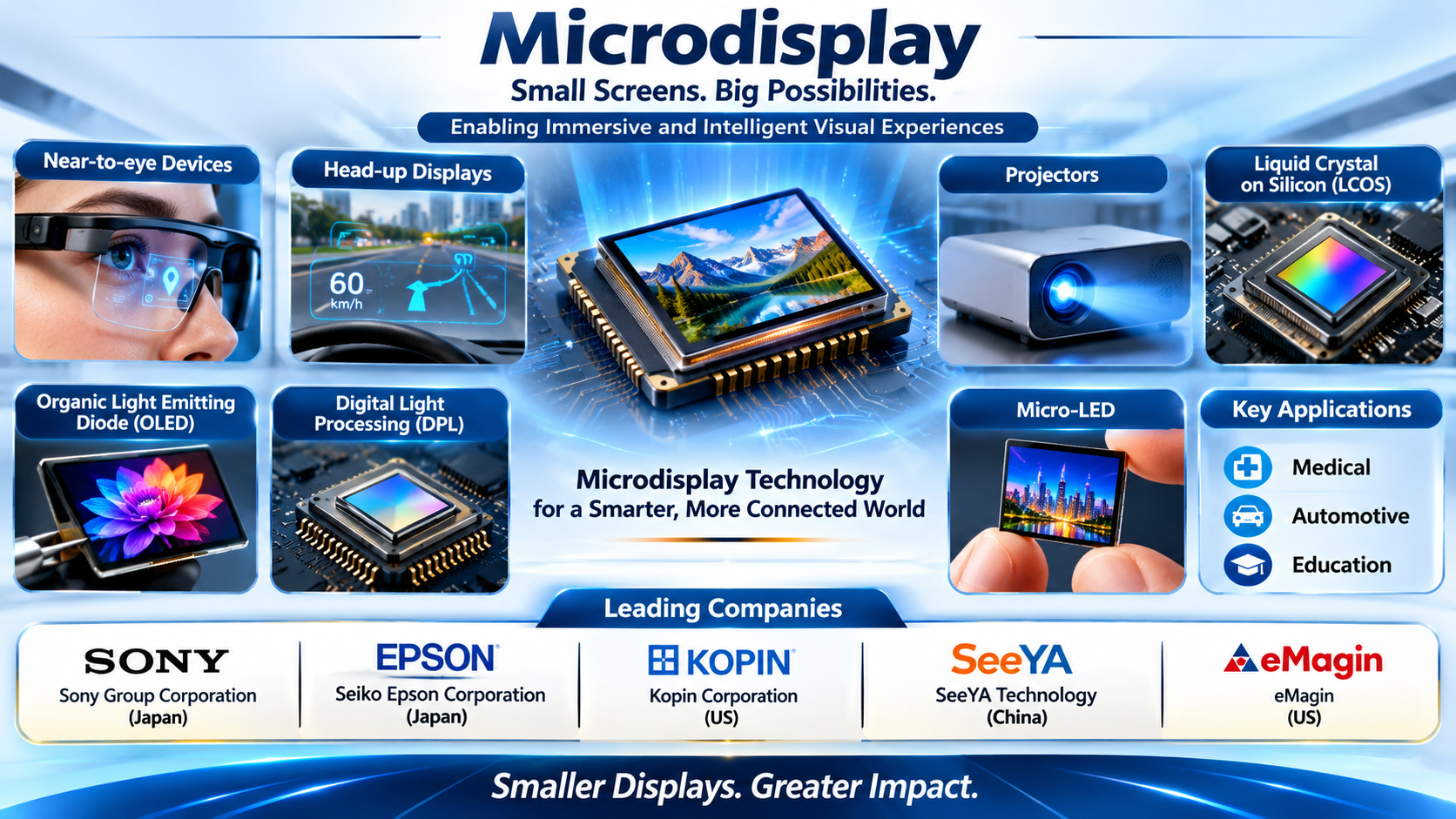
Key Optical Engine Technologies Shaping the Microdisplay Market
1. OLED Microdisplays: Enabling High-Resolution Visual Experiences
Organic Light Emitting Diode (OLED) microdisplays are gaining importance in compact display systems because of their self-emissive architecture. Unlike conventional LCD technologies, OLED pixels generate their own light, eliminating the need for a separate backlight.
OLED-on-Silicon (OLEDoS) integrates OLED technology with a silicon backplane, enabling high pixel density, compact dimensions, strong contrast, and accurate color reproduction.
These characteristics make OLED microdisplays suitable for VR headsets, electronic viewfinders, medical imaging equipment, and professional visualization systems.
However, brightness limitations can present challenges in optical systems designed for outdoor AR applications, particularly when light must pass through waveguides. Manufacturers are therefore focusing on improving OLED efficiency, brightness, and power consumption.
2. Micro-LED: Improving Brightness and Energy Efficiency
Micro-LED technology is emerging as a promising solution for next-generation optical engines. It uses microscopic light-emitting diodes to generate images with high brightness, strong contrast, and fast response times.
One of its major advantages is its potential to deliver high brightness while maintaining energy efficiency. This makes Micro-LED attractive for AR glasses, smart wearables, automotive displays, and advanced near-eye visualization systems.
The technology also offers opportunities for longer operating lifetimes and improved outdoor visibility.
However, manufacturing complexity, mass-transfer processes, color integration, and production costs remain important challenges. Continued innovation in fabrication and packaging could improve the commercial viability of Micro-LED optical engines.
MarketsandMarkets identifies Micro-LED as the fastest-growing technology segment in the microdisplay market during the forecast period.
3. Liquid Crystal on Silicon (LCoS): Supporting Compact Optical Architectures
Liquid Crystal on Silicon (LCoS) technology uses a reflective display architecture to modulate light and produce high-resolution images.
LCoS optical engines typically combine an illumination source, liquid crystal panel, polarizing components, and projection optics. This arrangement can deliver high pixel density and effective image quality in compact systems.
LCoS is particularly relevant for AR waveguide displays, pico-projectors, and specialized visualization applications.
Recent technology roadmaps are focusing on improving illumination efficiency, reducing projector volume, optimizing optical components, and integrating display modules into lightweight eyewear. These improvements could help LCoS remain competitive as Micro-LED technologies advance.
4. Digital Light Processing (DLP): Advancing Projection Systems
Digital Light Processing (DLP) technology uses Digital Micromirror Devices (DMDs), which contain microscopic mirrors that control light to generate images.
DLP-based optical engines are widely relevant to projection applications because of their brightness, fast image processing, and flexible optical design.
In microdisplay applications, DLP technology can support compact projectors, industrial visualization systems, automotive applications, and specialized imaging equipment.
Advancements in optical integration and illumination technologies could further improve the performance and compactness of DLP-based systems.
Five Technology Roadmap Developments That Could Transform Optical Engines
1. Ultra-Compact Optical Engine Integration
Miniaturization is becoming a major priority for manufacturers developing AR glasses and near-to-eye devices. Consumers increasingly expect wearable products to provide advanced visual capabilities without the bulk and weight associated with traditional headsets.
To address this requirement, manufacturers are working toward integrating display panels, illumination systems, optical lenses, and image-processing components into smaller modules.
Future optical engines could feature highly integrated architectures that reduce component count, simplify assembly, and improve device ergonomics.
2. Waveguide-Based Optical Systems
Waveguide technology is becoming increasingly important in AR optical engine development. Waveguides transport projected images through thin optical elements and direct them toward the user’s eyes.
This approach allows manufacturers to develop lightweight glasses that overlay digital information onto real-world environments.
Key development areas include:
- Improved light transmission efficiency.
- Wider field of view.
- Larger and more comfortable eyebox.
- Better color uniformity.
- Reduced optical distortion.
- Smaller and thinner optical modules.
3. AI-Powered Display Processing
Artificial intelligence is creating new opportunities for improving optical engine performance. AI-enabled image processing can support real-time image optimization, adaptive brightness, eye tracking, and improved visual rendering.
In AR and VR devices, intelligent processing can help adjust display output according to environmental lighting, viewing conditions, and user interactions.
AI can also support foveated rendering, where higher image detail is concentrated around the user’s point of focus. This can reduce unnecessary processing and potentially improve power efficiency.
As smart glasses and spatial computing devices become more sophisticated, AI-driven optical engine optimization could become an important competitive differentiator.
4. Advanced Illumination and Light Management
Efficient illumination is essential for optical engine performance, especially in compact wearable systems.
Manufacturers are exploring advanced RGB LED sources, laser-based illumination, and improved light-management components to enhance brightness and optical efficiency.
Better illumination systems can help reduce energy losses and improve the amount of usable light delivered to the viewer.
5. Advanced Optical Materials and Manufacturing
The future of optical engines will also depend on innovations in optical materials and manufacturing processes.
Advanced glass, polymers, nanostructured optical surfaces, and precision optical coatings can help improve light transmission, reduce distortion, and support compact optical designs.
Manufacturing improvements such as wafer-level optics, precision alignment, and automated optical inspection could also help increase production consistency and reduce manufacturing costs.
These developments will be important as manufacturers move from specialized optical modules toward higher-volume commercial production.
Challenges in Optical Engine Development
Despite significant technological progress, several challenges could influence the commercialization of advanced optical engines.
High Manufacturing Costs: Advanced microdisplay fabrication, optical alignment, and precision assembly require specialized manufacturing capabilities, increasing production costs.
Thermal Management: High-brightness display systems can generate heat, making thermal control important for compact wearable devices.
Power Efficiency: Maintaining high brightness and image quality while extending battery life remains a major challenge for AR and VR manufacturers.
Optical Performance: Improving field of view, eyebox, image uniformity, and light transmission requires continuous innovation in optical design.
Technology Integration: Combining microdisplay panels, waveguides, sensors, and processing components into compact modules requires close collaboration across the technology ecosystem.
Addressing these challenges will be essential for improving optical engine performance and supporting broader commercial adoption.
Future Outlook: Optical Engines as the Next Growth Frontier for Microdisplays
The future of microdisplay technology will increasingly depend on the development of advanced optical engines that combine compact display panels, efficient illumination systems, and sophisticated optical architectures.
Ultimately, optical engines could become a critical technology foundation for next-generation microdisplays. As manufacturers continue to improve brightness, resolution, power efficiency, and optical integration, these systems will help shape the future of smart glasses, immersive computing, automotive visualization, and advanced medical applications.
Frequently Asked Questions (FAQs) – Microdisplay Market
Q1. What are optical engines in microdisplay technology?
A. Optical engines are compact display systems that combine microdisplay panels, light sources, lenses, and optical components to deliver high-quality visual experiences in AR, VR, and other display applications.
Q2. How are optical engines shaping the future of the microdisplay market?
A. Optical engines are improving brightness, resolution, optical efficiency, and miniaturization, supporting the development of advanced smart glasses, head-up displays, and wearable devices.
Q3. Which technologies are driving innovation in the microdisplay market?
A. OLED, Micro-LED, Liquid Crystal on Silicon (LCoS), and Digital Light Processing (DLP) are key technologies driving microdisplay innovation.
Q4. Which applications are creating growth opportunities for microdisplay technology?
A. Near-to-eye devices, automotive head-up displays, medical imaging, projectors, and education are creating significant growth opportunities.
About MarketsandMarkets™
MarketsandMarkets™ has been recognized as one of America’s Best Management Consulting Firms by Forbes, as per their recent report.
MarketsandMarkets™ is a blue ocean alternative in growth consulting and program management, leveraging a man-machine offering to drive supernormal growth for progressive organizations in the B2B space. With the widest lens on emerging technologies, we are proficient in co-creating supernormal growth for clients across the globe.
Today, 80% of Fortune 2000 companies rely on MarketsandMarkets, and 90 of the top 100 companies in each sector trust us to accelerate their revenue growth. With a global clientele of over 13,000 organizations, we help businesses thrive in a disruptive ecosystem.
The B2B economy is witnessing the emergence of $25 trillion in new revenue streams that are replacing existing ones within this decade. We work with clients on growth programs, helping them monetize this $25 trillion opportunity through our service lines – TAM Expansion, Go-to-Market (GTM) Strategy to Execution, Market Share Gain, Account Enablement, and Thought Leadership Marketing.
Built on the ‘GIVE Growth’ principle, we collaborate with several Forbes Global 2000 B2B companies to keep them future-ready. Our insights and strategies are powered by industry experts, cutting-edge AI, and our Market Intelligence Cloud, KnowledgeStore™, which integrates research and provides ecosystem-wide visibility into revenue shifts.
To find out more, visit www.MarketsandMarkets™.com or follow us on Twitter , LinkedIn and Facebook .
Contact:
Mr. Rohan Salgarkar
MarketsandMarkets™ INC.
1615 South Congress Ave.
Suite 103, Delray Beach, FL 33445
USA: +1-888-600-6441
