The global thermoelectric cooler market is entering a strong growth phase as industries increasingly demand compact, precise, reliable, and refrigerant-free thermal management. The global thermoelectric cooler market is valued at approximately USD 835 million in 2025 and is projected to reach around USD 1.67 billion by 2032, expanding at a CAGR of roughly 10.3% between 2026 and 2032
Thermoelectric coolers, also known as Peltier coolers or thermoelectric modules, use the Peltier effect to move heat from one side of a device to another. Unlike conventional cooling systems, they have no compressor, refrigerant, or moving parts. This makes them particularly attractive for applications requiring precise temperature control, low vibration, compact form factors, and high reliability.
Solid-State Cooling Gains Momentum
The shift toward solid-state cooling is being supported by several structural trends across electronics and advanced technology industries. As electronic components become smaller and more powerful, heat densities are increasing while available space for conventional cooling systems is shrinking.
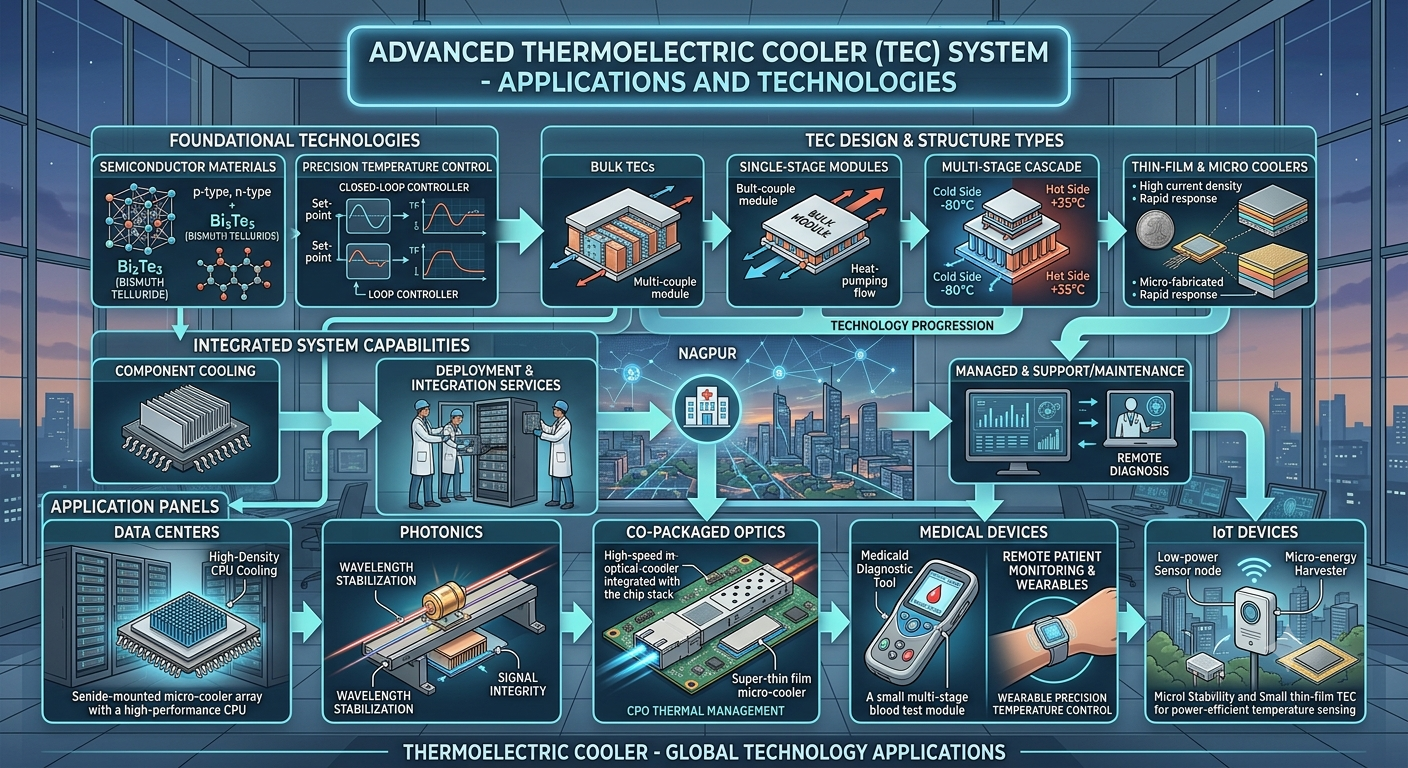
Thermoelectric coolers can deliver localized cooling directly at the component level. This capability makes them particularly suitable for photonics, semiconductor lasers, medical diagnostic equipment, telecommunications equipment, imaging sensors, and other precision applications.
Another advantage is their ability to operate without refrigerants. Increasing environmental and regulatory pressure surrounding refrigerants and hazardous substances is encouraging manufacturers to explore alternative cooling technologies. RoHS, REACH, and refrigerant phase-down initiatives are creating a favorable environment for refrigerant-free solid-state solutions.
AI and Data Centers Create a New Demand Opportunity
The expansion of artificial intelligence infrastructure is creating new requirements for thermal management. AI servers, networking equipment, optical components, and high-performance processors generate substantial heat within increasingly dense systems.
Co-packaged optics is emerging as a particularly important opportunity for thermoelectric cooling. As optical components move closer to high-power computing silicon, precise temperature control becomes increasingly important. Thermoelectric coolers can provide localized and deterministic cooling for lasers and photonic integrated circuits without introducing mechanical vibration.
This trend could significantly expand the role of thermoelectric technology in next-generation data center hardware, particularly as high-bandwidth optical interconnects become increasingly important for AI clusters.
Thin-Film and Micro Thermoelectric Coolers Reshape the Market
One of the most significant technology trends is the transition from conventional bulk modules toward thin-film and micro thermoelectric coolers.
Integrated photonics and miniaturized optical systems require cooling solutions that can fit into extremely small spaces while maintaining precise temperature control. Thin-film technologies can address these requirements through smaller footprints and application-specific designs.
This transition is creating opportunities for suppliers that can combine advanced materials, miniaturized architectures, improved packaging, and high-performance thermal control. As photonic components become more integrated, demand for small, high-precision thermoelectric solutions is expected to increase.
Download PDF Brochure @ https://www.marketsandmarkets.com/pdfdownloadNew.asp?id=132799659
Consumer Electronics Remains a Major Application Area
Consumer electronics represents the largest end-user industry for thermoelectric coolers, supported by demand for thermal management across increasingly compact and powerful electronic devices. Wearables, portable electronics, imaging systems, and other connected products require cooling technologies capable of operating within tight space constraints.
Thermoelectric coolers can also provide temperature stabilization for sensitive components, helping manufacturers maintain performance and reliability without adding bulky mechanical cooling systems.
Photonics and Semiconductor Lasers Drive Precision Cooling Demand
Photonics is one of the most important growth areas for thermoelectric cooling. Semiconductor lasers and optical components are highly sensitive to temperature changes. Variations in temperature can affect wavelength stability, efficiency, and overall device performance.
Thermoelectric coolers can maintain tightly controlled operating temperatures, making them valuable for optical communications, laser systems, LiDAR, imaging, and integrated photonics. The expansion of optical networks and high-speed communications is therefore creating additional demand for precision thermoelectric solutions.
Medical Devices Benefit From Refrigerant-Free Cooling
Medical and analytical equipment is another important application area. Thermoelectric cooling offers several characteristics that are valuable for medical devices, including quiet operation, low vibration, compact size, and precise temperature control.
These characteristics make the technology suitable for diagnostic instruments, analytical equipment, imaging systems, and portable medical devices. As healthcare equipment becomes more compact and decentralized, thermoelectric cooling could play a growing role in maintaining stable operating temperatures.
Asia Pacific Leads Global Market Growth
Asia Pacific is both the largest and fastest-growing regional market for thermoelectric coolers. MarketsandMarkets estimates that the region was valued at approximately USD 350.7 million in 2025 and is projected to reach roughly USD 751.4 million by 2032, representing a CAGR of approximately 11.5%.
China plays a central role because of its thermoelectric materials supply chain and large electronics manufacturing base. Japan and South Korea contribute through their semiconductor, electronics, and precision-instrument industries, while India is emerging as an important growth market as electronics manufacturing, medical-device production, and telecommunications infrastructure expand.
Single-Stage Modules Remain the Market Workhorse
Single-stage thermoelectric coolers continue to dominate the market by volume. Their broad availability, cost advantages, and suitability for a wide range of temperature-control applications make them the standard choice across many industries.
At the same time, multi-stage or cascade thermoelectric coolers are gaining momentum in applications requiring deeper cooling and more demanding temperature differentials. This creates a market structure in which established single-stage products maintain high volumes while specialized technologies generate higher-value opportunities.
Efficiency Remains a Key Challenge
Despite their advantages, thermoelectric coolers have limitations. Their coefficient of performance is generally lower than that of vapor-compression cooling systems, making them less suitable for applications requiring large-scale heat removal.
Consequently, the strongest opportunities are concentrated in precision, spot, and component-level cooling, rather than room-scale or bulk refrigeration.
Material costs are another challenge. High-performance thermoelectric modules depend on materials such as bismuth telluride, while the supply of elements such as tellurium can be geographically concentrated. Supply-chain resilience and material availability are therefore becoming increasingly important considerations for manufacturers.
Market Competition Moves Toward Integrated Solutions
The competitive landscape is evolving from standard component sales toward customized thermal-management solutions. Major companies identified by MarketsandMarkets include Ferrotec, Coherent, Laird Thermal Systems, Phononic, KELK, and Kryotherm.
Suppliers are increasingly combining thermoelectric modules with temperature controllers, sensors, thermal modeling, predictive management, and closed-loop control. This approach allows customers to integrate thermal management more effectively into complex electronic and optical systems.
The shift toward integrated solutions could also strengthen relationships between thermoelectric manufacturers and semiconductor, photonics, medical-device, and data-center equipment companies.
Outlook Through 2032
The thermoelectric cooler market is moving beyond traditional precision-temperature-control applications toward emerging opportunities in AI infrastructure, co-packaged optics, integrated photonics, medical devices, telecommunications, IoT, and advanced electronics.
The market’s projected growth from approximately USD 835 million in 2025 to USD 1.67 billion by 2032 reflects the increasing importance of localized thermal management in modern technology.
The long-term opportunity for solid-state cooling lies not in replacing every conventional refrigeration system, but in solving thermal challenges where compact size, precision, reliability, silent operation, and refrigerant-free design are more important than maximum cooling efficiency.
As electronics become denser, photonics becomes more integrated, and AI infrastructure drives new levels of computing and networking performance, thermoelectric cooling is positioned to become an increasingly strategic technology for next-generation thermal management.
Top 5 FAQs About the Thermoelectric Cooler Market
1. What is the projected size of the thermoelectric cooler market by 2032?
The global thermoelectric cooler market is projected to reach approximately USD 1.67 billion by 2032, up from about USD 835 million in 2025, growing at a CAGR of roughly 10.3% from 2026 to 2032.
2. What is driving growth in the thermoelectric cooler market?
Key growth drivers include the rising need for precision temperature control, miniaturized electronics, photonics, semiconductor lasers, co-packaged optics, AI data centers, medical devices, and refrigerant-free cooling. The growing density of electronic and optical components is creating greater demand for localized thermal management.
3. Which technology segment is expected to grow the fastest?
Thin-film and micro thermoelectric coolers are expected to be among the fastest-growing technology segments. Their compact form factors and precise cooling capabilities make them well suited for integrated photonics, silicon photonics, and co-packaged optics, where space is limited and heat density is high.
4. Which industries are creating new opportunities for thermoelectric coolers?
Major opportunities are emerging across telecommunications, data centers, photonics, medical devices, automotive, aerospace and defense, industrial instrumentation, and consumer electronics. In particular, co-packaged optics and AI-era data center hardware are emerging as important applications because they require precise, localized cooling of temperature-sensitive optical components.
5. Which region is expected to lead the thermoelectric cooler market?
Asia Pacific is both the largest and fastest-growing regional market. The region is projected to grow from approximately USD 350.7 million in 2025 to USD 751.4 million by 2032, at a CAGR of about 11.5%. China, Japan, South Korea, and India are key markets, supported by electronics manufacturing, semiconductor production, photonics, telecommunications, and medical-device development.
About MarketsandMarkets™
MarketsandMarkets™ has been recognized as one of America’s Best Management Consulting Firms by Forbes, as per their recent report.
MarketsandMarkets™ is a blue ocean alternative in growth consulting and program management, leveraging a man-machine offering to drive supernormal growth for progressive organizations in the B2B space. With the widest lens on emerging technologies, we are proficient in co-creating supernormal growth for clients across the globe.
Today, 80% of Fortune 2000 companies rely on MarketsandMarkets, and 90 of the top 100 companies in each sector trust us to accelerate their revenue growth. With a global clientele of over 13,000 organizations, we help businesses thrive in a disruptive ecosystem.
The B2B economy is witnessing the emergence of $25 trillion in new revenue streams that are replacing existing ones within this decade. We work with clients on growth programs, helping them monetize this $25 trillion opportunity through our service lines – TAM Expansion, Go-to-Market (GTM) Strategy to Execution, Market Share Gain, Account Enablement, and Thought Leadership Marketing.
Built on the ‘GIVE Growth’ principle, we collaborate with several Forbes Global 2000 B2B companies to keep them future-ready. Our insights and strategies are powered by industry experts, cutting-edge AI, and our Market Intelligence Cloud, KnowledgeStore™, which integrates research and provides ecosystem-wide visibility into revenue shifts.
To find out more, visit www.MarketsandMarkets™.com or follow us on Twitter , LinkedIn and Facebook .
Contact:
Mr. Rohan Salgarkar
MarketsandMarkets™ INC.
1615 South Congress Ave.
Suite 103, Delray Beach, FL 33445
USA: +1-888-600-6441
