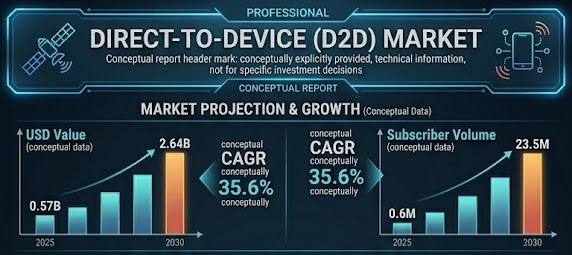
The global Direct-to-Device (D2D) Market is witnessing exponential growth as satellite-enabled communication becomes a viable alternative to traditional network infrastructure. The market is expected to reach USD 2.64 billion by 2030 from USD 0.57 billion in 2025, expanding at a CAGR of 35.6%. This growth is further supported by the rapid increase in D2D subscribers, highlighting strong market adoption.
As digital transformation accelerates across industries, the need for reliable and ubiquitous connectivity is becoming critical. The Direct-to-Device (D2D) Market is addressing this need by enabling seamless communication between devices and satellites, ensuring coverage even in the most challenging environments.
Understanding the Strategic Importance of the Direct-to-Device (D2D) Market
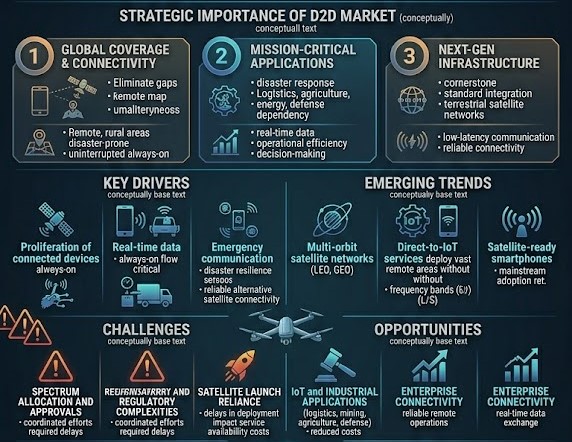
The Direct-to-Device (D2D) Industry plays a crucial role in bridging connectivity gaps that traditional networks cannot address. By enabling direct communication between devices and satellites, it provides a reliable solution for remote operations and emergency scenarios.
This technology is particularly valuable for industries operating in isolated or harsh environments, where continuous connectivity is essential. The Direct-to-Device (D2D) Market is therefore becoming a cornerstone of modern communication infrastructure.
Market Size, Forecast, and Growth Outlook of the Direct-to-Device (D2D) Market
The Direct-to-Device (D2D) Market is set to witness exponential growth over the forecast period, driven by advancements in satellite technology and increasing demand for global connectivity solutions. The market is projected to grow from USD 0.57 billion in 2025 to USD 2.64 billion by 2030, reflecting a CAGR of 35.6%.
North America currently leads the Direct-to-Device (D2D) Market, supported by the presence of key industry players and strong investments in satellite infrastructure. Meanwhile, Asia Pacific is emerging as the second fastest growing region, driven by rapid digital adoption, expanding mobile subscriber base, and increasing demand for IoT applications.
The deployment of low Earth orbit satellite constellations is a major factor contributing to market expansion. These systems offer lower latency, higher data speeds, and improved service quality, making them ideal for both consumer and enterprise applications in the Direct-to-Device (D2D) Market.
To Know About the Assumptions Considered for the Study Download the PDF Brochure: https://www.marketsandmarkets.com/pdfdownloadNew.asp?id=176759878
Key Drivers Accelerating the Direct-to-Device (D2D) Market
One of the primary drivers of the Direct-to-Device (D2D) Market is the growing demand for seamless global connectivity. As digital transformation accelerates across industries, the need for uninterrupted communication has become critical.
Another significant driver is the increasing demand for emergency communication and disaster resilience. In situations where terrestrial networks fail, D2D solutions provide a reliable alternative by enabling direct satellite connectivity. This capability is particularly valuable for emergency responders and disaster affected populations.
The proliferation of IoT devices is also fueling the growth of the Direct-to-Device (D2D) Market. Industries such as logistics, agriculture, and energy are increasingly relying on connected devices to monitor operations in real time. D2D technology enables these devices to function effectively even in remote locations.
Emerging Trends Transforming the Direct-to-Device (D2D) Market
The Direct-to-Device (D2D) Market is being reshaped by several key technological trends. One of the most significant is the integration of multi orbit satellite networks, which enhances coverage and reliability.
Another major trend is the growing adoption of direct-to-IoT services. These solutions are enabling enterprises to deploy connected devices across vast and remote areas without the need for additional infrastructure.
The evolution of satellite ready smartphones is also driving market growth. As devices become compatible with non terrestrial networks, the Direct-to-Device (D2D) Market is transitioning from niche applications to mainstream adoption.
Additionally, advancements in frequency bands such as L-band and S-band are improving signal reliability and performance, further supporting the expansion of the Direct-to-Device (D2D) Market.
Challenges Facing the Direct-to-Device (D2D) Market
Despite its strong growth potential, the Direct-to-Device (D2D) Market faces several challenges. One of the most significant is the complexity of spectrum allocation and regulatory approvals. Coordinating between satellite operators, telecom providers, and regulatory bodies adds layers of complexity to market expansion.
Another major challenge is the industry’s reliance on satellite launches. Delays in satellite deployment can impact service availability and slow market growth. The high costs associated with satellite manufacturing and launch also pose financial challenges for providers.
Ensuring interoperability between terrestrial and satellite networks is another critical issue. The Direct-to-Device (D2D) Market requires seamless integration to deliver consistent and reliable services across different environments.
Opportunities Unlocking Growth in the Direct-to-Device (D2D) Market
The Direct-to-Device (D2D) Market presents significant opportunities driven by the increasing adoption of IoT and industrial applications. Sectors such as logistics, mining, agriculture, and defense are leveraging D2D solutions to enhance operational efficiency and reduce costs.
The growing demand for enterprise connectivity is another key opportunity. Businesses are increasingly seeking reliable communication solutions that can support remote operations and real time data exchange.
Advancements in satellite technology and declining launch costs are also creating new growth avenues. These developments are enabling the deployment of large scale satellite constellations, expanding the reach and capabilities of the Direct-to-Device (D2D) Market.
Segment Analysis of the Direct-to-Device (D2D) Market
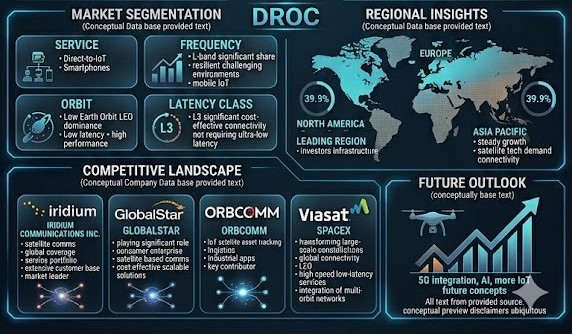
The Direct-to-Device (D2D) Market is segmented based on service type, frequency, customer type, orbit, and latency class.
Direct-to-IoT is expected to dominate the market due to its strong adoption in enterprise and industrial applications. These solutions enable real time monitoring and data collection across various sectors.
L-band frequencies hold a significant share in the Direct-to-Device (D2D) Market, offering reliable communication in challenging environments. Their resilience makes them ideal for mobile and IoT applications.
The enterprise network segment is projected to lead the market, driven by increasing demand for digital transformation and operational efficiency. Businesses are leveraging D2D solutions to enhance connectivity and improve productivity.
Low Earth orbit satellites dominate the market due to their low latency and high performance. These systems are essential for real time communication and data transmission.
The L3 latency class segment is also significant, providing cost effective connectivity for applications that do not require ultra low latency.
Regional Insights in the Direct-to-Device (D2D) Market
North America leads the Direct-to-Device (D2D) Market, supported by strong investments in satellite infrastructure and the presence of key industry players. The region’s focus on innovation and advanced communication technologies is driving market growth.
Asia Pacific is emerging as a key growth region, with increasing adoption of IoT applications and expanding mobile connectivity. The region’s large population and rapid digital transformation are contributing to the expansion of the Direct-to-Device (D2D) Market.
Europe is also witnessing steady growth, supported by advancements in satellite technology and increasing demand for connectivity solutions.
Competitive Landscape of the Direct-to-Device (D2D) Market
The Direct-to-Device (D2D) Market is highly competitive, with several key players driving innovation and market expansion.
Iridium Communications Inc.
Iridium Communications Inc. is a leading player in the Direct-to-Device (D2D) Market, offering advanced satellite communication services with global coverage. The company’s strong service portfolio and extensive customer base position it as a market leader.
Globalstar
Globalstar plays a significant role in the Direct-to-Device (D2D) Market, providing satellite based communication solutions for consumer and enterprise applications. Its focus on cost effective and scalable solutions enhances its market presence.
ORBCOMM
ORBCOMM specializes in IoT and satellite communication services, making it a key contributor to the Direct-to-Device (D2D) Market. The company’s solutions support asset tracking, logistics, and industrial applications.
Viasat
Viasat offers high capacity satellite communication services, supporting both consumer and enterprise connectivity needs. Its advanced technologies are driving innovation in the Direct-to-Device (D2D) Market.
SpaceX
SpaceX is transforming the Direct-to-Device (D2D) Market with its large scale satellite constellations and focus on global connectivity. The company’s investments in LEO satellites are enabling high speed, low latency communication services.
Future Outlook of the Direct-to-Device (D2D) Market
The Direct-to-Device (D2D) Market is poised for exponential growth as satellite technology continues to evolve and global connectivity demands increase. The integration of multi orbit networks and the expansion of satellite ready devices will further accelerate market adoption.
As D2D services transition from niche use cases to mainstream applications, the market will play a crucial role in bridging connectivity gaps and enabling digital transformation across industries.
Companies that invest in innovation, scalability, and regulatory compliance will be well positioned to lead the Direct-to-Device (D2D) Market in the coming years.
