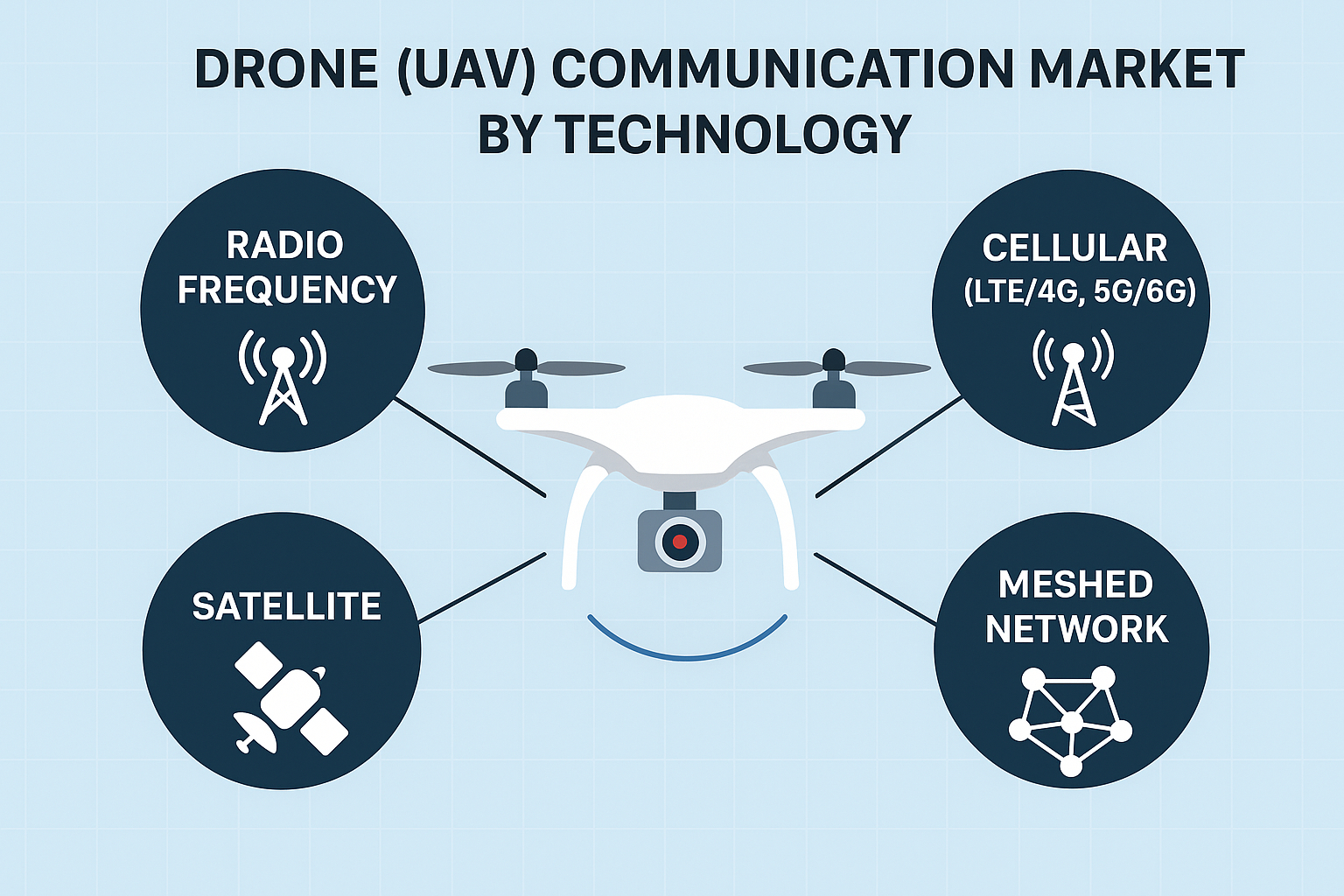
The drone communication market has rapidly evolved in the past decade as unmanned aerial vehicles have transitioned from experimental tools to essential assets across commercial, defense, and civil domains. At the heart of UAV operations lies communication technology, which ensures safe control, real time data transfer, mission success, and autonomy. Traditional methods of communication relied on simple radio frequency signals, but with the exponential rise in drone applications, the demand for advanced, secure, and high bandwidth communication solutions has surged. Technologies such as cellular connectivity through LTE and 5G, satellite communication, and meshed networking are revolutionizing how drones interact with control centers and each other. Artificial intelligence is also reshaping drone connectivity by enabling autonomous decision making and predictive bandwidth allocation. As industries ranging from defense to logistics and agriculture adopt drones for critical tasks, robust communication technology has become the backbone of market growth.
Radio Frequency Communication in UAVs
Radio frequency technology remains the most traditional and widely used communication mode for UAVs. It allows operators to maintain line of sight control and provides cost effective solutions for small scale drone operations. Common frequency bands such as 2.4 GHz and 5.8 GHz have supported consumer drones for years. RF communication is not without challenges. Its reliance on line of sight limits operational range, making it less effective for beyond visual line of sight (BVLOS) missions. Interference from other wireless devices also poses significant issues, particularly in urban environments where spectrum is crowded. The adaptability of software defined radios has improved the efficiency of RF communication. For defense applications, RF continues to dominate due to its simplicity and reliability in tactical environments. The affordability of RF modules ensures its continued adoption in recreational and commercial markets, though it faces increasing competition from advanced alternatives.
Cellular Communication Through LTE and 4G
The integration of LTE and 4G cellular technology into drone communication has significantly extended operational capabilities. By leveraging existing telecom infrastructure, UAVs can operate far beyond the line of sight, enabling real time video streaming, data collection, and cloud integration. LTE connected drones are particularly valuable in commercial sectors such as delivery, agriculture, and environmental monitoring. Companies conducting drone delivery pilots have relied on LTE connectivity to ensure reliable navigation through complex urban areas. The use of LTE also reduces infrastructure costs since operators do not need to build custom communication networks. Challenges remain in ensuring reliability in rural areas where cellular coverage is sparse. Security concerns have also emerged, with the risk of cyberattacks on cellular links. Despite these hurdles, the ability of LTE and 4G to scale quickly across consumer and enterprise drones has made it a key transitional technology before the widespread adoption of 5G.
Next Generation Cellular: 5G and 6G
The arrival of 5G technology has transformed the landscape of UAV communication. Unlike LTE, which offered incremental improvements, 5G introduces ultra low latency, higher bandwidth, and unprecedented reliability. These capabilities are critical for enabling drone swarms, autonomous navigation, and beyond visual line of sight missions. With 5G, UAVs can transmit real time high definition video feeds, coordinate fleet operations, and integrate with edge computing systems. This makes 5G essential for urban air mobility and smart city applications where drones need to share the airspace with manned aircraft. Several pilot projects worldwide have demonstrated the role of 5G in enabling autonomous delivery drones and surveillance operations. Looking further ahead, 6G is expected to provide even faster data rates and enhanced AI integration, unlocking potential for drone networks that operate almost entirely autonomously. Infrastructure readiness and cost remain major challenges for scaling 5G enabled drone ecosystems.
Satellite Communication for UAVs
Satellite communication has become increasingly important for extending UAV operations into remote or maritime environments where terrestrial infrastructure is unavailable. Low Earth Orbit constellations are particularly promising in offering lower latency and broader coverage. For defense and reconnaissance missions, satellite communication is indispensable, enabling drones to operate in contested regions without relying on vulnerable ground infrastructure. Humanitarian organizations also leverage satellite connected UAVs for disaster management, search and rescue, and emergency connectivity. Despite its advantages, satellite communication remains expensive compared to other methods and still suffers from latency issues, particularly with geostationary satellites. Partnerships between UAV manufacturers and satellite providers are reducing costs, making satcom more accessible for commercial and civil applications. As mega constellations like Starlink expand global coverage, the role of satellites in UAV communication is expected to grow significantly, particularly for long endurance missions.
Meshed Network Communication
Meshed networking represents a groundbreaking shift in UAV communication, particularly for swarm and fleet based operations. Unlike traditional point to point communication, meshed networks allow drones to communicate directly with one another in a peer to peer structure. This enables real time coordination, resilience against jamming, and adaptability in dynamic environments. Military applications have been at the forefront of meshed UAV networks, using them for tactical missions, surveillance, and combat scenarios where communication infrastructure may be compromised. In the civilian space, meshed networks are proving valuable for disaster relief, search and rescue, and environmental monitoring where rapid deployment of autonomous drone fleets is required. Artificial intelligence further enhances meshed networks by enabling dynamic routing and load balancing, ensuring efficient use of bandwidth. While scalability and power consumption remain challenges, the potential of meshed networking in creating autonomous drone ecosystems makes it a crucial area of research and development.
Artificial Intelligence in UAV Communication
Artificial intelligence is increasingly integrated into drone communication systems, enabling smarter and more autonomous operations. AI driven algorithms allow UAVs to predict communication bottlenecks, optimize bandwidth allocation, and seamlessly transition between networks such as RF, 5G, and satellite. Machine learning models also detect interference and cyber threats in real time, ensuring secure data transmission. In swarm operations, AI enables drones to coordinate autonomously, share information, and adapt to changing mission conditions. AI powered self healing networks enhance reliability by rerouting communication pathways when disruptions occur. Integration with traffic management systems further enables AI to manage UAV corridors, reducing congestion and latency. The synergy between AI and UAV communication is pivotal in realizing the vision of fully autonomous aerial systems. By reducing human dependency, AI not only enhances efficiency but also increases safety in both civilian and military applications.
Regional Market Insights
The UAV communication market shows varying adoption trends across regions. North America leads the market, driven by strong investments in defense UAVs, advanced telecommunications infrastructure, and regulatory support for drone integration into air traffic systems. Europe follows closely, with a focus on harmonized regulations and the deployment of 5G for urban drone operations. The Asia Pacific region is experiencing rapid growth, particularly in China, Japan, and India, where commercial drone applications in agriculture, logistics, and surveillance are expanding. The Middle East is investing heavily in defense UAVs and satellite infrastructure, while Latin America is leveraging UAVs for agriculture and environmental monitoring. In Africa, UAVs are increasingly used for humanitarian aid and connectivity in underserved regions. Each region faces unique regulatory, technological, and economic challenges, but the global trajectory points toward widespread adoption of advanced communication systems for drones.
Key Industry Players and Partnerships
The drone communication market is characterized by collaborations between UAV manufacturers, telecom operators, and satellite providers. Companies such as DJI, Parrot, and Skydio dominate the consumer and commercial drone markets, while defense contractors like Northrop Grumman and General Atomics lead in military UAVs. Telecom operators including Verizon, AT&T, and Huawei are partnering with drone companies to develop LTE and 5G enabled UAV solutions. Satellite providers such as Iridium, Inmarsat, and SpaceX’s Starlink are also expanding partnerships to support UAV connectivity. Startups focused on meshed networks and AI driven communication systems are adding new competition to the market. Public private collaborations are increasingly common, particularly in UAV traffic management systems. The competitive landscape is dynamic, with companies racing to integrate multiple communication technologies into hybrid solutions that balance cost, performance, and scalability.
Future Outlook of the UAV Communication Market
The future of UAV communication lies in hybrid models that combine RF, cellular, satellite, and meshed networks to create seamless and secure connectivity. As drones become more integral to commercial, defense, and civil operations, communication systems will need to handle greater data volumes, stricter security requirements, and real time coordination across multiple platforms. Urban air mobility, drone deliveries, and autonomous fleets will demand ultra reliable low latency communication supported by 5G and satellite integration. AI will continue to play a transformative role, automating traffic management and ensuring resilient networks. By 2035, UAV communication is expected to evolve into a global ecosystem that supports millions of drones operating simultaneously across diverse applications. This evolution will not only redefine industries but also reshape the very fabric of global communication networks.
