The Drone (UAV) Communication (Radio) Market is undergoing an unprecedented shift as unmanned aerial vehicles become central to both commercial and defense modernization efforts. With an estimated value of USD 2.46 billion in 2024, the market is projected to reach USD 3.67 billion by 2029, growing at a robust CAGR of 8.%. This growth is driven by advancements in communication technologies, expansion of UAV applications, emergence of beyond visual line of sight (BVLOS) operations, and integration of cutting edge connectivity systems that enable drones to operate smarter, safer, and more autonomously than ever before.
The Drone (UAV) Communication (Radio) Market is shaped by rapidly evolving technologies such as 5G networks, artificial intelligence, IoT based communication, encrypted RF links, and SATCOM based long range connectivity. As UAV deployment expands across defense surveillance, logistics, agriculture, inspection, emergency response, and smart city operations, the need for highly reliable, secure, and low latency communication systems is becoming critical.
Today, communication systems are the backbone of unmanned aerial operations. Whether it is radio frequency (RF) based command and control, high bandwidth data streaming, swarm communication, or satellite based telemetry, every operational layer of UAVs depends on efficient communication architecture. The Drone (UAV) Communication (Radio) Market is therefore experiencing rising demand across both mature and emerging sectors, as organizations focus on expanding UAV capabilities for real time intelligence, situational awareness, automation, and enhanced mission safety.
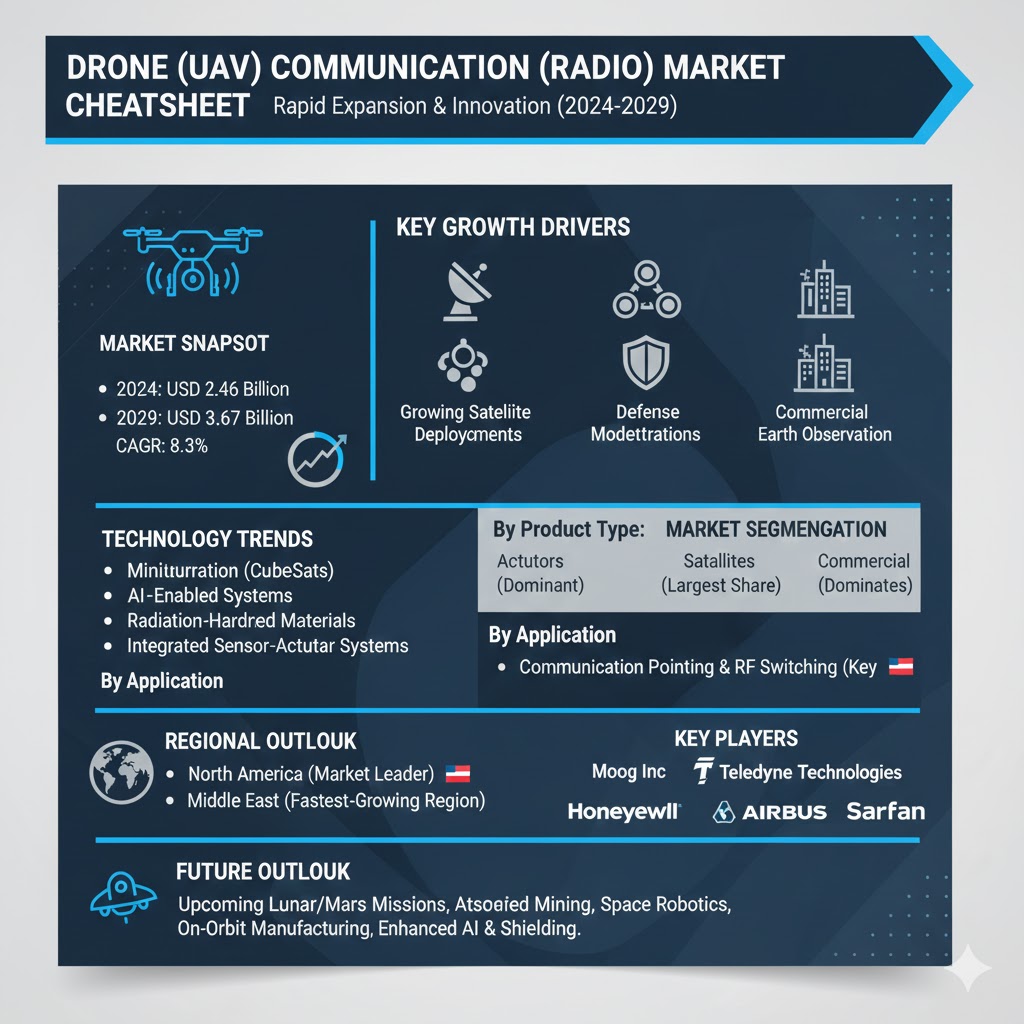
Market Overview and Growth Drivers
Increasing Adoption in Defense and Government Sectors
Defense agencies across the world are accelerating UAV adoption for intelligence, surveillance, reconnaissance, and combat operations. Modern defense systems require uninterrupted long range communication, secure data links, anti jamming technologies, and encrypted transmission. As defense missions become more network centric, the dependence on advanced communication radios intensifies. This substantially contributes to the growth of the Drone (UAV) Communication (Radio) Market.
Expansion of Commercial UAV Applications
Commercial UAV operations are witnessing strong growth in logistics, agriculture, mining, railways, construction, oil and gas, and public safety. With BVLOS operations becoming more common, drones require longer range, robust communication channels. Real time data transfer, cloud based mission management, and AI enabled analytics further elevate the role of communication systems. As a result, the commercial segment is projected to grow at the fastest pace from 2024 to 2029.
Surge in New Technologies such as IoD and BVLOS
The Internet of Drones (IoD) is an emerging communication architecture that integrates drones into IoT ecosystems, enabling seamless coordination, cloud connectivity, and large scale autonomous operations. BVLOS operations, which depend heavily on reliable communication systems, are enabling drones to cover long distances, making them vital for delivery services, pipeline inspections, agricultural surveys, and emergency response missions. These advancements are major growth catalysts in the Drone (UAV) Communication (Radio) Market.
5G and SATCOM Transforming UAV Connectivity
The integration of 5G networks offers ultra low latency, higher bandwidth, and network slicing, which makes it easier to allocate dedicated data channels to UAV operations. Meanwhile, satellite communication (SATCOM) unlocks global connectivity, especially in remote or maritime regions where cellular networks are unavailable. Together, these technologies are revolutionizing UAV operations, creating continuous demand within the Drone (UAV) Communication (Radio) Market.
To Know About the Assumptions Considered for the Study Download the PDF Brochure
Trends Shaping the Drone (UAV) Communication (Radio) Market
Adoption of AI Driven Network Management
Artificial intelligence is transforming communication systems by enabling autonomous decision making, predictive routing, and smart frequency allocation. AI enhanced data links allow drones to analyze network conditions, avoid interference, and optimize signal performance. This evolution is a major contributor to market expansion as UAVs shift toward greater autonomy.
High Demand for Secure Encrypted Communication
Cybersecurity vulnerabilities such as GPS spoofing, signal interference, and data extraction threaten mission integrity in UAV operations. As UAVs are increasingly used in critical sectors, demand for encrypted radios, anti jamming technologies, intrusion detection, and blockchain authentication is growing rapidly. These developments are reshaping the Drone (UAV) Communication (Radio) Market.
Emergence of Swarm Drone Communication
Swarm drones, operating in coordinated formations, require high speed communication networks capable of transmitting real time data across multiple nodes. Swarm coordination depends on decentralized communication, mesh networking, and AI based system synchronization. As defense, agriculture, and emergency response sectors adopt swarms, the need for advanced communication systems increases significantly.
Integration of UAVs into Air Traffic Management Systems
With UAV traffic rising, national aviation authorities are developing unmanned traffic management (UTM) systems. This requires drones to be able to communicate with centralized networks, exchange positional data, and navigate shared airspace safely. This emerging ecosystem fuels demand for standardized, interoperable radio systems.
Market Challenges
Cybersecurity Risks and Increasing Data Vulnerabilities
As UAV communication systems become more advanced, they also become more exposed to cyberattacks. Critical missions using UAVs for military intelligence or pipeline monitoring face threats from signal hijacking or data interception. While encryption and AI based anomaly detection solutions are improving, cybersecurity remains a persistent challenge for the Drone (UAV) Communication (Radio) Market.
Interoperability Issues Across Platforms
With multiple manufacturers and diverse UAV categories, communication standards vary widely. The lack of unified global standards for frequency allocation, data formats, or transmission protocols creates integration challenges, especially for multi fleet operations. Achieving standardization is essential for scalable, future ready drone ecosystems.
Market Segmentation of the Drone (UAV) Communication (Radio) Market
By Technology: Radio Frequency (RF) Dominates
Radio frequency communication remains the backbone of UAV operations. RF technology allows reliable, low latency data exchange in both line of sight and BVLOS missions. Tactical UAVs, long endurance drones, and commercial platforms rely heavily on multi band RF communication for telemetry, command control, payload data, and high speed video transmission. This dominance makes RF the strongest driver of demand in the market.
By Application: Military Leads Global Demand
The military sector contributes the largest share to the Drone (UAV) Communication (Radio) Market. Defense UAVs require secure, encrypted, anti jamming communication radios for reconnaissance, surveillance, and strike missions. Military operations occupy high security frequency bands, ensuring uninterrupted command and control capability across strategic missions. Rising defense budgets, geopolitical tensions, and border monitoring requirements ensure sustained military demand.
By Component: Transmitters and Receivers Lead the Market
Transmitters and receivers form the core of UAV communication architecture. As UAV operations expand across autonomous flights and data heavy missions, demand for advanced transmitters offering dynamic frequency switching, adaptive modulation, AI enabled signal optimization, and secure data exchange continues to grow. Their indispensable role positions this segment as the largest contributor to the market.
Market Dynamics and Customer Impact
Transformation of Defense Missions
UAV communication systems are reshaping the future battlefield. With secure, long range radios and SATCOM links, drones are now capable of real time coordination with ground forces, armored units, naval fleets, and command centers. The rapid adoption of multi domain operations greatly increases reliance on sophisticated communication systems.
Revolution in Commercial Delivery and Logistics
Companies across global logistics, e commerce, healthcare, and retail are deploying UAVs for faster deliveries. BVLOS capabilities and reliable communication systems allow drones to cover large distances and navigate difficult environments. Medical delivery drones operating in remote areas depend heavily on persistent connectivity to maintain safety and precision.
Enhanced Efficiency in Industrial Inspections
From oil and gas pipelines to power lines, UAVs equipped with high bandwidth communication systems transmit real time imagery and sensor data. Seamless communication reduces downtime, improves safety, and enhances data accuracy, transforming the inspection landscape.
Regional Analysis of the Drone (UAV) Communication (Radio) Market
North America: Leading Market Share
North America holds 41.6 percent of the Drone (UAV) Communication (Radio) Market in 2024. The region’s technological leadership, strong defense spending, and widespread commercial UAV adoption drive market growth. The presence of industry leaders such as RTX, Northrop Grumman, and L3Harris adds further strength to the regional ecosystem.
Asia Pacific: Fastest-Growing Region
Asia Pacific is projected to grow at the highest CAGR during the forecast period. Expanding investments in UAV technologies, rapid 5G rollout, and government led drone programs across China, Japan, South Korea, and India are key drivers. Demand for UAVs across agriculture, disaster management, smart cities, and border security further accelerates growth.
Key Players in the Drone (UAV) Communication (Radio) Market
DJI (US)
DJI is the world’s largest UAV manufacturer, dominating commercial drone markets. Its communication systems integrate advanced RF link technologies, ultra reliable transmission systems, and enhanced video data streaming. DJI’s innovations in hardware software integration make it a core player in the Drone (UAV) Communication (Radio) Market.
RTX (US)
RTX develops secure communication systems, military grade data links, and anti jamming radios for tactical UAVs. Its defense focused solutions ensure stable connectivity, encrypted command systems, and reliable performance under contested environments. RTX’s long standing leadership in aerospace communication positions it among the strongest players in the market.
Northrop Grumman (US)
Northrop Grumman is a major defense contractor specializing in autonomous systems, secure satellite communication, and ISR drone connectivity. Its UAV platforms use high performance radios and AI enabled communication modules, strengthening its presence within the Drone (UAV) Communication (Radio) Market.
Israel Aerospace Industries (Israel)
IAI manufactures military UAVs equipped with advanced RF, satellite, and sensor communication systems. Its expertise in defense platforms, secure communication architecture, and long range operations makes it a significant global competitor.
L3Harris Technologies (US)
L3Harris is a leader in tactical communication systems, providing SATCOM modules, encrypted radios, and secure data link solutions. Its high performance communication technologies support both military and commercial UAV missions.
Future Outlook of the Drone (UAV) Communication (Radio) Market
The Drone (UAV) Communication (Radio) Market is at a pivotal point where technological evolution meets operational necessity. In the coming decade, communication systems will become more autonomous, secure, and globally connected. Future UAV architectures will rely on multifunctional radios capable of seamless switching between RF, cellular, and satellite networks. Swarm systems will expand, AI based frequency allocation will become standard, and cyber resilient communication will be mandatory for all mission critical operations.
As the global airspace becomes increasingly populated with UAVs, communication systems will play the central role in ensuring safe, scalable, and reliable drone operations. Industry investments, regulatory progress, and technological breakthroughs will continue shaping an interconnected UAV ecosystem across commercial, defense, and industrial applications.
Related Report:
Drone (UAV) Communication Market by Technology (Radio Frequency, Cellular (LTE/4G, 5G/6G), Satellite, Meshed Network), Application (Military (ISR, Combat), Commercial), Component (Transmitter, Receiver, Antenna, Data Link) and Region – Global Forecast to 2029
