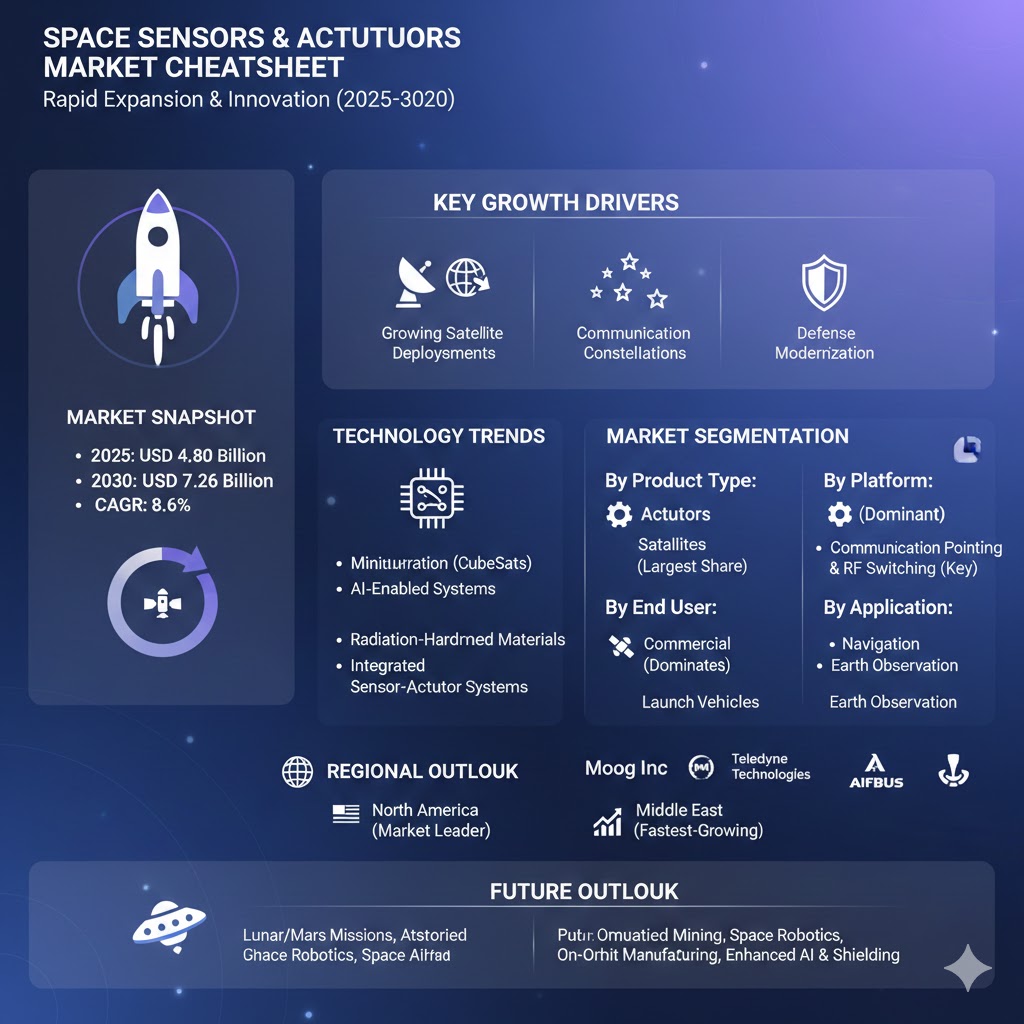
The Global Space Sensors and Actuators Market is entering a period of rapid technological expansion as satellite operators, space agencies, and private sector launch firms accelerate the pace of orbital deployments and deep space exploration. In 2025, the Space Sensors and Actuators Market is valued at USD 4.80 billion, and by 2030 it is projected to reach USD 7.26 billion at a robust CAGR of 8.6%. The surge in satellite launch volumes, rising appetite for commercial Earth observation, increasing deployment of communication constellations, and strategic investments in defense modernization are setting the foundation for sustained market expansion in the coming decade.
The heart of modern spacecraft operations relies on sophisticated sensor and actuator systems. Satellites and exploration platforms cannot function without precision sensing of temperature, pressure, position, radiation exposure, and orientation, nor can they maneuver or operate robotic components without reliable actuation. The increased reliability, miniaturization, and radiation tolerance of today’s components are enabling new mission profiles, including autonomous navigation, high frequency antenna steering, on orbit servicing missions, and long duration planetary operations.
As new governmental and private entities enter space, their spacecraft rely on increasingly efficient and accurate sensor and actuator subsystems to maintain stability, ensure regulatory compliance, optimize payload performance, and process real time data. This strong ecosystem momentum is fueling the long term growth of the Space Sensors and Actuators Market.
Market Dynamics of the Space Sensors and Actuators Market
Growing Satellite Deployments
The Space Sensors and Actuators Market is directly linked to the expanding global demand for satellite constellations. Large scale projects for Earth observation, communication, navigation, and defense are accelerating the requirement for precision hardware. Every satellite requires multiple sensors to monitor thermal conditions, detect radiation, support autonomous maneuvering, and maintain power distribution. Similarly, actuators are essential for propulsion alignment, robotic assembly, deployment of solar arrays, and directional antenna control.
Rise in Commercial Satellite Constellations
Commercial ventures are now driving the bulk of launches. SpaceX, OneWeb, Amazon Kuiper, Telesat, and a new wave of regional satellite operators have intensified the demand for high precision sensors and actuators. With rising investments in reusable launch vehicles, on orbit logistics, space based internet services, and optical communication networks, the commercial segment remains the largest consumer in the Space Sensors and Actuators Market.
Regulatory Pressures Slowing Innovation
Despite the market’s strong growth trajectory, regulatory and certification requirements remain a bottleneck. All spacecraft components must comply with stringent standards set by NASA, ESA, JAXA, ISRO, and national defense agencies. Hardware must withstand extreme radiation environments, thermal cycling, mechanical vibration, and prolonged exposure to vacuum. Qualification delays affect timelines and increase costs, especially for newer entrants.
Growing Deep-Space and Lunar Exploration Programs
The transition from Earth centric missions to lunar, Martian, and asteroid exploration is reshaping the Space Sensors and Actuators Market. Spacecraft venturing into deep space environments require highly durable, radiation resistant sensors and actuators capable of performing under severe temperature gradients. This shift is leading to long term contracts with major aerospace firms and stimulating innovation across the value chain.
Technology Obsolescence Risk
Sensor and actuator suppliers face the challenge of rapid technological advancement in the commercial sector. Space missions, which often span a decade or longer between design and launch, risk deploying components that may become technologically obsolete by mission completion. As sensors and actuators undergo multi year qualification processes, fast evolving commercial technologies sometimes surpass onboard systems before spacecraft ever reach orbit.
To Know About the Assumptions Considered for the Study Download the PDF Brochure
Market Trends Transforming the Space Sensors and Actuators Market
Miniaturization for CubeSats and Small Satellites
The global shift toward miniaturized satellites is compelling manufacturers to produce compact, low power, radiation hardened sensors and actuators. Small satellites account for the majority of new space systems, especially in low Earth orbit (LEO). These missions require smaller, lightweight precision hardware that can perform complex tasks while adhering to strict power constraints.
AI-Enabled Sensor and Actuator Systems
Artificial intelligence is progressively being integrated into satellite subsystems. AI powered sensors enhance autonomous navigation, attitude control, environmental monitoring, and adaptive system calibration. Actuators enhanced with predictive algorithms can perform smoother motion control, faster antenna adjustments, and more efficient robot assisted servicing.
Radiation-Hardened Materials Driving Longevity
To meet the demands of multi year missions, manufacturers are focusing on radiation hardened materials, shielding technologies, and error tolerant electronics. These enhancements directly contribute to extending the operational lifespan of spacecraft, reducing maintenance costs, and increasing mission reliability.
Integration of Sensor-Actuator Systems
Modern spacecraft demand integrated sensor actuator subsystems that reduce overall weight and power consumption. This level of integration improves response times, supports high frequency communication operations, enables larger payload flexibility, and enhances overall spacecraft performance.
Market Segmentation of the Space Sensors and Actuators Market
By Product Type: Actuators Lead the Market
Actuators remain the dominant segment in the Space Sensors and Actuators Market. They are fundamental for propulsion management, surface deployment, robotic mechanisms, antenna orientation, and structural adjustments. Electromechanical actuators, in particular, are seeing strong demand due to their superior precision, reduced weight, and reliability under harsh space conditions.
By Platform: Satellites Hold the Largest Share
The satellite platform category is the largest contributor to the Space Sensors and Actuators Market. Low Earth orbit and geostationary satellite deployments continue to expand as nations and private enterprises invest heavily in broadband, imaging, and global connectivity missions. Satellite operators rely on miniaturized, high efficiency sensing and actuation technologies to optimize energy use, stabilize orbital position, and extend spacecraft life.
By End User: Commercial Segment Dominates
The commercial sector holds significant market share due to the proliferation of privately funded missions. Companies developing Earth observation satellites, broadband communication services, and data analytics platforms are driving the commercial demand for sensors and actuators. Collaborations between commercial operators and space agencies ensure steady access to advanced components.
By Application: Communication Pointing and RF Switching Dominate
Communication satellites require precise antenna control and high frequency RF switching capabilities to ensure stable, high bandwidth data transmission. Advanced sensing and actuation systems enhance the accuracy of beam steering, optimize signal clarity, and maintain consistent communication across multi orbit architectures.
Regional Insights of the Space Sensors and Actuators Market
North America: Market Leader
North America remains the dominant region in the Space Sensors and Actuators Market due to its mature aerospace ecosystem and institutional support from NASA, the U.S. Space Force, and leading defense contractors. The presence of major space manufacturers contributes to strong regional demand and continued innovation.
Middle East: Fastest-Growing Region
The Middle East is projected to exhibit the highest growth rate during the forecast period. National space programs in the UAE and Saudi Arabia are driving the development of indigenous satellite manufacturing, deep space missions, and interplanetary research initiatives. Large investments in both civil and defense space projects are stimulating the regional market.
Key Players in the Space Sensors and Actuators Market
The Space Sensors and Actuators Market is shaped by major international aerospace and defense companies with strong technological capabilities.
Moog Inc.: Moog is a leading supplier of precision actuators, control systems, and integrated subsystems for satellites and exploration vehicles. Its electromechanical actuators are widely used in propulsion management, robotic assemblies, and deployment mechanisms. Moog’s long standing expertise and global manufacturing presence make it a dominant player.
Teledyne Technologies Incorporated: Teledyne designs radiation hardened imaging sensors, multispectral detectors, and advanced actuator systems used in communication and Earth observation missions. Its products are known for durability, long operational life, and advanced calibration accuracy.
Honeywell International Inc.: Honeywell provides inertial measurement units, gyroscopes, and other navigation sensors essential for satellite stability. Its decades of experience in avionics and aerospace materials make it a core contributor to reliable spacecraft systems.
Airbus: Airbus is heavily invested in satellite manufacturing and integrated subsystem development. The company’s sensors and actuators support defense satellites, commercial constellations, and deep space missions. Its engineering teams continue to push innovation for high performance spacecraft components.
Safran: Safran develops advanced inertial sensors and precision control actuators used for satellite stabilization and mission navigation. The company is known for producing high accuracy systems that withstand long duration missions in harsh space environments.
Future Outlook of the Space Sensors and Actuators Market
The future of the Space Sensors and Actuators Market is strongly aligned with the expansion of the global space economy. Upcoming lunar surface missions, Mars exploration initiatives, asteroid mining concepts, on orbit manufacturing, space robotics, optical communication systems, and space tourism ventures will continue to create demand for increasingly advanced sensors and actuators.
The next generation of components will feature embedded AI, lower power consumption, enhanced radiation shielding, autonomous diagnostics, and extended calibration stability. As national space agencies and private players rapidly develop their launch capabilities, the demand for these critical subsystems is expected to accelerate even further.
Related Report:
Space Sensors and Actuators Market by Product Type (Sensors, Actuators), Platform (Satellites, Capsules/Cargo, Interplanetary Spacecraft and Probes, Launch Vehicles), Application, End User, Region- Global Forecast to 2030

