In today’s digital economy, data centers have become the backbone of cloud computing, artificial intelligence (AI), enterprise applications, and mission-critical services. As businesses increasingly rely on digital infrastructure, the demand for high-performing, secure, and energy-efficient data centers has never been greater. This shift is fueling the rapid growth of the Data Center Certification Market, where certifications serve as benchmarks for operational excellence, infrastructure reliability, and environmental sustainability.
Data center certifications not only validate compliance with global standards but also provide customers, investors, and regulators with confidence that facilities meet stringent requirements for uptime, resilience, security, and energy efficiency. As hyperscale deployments, edge computing, and AI-driven workloads continue to expand, certification is becoming a strategic differentiator rather than just a compliance requirement.
Why Data Center Certification Matters
Modern enterprises cannot afford service disruptions, inefficient operations, or excessive energy consumption. Certification frameworks help data center operators establish standardized processes that improve operational performance while minimizing risks.
Certified facilities benefit from:
- Higher infrastructure reliability and availability
- Improved operational efficiency
- Better energy management
- Enhanced customer trust
- Regulatory compliance
- Reduced operational costs
- Stronger business continuity capabilities
As organizations migrate critical workloads to cloud environments and digital services become increasingly essential, certified infrastructure is emerging as a key competitive advantage.
Market Segmentation
By Certification Type
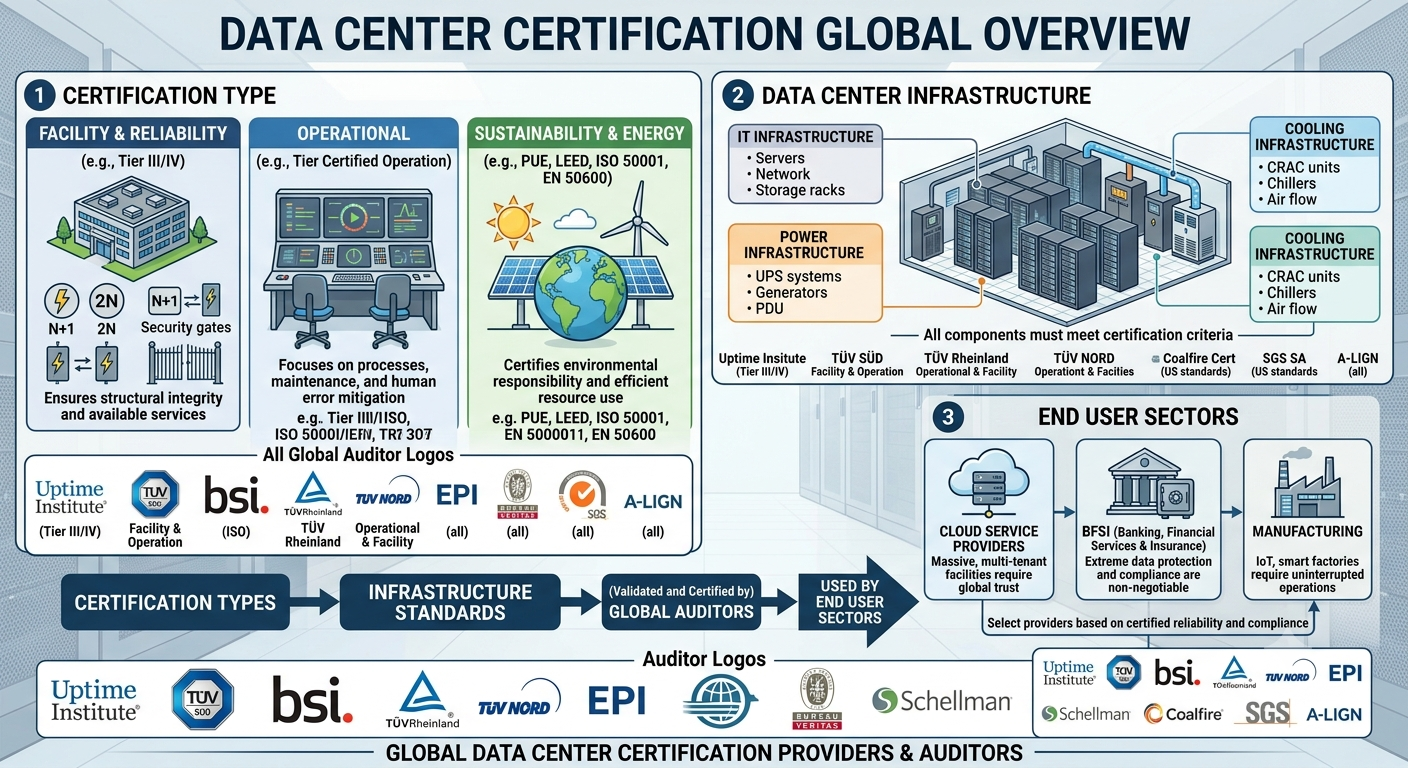
Facility & Reliability Certification
This category evaluates the physical infrastructure, redundancy levels, fault tolerance, and availability of data centers. It ensures facilities are capable of delivering uninterrupted services under demanding operational conditions.
Operational Certification
Operational certifications focus on maintenance procedures, operational best practices, risk management, staffing, and continuous improvement processes that enhance long-term performance.
Sustainability & Energy Certification
With sustainability becoming a corporate priority, certifications emphasizing energy efficiency, carbon reduction, renewable energy integration, and environmental performance are gaining significant importance.
By Infrastructure
IT Infrastructure
Certification covers servers, storage systems, networking equipment, virtualization technologies, and security systems to ensure optimal performance and resilience.
Power Infrastructure
Reliable power distribution, backup generators, UPS systems, and electrical redundancy remain fundamental components evaluated during certification.
Cooling Infrastructure
Advanced cooling technologies are increasingly critical as AI and high-performance computing generate higher rack densities and thermal loads.
By End User
Cloud Service Providers
Cloud providers continue investing in certified hyperscale facilities to deliver reliable and scalable services while meeting customer expectations for availability and security.
BFSI
Banks and financial institutions require certified data centers to support mission-critical operations, regulatory compliance, cybersecurity, and disaster recovery initiatives.
Manufacturing
Manufacturers increasingly deploy certified data centers to support Industry 4.0, industrial IoT, predictive maintenance, and real-time production analytics.
Download PDF Brochure @ https://www.marketsandmarkets.com/pdfdownloadNew.asp?id=37943401
Key Market Drivers
Growing Cloud Adoption
Cloud computing continues to reshape enterprise IT strategies, increasing demand for reliable and certified digital infrastructure capable of supporting business-critical workloads.
Expansion of AI and High-Performance Computing
Artificial intelligence applications require enormous computing capacity and continuous availability, driving investments in resilient, energy-efficient certified facilities.
Increasing Focus on Sustainability
Governments, investors, and customers expect organizations to reduce carbon emissions and improve energy efficiency. Certifications help operators demonstrate measurable progress toward sustainability goals.
Regulatory Compliance
Industries including healthcare, finance, telecommunications, and government face increasingly stringent regulatory requirements regarding data security, operational resilience, and environmental responsibility.
Rising Demand for Business Continuity
Organizations seek certified facilities capable of minimizing downtime and ensuring uninterrupted operations during unexpected failures or disasters.
Emerging Industry Trends
AI-Powered Data Center Operations
Artificial intelligence is transforming facility management through predictive maintenance, intelligent workload optimization, automated cooling, and energy forecasting.
Sustainability Becoming a Competitive Advantage
Green certifications are increasingly influencing investment decisions, customer preferences, and corporate ESG initiatives. Operators are adopting renewable energy, advanced cooling systems, and carbon-neutral strategies.
Edge Data Centers Expanding
The rapid growth of edge computing is driving certification demand for smaller distributed facilities supporting low-latency applications, autonomous systems, and IoT deployments.
Advanced Cooling Technologies
Liquid cooling, immersion cooling, and AI-optimized thermal management are becoming increasingly important for supporting high-density computing environments.
Automation and Digital Twins
Digital twin technologies enable operators to simulate infrastructure performance, optimize maintenance schedules, and improve operational efficiency before implementing physical changes.
Opportunities Across the Value Chain
The market presents significant opportunities for:
- Certification providers
- Data center consultants
- Infrastructure equipment manufacturers
- Engineering and construction firms
- Energy management solution providers
- AI-based monitoring software vendors
- Sustainability consulting organizations
As digital infrastructure investments continue to accelerate globally, demand for certification services is expected to expand across hyperscale, colocation, enterprise, and edge data center segments.
Future Outlook
The future of the Data Center Certification Market will be shaped by the convergence of AI, cloud computing, edge infrastructure, sustainability, and digital transformation. Organizations increasingly recognize that certification is no longer simply a compliance exercise—it is a strategic investment that enhances operational resilience, reduces costs, strengthens customer confidence, and supports long-term business growth.
With enterprises demanding higher availability, improved energy efficiency, and greater environmental responsibility, certified data centers will continue to play a pivotal role in enabling secure, reliable, and sustainable digital ecosystems.
As global data consumption continues to rise and digital services become increasingly mission-critical, the importance of certified data center infrastructure will only grow. Certifications provide a structured framework for achieving reliability, operational excellence, and sustainability while helping organizations navigate evolving technological and regulatory landscapes.
For operators, investors, and enterprise customers alike, data center certification represents more than a quality benchmark—it is a foundation for building resilient digital infrastructure capable of supporting the next generation of cloud computing, AI, and connected technologies.
FAQ
1. What is the projected size of the Data Center Certification Market by 2032?
The global Data Center Certification Market is projected to grow from USD 1.16 billion in 2026 to USD 3.05 billion by 2032, registering a CAGR of 17.4% during the forecast period. This growth is driven by increasing investments in hyperscale and colocation data centers, AI infrastructure, and cloud computing.
2. What factors are driving the growth of the Data Center Certification Market?
Key growth drivers include expanding hyperscale and colocation facilities, rising AI and cloud infrastructure deployments, increasing demand for reliable digital infrastructure, stricter regulatory compliance, growing emphasis on sustainability, and the need for operational resilience and continuous certification.
3. Which certification type is expected to lead the Data Center Certification Market?
The Facility & Reliability Certification segment is expected to hold the largest market share by 2032. Organizations are increasingly prioritizing infrastructure availability, fault tolerance, and operational resilience to ensure uninterrupted digital services and business continuity.
4. Which end-user segment is expected to grow the fastest?
Cloud Service Providers are projected to register the highest growth during the forecast period, driven by rapid expansion of hyperscale cloud infrastructure, increasing AI workloads, and rising demand for certifications related to operational performance, cybersecurity, and sustainability.
5. Which region is expected to dominate the Data Center Certification Market?
North America is expected to account for the largest market share due to its mature digital infrastructure, strong presence of hyperscale cloud providers, and widespread adoption of certification standards. Meanwhile, Asia Pacific is forecast to experience the fastest growth, supported by expanding data center investments, digital transformation initiatives, and increasing cloud adoption across countries such as China, India, Japan, and Singapore.
About MarketsandMarkets™
MarketsandMarkets™ provides quantified B2B research on 30,000 high growth niche opportunities/threats which will impact 70% to 80% of worldwide companies’ revenues. Currently servicing 7500 customers worldwide including 80% of global Fortune 1000 companies as clients. Almost 75,000 top officers across eight industries worldwide approach MarketsandMarkets™ for their painpoints around revenues decisions.
Our 850 fulltime analyst and SMEs at MarketsandMarkets™ are tracking global high growth markets following the “Growth Engagement Model – GEM”. The GEM aims at proactive collaboration with the clients to identify new opportunities, identify most important customers, write “Attack, avoid and defend” strategies, identify sources of incremental revenues for both the company and its competitors. MarketsandMarkets™ now coming up with 1,500 MicroQuadrants (Positioning top players across leaders, emerging companies, innovators, strategic players) annually in high growth emerging segments. MarketsandMarkets™ is determined to benefit more than 10,000 companies this year for their revenue planning and help them take their innovations/disruptions early to the market by providing them research ahead of the curve.
MarketsandMarkets’s flagship competitive intelligence and market research platform, “Knowledgestore” connects over 200,000 markets and entire value chains for deeper understanding of the unmet insights along with market sizing and forecasts of niche markets.
Contact:
Mr. Rohan Salgarkar
MarketsandMarkets™ INC.
630 Dundee Road
Suite 430
Northbrook, IL 60062
USA : 1-888-600-6441
