Quantum computing is emerging as a transformative technology with the potential to solve complex computational problems that remain difficult for conventional computing systems. By using quantum-mechanical principles such as superposition and entanglement, quantum computers can process certain types of problems in fundamentally different ways from classical computers. This capability is attracting investment from technology companies, governments, research institutions, and enterprises seeking new approaches to optimization, simulation, cybersecurity, and advanced analytics.
The Quantum Computing Market Analysis highlights how technological innovation, cloud-based access, growing research investments, and expanding industrial applications are shaping the industry’s development. As organizations explore quantum computing for practical business use cases, advancements in quantum processors, algorithms, error correction, and software platforms are becoming increasingly important.
Quantum Computing Market Analysis: Market Size and Growth Drivers
The quantum computing market is moving from research-focused experimentation toward broader commercial exploration. Although practical applications remain limited by hardware complexity and error rates, organizations are increasingly testing quantum systems to determine where they may offer advantages over conventional computing approaches.
Several factors are supporting this market expansion.
Increasing Investments in Quantum Technology
Government funding and private-sector investments are accelerating quantum research, processor development, and commercialization. Technology companies are investing in quantum hardware, cloud platforms, software development tools, and partnerships with academic institutions.
Public research programs also support the development of specialized talent, infrastructure, and domestic quantum technology capabilities. These investments help strengthen the broader ecosystem, from hardware manufacturing to algorithm development and enterprise applications.
As funding increases, companies are working to improve qubit stability, expand processing capabilities, and develop systems that can address more complex computational challenges.
Growing Demand for Advanced Computing
Traditional computing systems remain essential for most enterprise workloads. However, certain optimization, simulation, and mathematical problems can require substantial computational resources as their complexity increases.
Quantum computing offers alternative methods for approaching selected problems in financial modeling, molecular simulation, materials research, and logistics planning. Businesses are evaluating these capabilities to identify potential improvements in research efficiency, resource allocation, and decision-making.
The opportunity is not to replace all classical computers. Instead, quantum systems are expected to complement conventional high-performance computing and artificial intelligence infrastructure for suitable workloads.
Increasing Adoption in Banking and Financial Services
Banking, financial services, and insurance (BFSI) represent an important application area for quantum computing. Financial institutions manage complex portfolios, assess market risks, detect fraud, and evaluate numerous variables when developing investment strategies.
Quantum computing is being explored for portfolio optimization, risk modeling, asset pricing, trading strategies, and selected cybersecurity applications. Financial institutions are also investigating quantum algorithms that could improve specific optimization processes.
However, practical benefits depend on hardware capabilities, algorithm maturity, and the ability to demonstrate measurable improvements against established classical methods.
Download PDF Brochure @ https://www.marketsandmarkets.com/pdfdownloadNew.asp?id=144888301
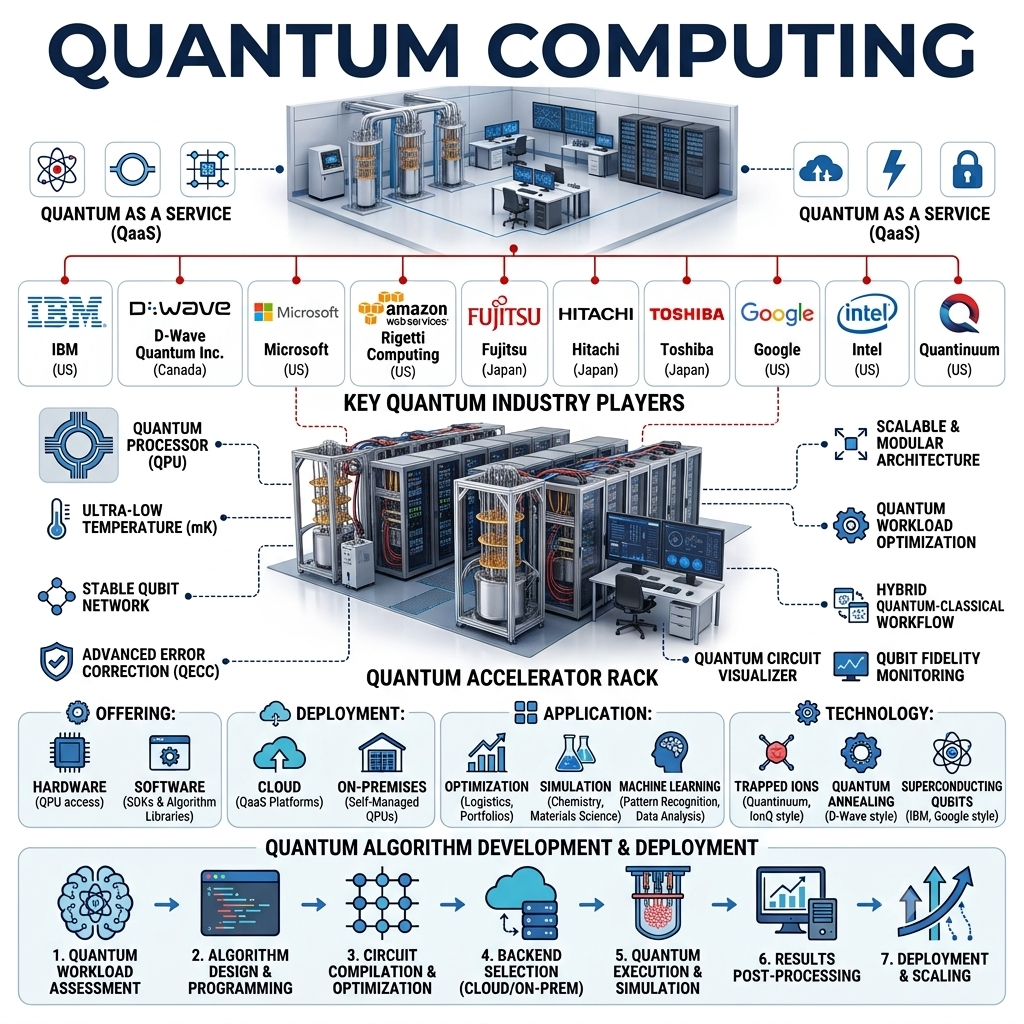
Technology Advancements Transforming the Quantum Computing Market
Technology innovation is central to the Quantum Computing Market Analysis because improvements in hardware, software, and system architecture influence both commercial readiness and long-term growth.
Superconducting Qubits
Superconducting qubits are among the leading quantum computing technologies. They use superconducting electrical circuits to create and manipulate quantum states, typically operating at extremely low temperatures.
This technology supports fast gate operations and benefits from established expertise in semiconductor fabrication, microwave engineering, and cryogenic systems. Major technology companies are investing in superconducting processors to improve qubit performance, connectivity, and scalability.
Despite these advantages, superconducting systems require sophisticated cooling infrastructure and careful control of environmental noise. Improving coherence times, reducing operational errors, and scaling processor architectures remain important development priorities.
Trapped-Ion Technology
Trapped-ion quantum computers use electrically charged atoms held in electromagnetic fields as qubits. Lasers and other control systems manipulate their quantum states to perform computations.
Trapped-ion systems are attractive because of their potential for high-fidelity operations and strong qubit coherence. Researchers are working to improve gate speeds, system connectivity, and the ability to control larger numbers of ions.
Commercial development in this area is focused on making trapped-ion systems more scalable and practical for cloud access and specialized workloads.
Quantum Annealing
Quantum annealing is designed primarily to address optimization problems. It seeks low-energy solutions to mathematical models representing complex combinations of constraints and variables.
Potential applications include scheduling, logistics, supply chain planning, resource allocation, and portfolio optimization. Quantum annealing systems can be useful for investigating certain optimization workloads, although performance varies according to the problem and the comparison method.
As enterprises seek more efficient planning and decision-making tools, quantum annealing continues to contribute to the broader quantum computing ecosystem.
Photonic Quantum Computing
Photonic quantum computing uses particles of light to represent and manipulate quantum information. Researchers are exploring this approach because photons can travel through optical systems and may support networking and integration with photonic technologies.
The approach offers opportunities for developing alternative quantum architectures, although practical systems must address challenges involving photon generation, detection, loss, and reliable operations.
Progress in photonic components and quantum communication could help diversify the technological approaches available to quantum computing providers.
Quantum Error Correction and Fault Tolerance
Qubits are highly sensitive to environmental disturbances, which can introduce errors and disrupt calculations. Quantum error correction techniques aim to identify and correct these errors while preserving the information required for computation.
Developing fault-tolerant systems is a major priority for the industry. This requires advances in physical qubits, logical qubits, control electronics, system architecture, and error-correction algorithms.
Quantum Computing as a Service and Cloud Deployment
Cloud platforms are expanding access to quantum hardware and software. Rather than purchasing and maintaining specialized quantum systems, organizations can use remote platforms to experiment with quantum processors, simulators, development environments, and algorithms.
Quantum Computing as a Service
Quantum Computing as a Service (QCaaS) enables enterprises, universities, and developers to access quantum resources through cloud-based platforms. This model reduces the need for substantial upfront investments in hardware, cooling systems, and specialized facilities.
QCaaS providers can offer access to different processor architectures, allowing users to test algorithms and compare approaches without maintaining their own quantum infrastructure.
The service model also supports collaboration between technology providers, researchers, and industry users. As cloud platforms develop, improvements in programming tools, workflow integration, and user support may encourage wider experimentation.
Hybrid Quantum-Classical Computing
Hybrid computing combines quantum processors with classical computing resources. Classical systems handle conventional processing tasks, data preparation, and workflow management, while quantum processors are used for selected operations.
This model is important because current quantum computers cannot efficiently replace classical infrastructure across most applications. Hybrid architectures allow developers to test how quantum processing may contribute to specific stages of a larger computational workflow.
Over time, better integration between quantum processors, classical high-performance computing, cloud infrastructure, and AI development environments could support more practical enterprise experimentation.
Optimization
Optimization involves finding effective solutions among many possible combinations of variables and constraints. Quantum computing is being investigated for problems involving logistics, supply chain management, scheduling, transportation, and financial portfolios.
For example, a logistics company may need to determine delivery routes while balancing fuel costs, time constraints, vehicle capacity, and customer demand. Quantum approaches could help explore certain complex optimization formulations, although performance advantages must be validated for each use case.
Simulation and Materials Discovery
Quantum systems may be particularly relevant to modeling molecular and chemical behavior because quantum mechanics governs the interactions being simulated.
In pharmaceuticals, quantum computing is being explored for molecular modeling and drug discovery research. In chemicals and materials science, potential applications include investigating reaction pathways, catalysts, batteries, and advanced materials.
These applications could help researchers evaluate promising candidates and understand complex interactions. Nevertheless, widespread practical benefits depend on improvements in quantum hardware, error correction, and computational reliability.
Machine Learning and Artificial Intelligence
Researchers are investigating how quantum algorithms might support selected machine learning tasks, including feature analysis, classification, and optimization within AI workflows.
Quantum computing could eventually complement classical AI by addressing specific computational bottlenecks. However, quantum machine learning remains an evolving field, and a consistent advantage over classical methods has not been established for most practical applications.
The combination of quantum computing, AI, and high-performance computing is therefore an important area for research, experimentation, and technology development.
Cybersecurity and Cryptography
Quantum computing has significant implications for cybersecurity. Powerful future quantum computers could threaten some widely used public-key cryptographic methods, increasing the need for quantum-resistant security approaches.
Organizations are evaluating post-quantum cryptography and planning transitions to cryptographic systems designed to resist attacks from quantum-capable adversaries. Quantum technologies are also being explored for secure communications and related applications.
These developments create opportunities for security vendors, infrastructure providers, and enterprises preparing their systems for long-term cryptographic risks.
Competitive Landscape of the Quantum Computing Market
Competition in the quantum computing market involves established technology companies, specialized quantum hardware developers, cloud service providers, and software firms. Companies are pursuing different hardware architectures and commercial strategies, reflecting the absence of a single dominant technical approach.
Regional Outlook: Asia Pacific and Global Opportunities
The global quantum computing market includes North America, Asia Pacific, Europe, and other regions. Regional growth depends on public funding, research capabilities, private investment, technology infrastructure, and collaboration between industry and academia.
Challenges and Opportunities in the Quantum Computing Market
Despite strong growth expectations, several challenges affect the industry’s development.
Technical complexity and error rates: Qubits can be disrupted by environmental noise, making reliable computation difficult. Improving coherence, gate fidelity, and error correction is essential for more advanced systems.
High development and operating costs: Quantum hardware often requires specialized components, precision control systems, and sophisticated cooling infrastructure. These requirements can make research and system deployment expensive.
Limited practical applications: Many proposed use cases remain experimental. Businesses need clear evidence of performance, cost, and operational benefits before adopting quantum solutions at scale.
Skills and integration gaps: Quantum development requires specialized knowledge of quantum physics, mathematics, software engineering, and domain-specific applications. Enterprises also need tools that integrate quantum experiments with established IT workflows.
At the same time, these challenges create opportunities for hardware innovation, cloud services, quantum software, error-correction technologies, workforce development, and application-specific solutions. Drug discovery, advanced materials, financial modeling, and optimization remain important areas for exploration.
Future Outlook for the Quantum Computing Market
The future of the quantum computing market will depend on whether advances in hardware and software translate into reliable, commercially valuable applications. Improvements in qubit quality, system scalability, error correction, and hybrid computing could expand the range of workloads that organizations can evaluate.
Cloud access is expected to remain important because it allows businesses and researchers to experiment without owning specialized infrastructure. Partnerships between quantum technology providers, enterprises, universities, and government agencies will also help develop application expertise and accelerate commercialization.
The industry is likely to progress through a combination of research breakthroughs, incremental engineering improvements, and practical testing. Organizations that invest in quantum literacy, identify suitable computational challenges, and benchmark emerging solutions against classical alternatives may be better prepared to adopt the technology as it matures.
The Quantum Computing Market Analysis demonstrates how technology advancements, cloud-based services, increasing investments, and emerging applications are shaping a rapidly developing industry. Superconducting qubits, trapped-ion systems, quantum annealing, photonic approaches, and error-correction techniques are contributing to the evolution of quantum computing.
MarketsandMarkets projects that the market will reach USD 20.20 billion by 2030, supported by growing interest in optimization, simulation, machine learning, and other specialized workloads. However, the pace of commercialization will depend on resolving technical challenges and demonstrating measurable value in real-world applications.
As competition intensifies, hardware innovation, cloud accessibility, software development, and strategic partnerships will remain central to the market’s evolution. Quantum computing is not expected to replace classical computing universally, but it could become an important complementary technology for solving selected complex problems across industries.
FAQs:
1. What is the projected size of the Quantum Computing Market by 2030?
According to MarketsandMarkets, the global Quantum Computing Market is projected to grow from USD 3.52 billion in 2025 to USD 20.20 billion by 2030, at a CAGR of 41.8% during the forecast period.
2. What are the key factors driving Quantum Computing Market growth?
Key growth drivers include increasing investments in quantum technology, advancements in quantum processors, growing demand for high-performance computing, expanding cloud-based quantum services, and emerging applications in healthcare, BFSI, manufacturing, and cybersecurity.
3. Which technology advancements are shaping the Quantum Computing Market?
Major advancements include superconducting qubits, trapped-ion systems, quantum annealing, photonic quantum computing, quantum error correction, and fault-tolerant architectures. These technologies aim to improve processing performance, reliability, and scalability.
4. Who are the major players in the Quantum Computing Market?
Key companies include IBM, Google, Microsoft, Amazon Web Services, IonQ, Rigetti Computing, D-Wave Quantum, Quantinuum, Intel, Toshiba, and QC Ware. These companies focus on quantum hardware, cloud platforms, software, and application development.
5. What are the major applications of quantum computing?
Quantum computing is being explored for optimization, molecular simulation, drug discovery, materials science, financial modeling, machine learning, and cybersecurity. The practical adoption of these applications depends on continued improvements in hardware reliability and demonstrated advantages over classical computing methods.
About MarketsandMarkets™
MarketsandMarkets™ has been recognized as one of America’s Best Management Consulting Firms by Forbes, as per their recent report.
MarketsandMarkets™ is a blue ocean alternative in growth consulting and program management, leveraging a man-machine offering to drive supernormal growth for progressive organizations in the B2B space. With the widest lens on emerging technologies, we are proficient in co-creating supernormal growth for clients across the globe.
Today, 80% of Fortune 2000 companies rely on MarketsandMarkets, and 90 of the top 100 companies in each sector trust us to accelerate their revenue growth. With a global clientele of over 13,000 organizations, we help businesses thrive in a disruptive ecosystem.
The B2B economy is witnessing the emergence of $25 trillion in new revenue streams that are replacing existing ones within this decade. We work with clients on growth programs, helping them monetize this $25 trillion opportunity through our service lines – TAM Expansion, Go-to-Market (GTM) Strategy to Execution, Market Share Gain, Account Enablement, and Thought Leadership Marketing.
Built on the ‘GIVE Growth’ principle, we collaborate with several Forbes Global 2000 B2B companies to keep them future-ready. Our insights and strategies are powered by industry experts, cutting-edge AI, and our Market Intelligence Cloud, KnowledgeStore™, which integrates research and provides ecosystem-wide visibility into revenue shifts.
To find out more, visit www.MarketsandMarkets™.com or follow us on Twitter , LinkedIn and Facebook .
Contact:
Mr. Rohan Salgarkar
MarketsandMarkets™ INC.
1615 South Congress Ave.
Suite 103, Delray Beach, FL 33445
USA: +1-888-600-6441
