The Aerospace Testing Market Ecosystem Analysis reveals a rapidly evolving industry in which aircraft manufacturers, component suppliers, testing service providers, certification organizations, and aerospace operators are increasingly connected through advanced testing technologies. As aircraft platforms become more sophisticated, testing is moving beyond conventional material and structural validation toward AI-driven analytics, digital twins, advanced non-destructive testing (NDT), avionics verification, autonomous systems testing, and cybersecurity validation.
According to MarketsandMarkets, the global aerospace testing market is projected to grow from USD 5.50 billion in 2025 to USD 6.91 billion by 2030, registering a CAGR of 4.6% from 2025 to 2030. Rising demand for commercial aircraft in developing economies and the growing use of UAVs in military and commercial applications are among the key factors supporting market expansion.
Aerospace Testing Market Ecosystem: Understanding the Value Chain
The Aerospace Testing Market Ecosystem Analysis can broadly be divided into three interconnected groups: component manufacturers, testing service providers, and end users.
Component manufacturers—including companies such as GE Aerospace, Collins Aerospace, Airbus, Honeywell, and Safran—develop aircraft and spacecraft components and systems that must undergo extensive testing before deployment. Testing service providers, including DEKRA, TÜV SÜD, Eurofins, TÜV Rheinland, and Intertek, provide specialized testing across materials, electronics, structures, and other aerospace systems.
At the final stage are end users such as Boeing, SpaceX, NASA, Northrop Grumman, and other commercial, defense, and space organizations. These organizations depend on validated components and systems to ensure safety, performance, reliability, and regulatory compliance.
This interconnected ecosystem is becoming increasingly technology-driven. Testing companies are no longer simply validating finished products; they are becoming strategic partners in aircraft development, qualification, certification, maintenance, and lifecycle management.
AI and Digital Twins Transform Aerospace Testing
One of the most important developments highlighted in the Aerospace Testing Market Ecosystem Analysis is the growing adoption of artificial intelligence and digital twins.
AI-driven testing tools can analyze large volumes of test data, identify anomalies, and support predictive insights. This is particularly valuable as aircraft systems generate increasing amounts of information from sensors, avionics, propulsion systems, and structural monitoring technologies.
Digital twins can complement physical testing by creating virtual representations of aircraft components or systems. Engineers can use these models to simulate operating conditions, evaluate performance, identify potential failure points, and optimize testing strategies.
MarketsandMarkets identifies AI-driven predictive tools and digital twins among the technologies reshaping aerospace validation. The industry is also moving toward structural health monitoring, autonomous systems, and avionics cybersecurity.
The combination of physical testing and simulation can help aerospace companies make development processes more efficient while maintaining rigorous safety and certification requirements.
Download PDF Brochure @ https://www.marketsandmarkets.com/pdfdownloadNew.asp?id=32924426
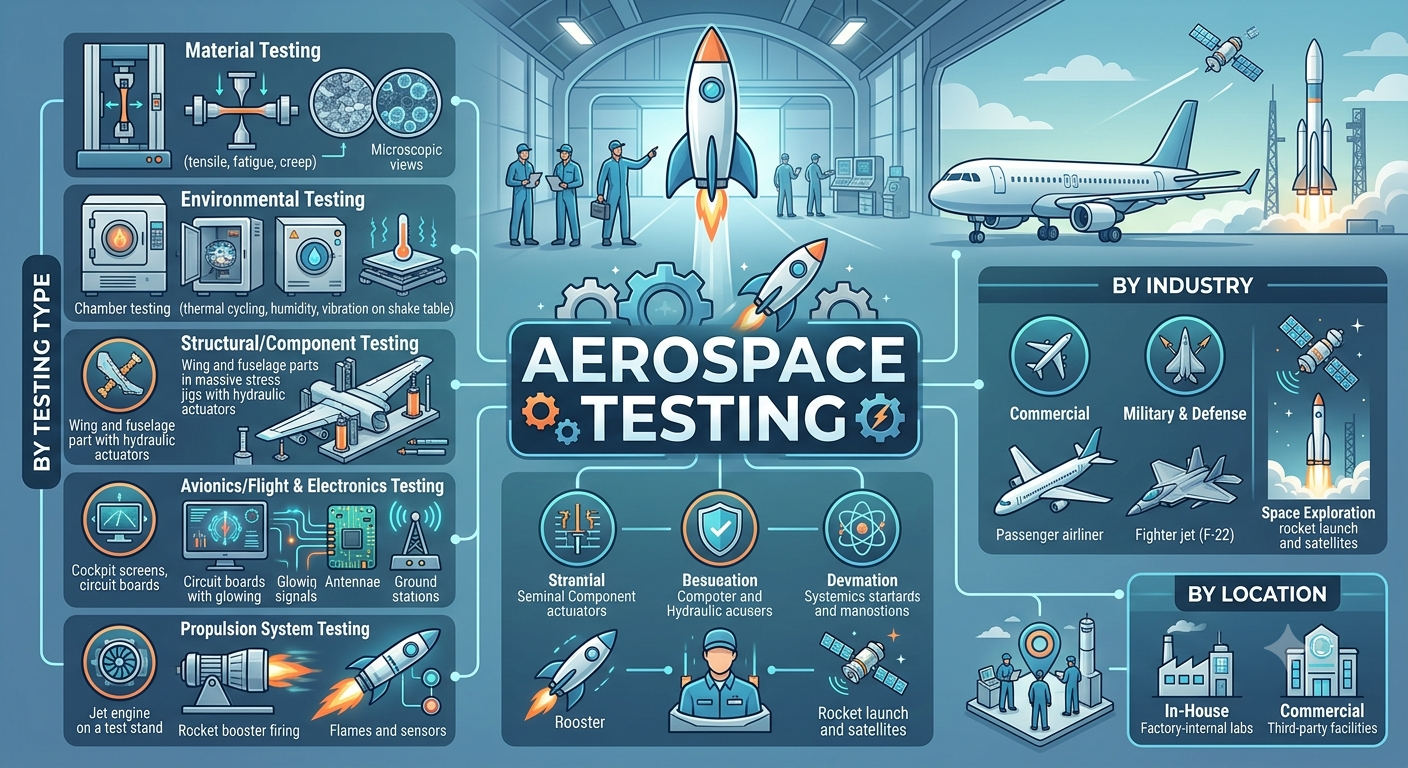
Advanced Avionics Testing Becomes a Growth Engine
The avionics/flight and electronics testing segment is projected to register the fastest growth among testing types during the forecast period. This growth is linked to rapid advances in aircraft electronics, next-generation flight-control systems, communication systems, navigation technologies, and autonomous capabilities.
Modern aircraft increasingly depend on sophisticated electronic systems to improve safety, efficiency, connectivity, and automation. As a result, testing must cover not only individual components but also the interaction between multiple interconnected systems.
The emergence of electric aircraft and growing demand for UAVs are further increasing the requirement for comprehensive avionics testing. Testing providers are therefore expanding capabilities across hardware, software, communication, navigation, control, and integrated flight systems.
This represents a significant change in the Aerospace Testing Market Ecosystem Analysis, as electronics and software are becoming just as important as mechanical and structural components.
Advanced Aircraft Technologies Create New Testing Opportunities
Aerospace manufacturers are developing aircraft around new technologies such as lightweight composites, hybrid-electric propulsion, autonomous flight systems, and advanced avionics. These technologies create testing requirements that may not be fully addressed by conventional testing methodologies.
MarketsandMarkets identifies the development of advanced aircraft technologies as a major opportunity because new systems require specialized testing to validate safety, performance, reliability, and regulatory compliance.
For example, hybrid-electric propulsion systems require testing of electrical power systems, thermal management, propulsion integration, and related components. Autonomous aircraft require testing of sensors, navigation, flight-control systems, communications, and decision-making technologies.
This is creating demand for testing organizations capable of combining multiple testing disciplines within integrated validation programs.
Structural and Component Testing Remains Critical
Despite the rapid adoption of digital technologies, physical structural and component testing continues to form a fundamental part of the aerospace testing ecosystem.
Full-scale structural testing, fatigue testing, vibration analysis, and component-level testing are essential for validating aircraft durability and safety. These tests help manufacturers understand how structures perform under operational loads and environmental conditions.
The increasing use of composite-rich aircraft is also creating demand for advanced materials and environmental testing. Testing under temperature, humidity, vibration, pressure, and other conditions helps validate the reliability of materials and components across their expected operating environments.
Consequently, the future ecosystem will not replace physical testing with digital tools. Instead, physical testing, simulation, AI, and digital twins are expected to become increasingly interconnected.
UAVs Expand the Aerospace Testing Ecosystem
The growing use of unmanned aerial vehicles (UAVs) in commercial and military applications is another important growth driver.
UAV platforms require testing of propulsion systems, flight controls, communications, navigation, sensors, batteries, structures, and autonomous capabilities. The diversity of UAV applications—from surveillance and defense to logistics and commercial operations—creates demand for specialized testing solutions.
MarketsandMarkets identifies the growing use of UAVs in military and commercial applications as a key driver of the aerospace testing market.
The expansion of UAVs also creates new opportunities for testing providers because many emerging UAV manufacturers require access to specialized external testing and certification capabilities.
Space Exploration Creates High-Growth Opportunities
Space exploration represents another important component of the Aerospace Testing Market Ecosystem Analysis. The space exploration end-user segment is expected to register the highest CAGR of 7.4% during the forecast period.
The growing development of satellites, launch vehicles, propulsion systems, and space technologies requires extensive qualification and verification. Components must withstand extreme temperatures, vibration, pressure, radiation, and other demanding operating environments.
The emergence of private space companies and new satellite technologies is further expanding the ecosystem. MarketsandMarkets identifies companies such as Astroscale and Accion Systems as high-potential startups within the aerospace testing landscape, supported by innovations in satellite servicing and propulsion technologies requiring intensive qualification and verification.
Commercial Aviation Drives Testing Demand
Commercial aviation remains a major end-user segment. In 2024, commercial aviation dominated the aerospace testing market, supported by increasing passenger traffic, airline fleet expansion, and demand for fuel-efficient next-generation aircraft.
Aircraft manufacturers and operators require comprehensive testing across materials, structures, propulsion, environmental conditions, avionics, and electronics. Safety and regulatory compliance further reinforce the need for rigorous testing throughout the aircraft lifecycle.
As aircraft fleets expand, testing requirements extend beyond initial aircraft development. MRO organizations also require inspection and validation technologies for aircraft components during scheduled maintenance and repair activities.
In-House and Outsourced Testing Shape the Ecosystem
The Aerospace Testing Market Ecosystem Analysis also highlights the strategic importance of testing sourcing models.
The in-house segment is expected to dominate the market because aerospace companies often prefer internal testing capabilities for greater control over quality, security, confidentiality, turnaround times, and proprietary technologies.
However, outsourced testing is expected to grow at a faster rate, with MarketsandMarkets projecting a 5.7% CAGR for the outsourced segment.
Outsourcing allows aerospace companies to access specialized laboratories, advanced equipment, accreditation capabilities, and technical expertise without making the full capital investment required to build internal facilities.
This creates a hybrid ecosystem in which large aerospace organizations maintain critical testing capabilities internally while relying on specialized external providers for highly complex or specialized requirements.
Asia Pacific Becomes a Strategic Growth Hub
Asia Pacific is expected to be the fastest-growing region in the global aerospace testing market. Economic growth in countries such as China, India, and Japan is supporting increased commercial and military aircraft production, while rising air travel is encouraging airlines to expand their fleets.
Government investments in defense and space programs are also increasing demand for specialized aerospace testing capabilities.
The regional ecosystem is therefore becoming more diverse, with aerospace OEMs, suppliers, MRO organizations, testing laboratories, defense organizations, and space companies creating new demand for advanced testing infrastructure.
Key Companies in the Aerospace Testing Ecosystem
The competitive landscape includes major testing, inspection, certification, aerospace, and technology organizations. Key companies identified by MarketsandMarkets include Element Materials Technology, SGS, Intertek, Applus+, TÜV SÜD, TÜV Rheinland, TÜV NORD Group, Rohde & Schwarz, Eurofins Scientific, Boeing, Airbus, MISTRAS Group, Lockheed Martin, Bureau Veritas, and DEKRA.
SGS, Intertek, and Element Materials Technology stand out for their global laboratory networks, accreditation capabilities, and broad testing portfolios covering materials, NDT, environmental, engine, and avionics testing.
The competitive landscape is increasingly shaped by investments in advanced test rigs, aerospace-grade quality systems, digital testing capabilities, and specialized expertise.
Challenges in the Aerospace Testing Ecosystem
While emerging technologies are creating significant opportunities, aerospace testing remains a complex and highly regulated process.
Stringent safety and quality requirements require extensive documentation, validation, and certification. MarketsandMarkets identifies complex and time-consuming testing processes caused by stringent regulations as a major restraint.
Cost is another challenge. Aerospace companies face rising expenses related to raw materials, labor, fuel, and supply chains. These pressures can lead organizations to seek more efficient testing processes and reduce unnecessary testing costs.
As a result, testing providers must demonstrate not only technical capability but also measurable improvements in testing speed, reliability, data management, and cost efficiency.
Future Outlook for the Aerospace Testing Market Ecosystem
The future of the Aerospace Testing Market Ecosystem Analysis points toward a more integrated model built around AI, digital twins, automation, advanced NDT, structural health monitoring, autonomous systems, and cybersecurity testing.
The aerospace testing market is projected to reach USD 6.91 billion by 2030, up from USD 5.50 billion in 2025, representing a CAGR of 4.6%.
As aircraft become more connected, electrified, autonomous, and software-defined, testing will increasingly span mechanical, electrical, electronic, software, cybersecurity, and environmental domains.
The most successful ecosystem participants will be those capable of combining physical testing with simulation, AI-driven analytics, digital engineering, and advanced data management. Testing will increasingly become an integrated part of aircraft development rather than a final-stage compliance activity.
Ultimately, emerging technologies are transforming the aerospace testing ecosystem from a collection of specialized validation processes into a connected, intelligent, and data-driven environment. As aerospace manufacturers pursue safer, lighter, more efficient, autonomous, and sustainable aircraft, advanced testing technologies will remain essential for reducing development risks, accelerating certification, and ensuring reliable performance throughout the aircraft lifecycle.
FAQ
1. What are the key trends shaping the Aerospace Testing Market?
Key trends include the adoption of AI-driven testing, digital twins, automation, advanced non-destructive testing, structural health monitoring, robotics, and cybersecurity testing for connected aircraft systems.
2. What is driving the growth of the Aerospace Testing Market?
The major growth drivers include increasing aircraft production, rising commercial air travel, growing UAV adoption, expansion of MRO activities, increasing space exploration, and the development of advanced aircraft technologies.
3. How is AI transforming aerospace testing?
AI helps analyze large volumes of testing data, identify anomalies, support predictive maintenance, automate defect detection, and improve the speed and accuracy of aircraft testing and validation.
4. Which aerospace testing segment is expected to grow at the fastest rate?
The avionics/flight and electronics testing segment is expected to register the fastest growth, driven by increasing aircraft electrification, advanced avionics, UAV adoption, and increasingly complex electronic systems.
5. Which region is expected to witness the highest growth in the Aerospace Testing Market?
Asia Pacific is expected to be the fastest-growing region, supported by increasing aircraft production, expanding airline fleets, rising defense investments, growing passenger traffic, and development of aerospace and space infrastructure.
About MarketsandMarkets™
MarketsandMarkets™ is a blue ocean alternative in growth consulting and program management, leveraging a man-machine offering to drive supernormal growth for progressive organizations in the B2B space. We have the widest lens on emerging technologies, making us proficient in co-creating supernormal growth for clients.
The B2B economy is witnessing the emergence of $25 trillion of new revenue streams that are substituting existing revenue streams in this decade alone. We work with clients on growth programs, helping them monetize this $25 trillion opportunity through our service lines – TAM Expansion, Go-to-Market (GTM) Strategy to Execution, Market Share Gain, Account Enablement, and Thought Leadership Marketing.
Built on the ’GIVE Growth’ principle, we work with several Forbes Global 2000 B2B companies – helping them stay relevant in a disruptive ecosystem. Our insights and strategies are molded by our industry experts, cutting-edge AI-powered Market Intelligence Cloud, and years of research. The KnowledgeStore™ (our Market Intelligence Cloud) integrates our research, facilitates an analysis of interconnections through a set of applications, helping clients look at the entire ecosystem and understand the revenue shifts happening in their industry.
To find out more, visit www.MarketsandMarkets™.com or follow us on Twitter, LinkedIn and Facebook.
Contact:
Mr. Rohan Salgarkar
MarketsandMarkets™ INC.
1615 South Congress Ave.
Suite 103
Delray Beach, FL 33445
USA : 1-888-600-6441
