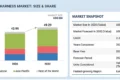
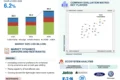
The automotive fuel tank market is projected to grow from USD 16.96 billion in 2026 to USD 22.87 billion by 2033 at a CAGR of 4.4%.
The automotive fuel tank market is shifting toward lightweight, low permeation, pressure-resistant, and integrated fuel storage systems, driven by hybridization, tighter emission requirements, and evolving vehicle architectures. OEMs and Tier 1 suppliers are increasing adoption of multilayer plastic tanks, sealed PHEV tanks, vapor management, leak detection, and integrated fuel delivery modules. Suppliers such as OPmobility, Kautex, TI Fluid Systems, and Motherson Yachiyo are expanding capabilities across advanced barrier materials, pressure management, and system integration. As OEMs seek higher functional content and platform flexibility, lightweighting, permeation control, packaging efficiency, system integration, and validation capability are becoming key supplier differentiators. This is creating opportunities for suppliers that can provide integrated tank, fuel delivery, vapor management, and sensing solutions across ICE, hybrid, CNG, and alternative fuel platforms.
Gasoline passenger cars remain a key application for fuel tank suppliers, particularly across compact cars, sedans, and compact SUVs where tank packaging and weight directly affect vehicle architecture. The shift from conventional single-layer tanks toward multi-layer HDPE structures with EVOH barrier layers is increasing demand for improved permeation control and integrated tank components. For instance, Motherson Yachiyo’s six-layer, four-material plastic tank with an EVOH barrier was mass-produced for the Honda Insight and Honda Odyssey 4WD, demonstrating the application of low-permeation tank technology in gasoline passenger cars. Compact SUVs and crossovers also require tank geometries that accommodate rear suspension, exhaust routing, and spare wheel spaces, creating demand for application-specific molded designs. For suppliers, the opportunity is moving beyond tank volume toward low permeation materials, thin-wall molding, integrated fuel delivery components, and platform-specific tank geometry for high-volume gasoline passenger car programs.
Download PDF Brochure @ https://www.marketsandmarkets.com/pdfdownloadNew.asp?id=23737735
The 45L-70 L segment represents a major application in the automotive fuel tank market, supported by its broad use across passenger cars, SUVs, pickups, and light commercial vehicles. Demand is shifting toward lightweight multilayer plastic tanks, higher barrier performance, and optimized packaging, as OEMs balance driving range, vehicle weight, and underbody space. For instance, Motherson Yachiyo applies multilayer EVOH barrier technology in plastic fuel tanks, while Kautex develops multilayer and pressure-resistant tank systems for conventional and hybrid vehicles. The demand is driven by 45L to 70L tanks, particularly in compact and midsize SUVs where fuel capacity must be balanced with underbody packaging and vehicle weight. Similar applications exist across North America, China, Southeast Asia, and Latin America, where SUVs, pickups, and utility vehicles form important production and sales categories. As a result, the 45L-70 L segment is becoming an important volume and technology segment, with supplier competitiveness increasingly linked to weight reduction, barrier performance, packaging efficiency, and integration with fuel delivery and vapor management systems. Asia Pacific represents a lucrative destination for automotive fuel tank suppliers, with India and Thailand providing distinct vehicle segment opportunities. In India, rising SUV and MPV production is increasing demand for 45L to 70L plastic fuel tanks, particularly for compact and midsize SUVs where higher fuel capacity must be balanced with weight and underbody packaging. In Thailand, the strong production base for pickups and LCVs supports demand for larger-capacity tanks, including plastic tanks designed around ladder-frame chassis and rear-axle packaging. Yachiyo’s supply of plastic fuel tanks for Honda City and CR V in Thailand demonstrates localized production for high-volume passenger vehicle programs. Across these applications, demand is shifting toward multilayer plastic construction, improved permeation resistance, optimized tank geometry, and integration with fuel delivery and vapor management systems. This creates opportunities for suppliers with localized manufacturing and capabilities in application-specific tank design for SUVs in India and pickups and LCVs in Thailand.
Asia Pacific is leading the automotive fuel tank market
Asia Pacific holds the largest share of the automotive fuel tank market, led by China, Japan, India, South Korea, and Southeast Asia, supported by high vehicle production, large passenger and commercial vehicle fleets, and established automotive supply chains. Plastic fuel tanks, particularly multilayer low-permeability systems, remain widely used, while China, Japan, and South Korea are driving adoption of lightweight and pressure-resistant tanks for hybrid vehicles. India and Southeast Asia continue to support demand through strong ICE vehicle production, commercial vehicle applications, and growing adoption of CNG and hybrid powertrains.
Key Players
The automotive fuel tank market is led by established players, including OPmobility (France), Kautex Textron (Germany), TI Automotive (US), YAPP Automotive Systems (China), and Motherson Yachiyo Automotive (Japan). Market participants are focusing on lightweight multilayer HDPE tanks, low-permeation barrier technologies, complex blow-molded geometries, saddle and dual-chamber configurations, and integrated fuel delivery and vapor-management systems to meet evolving vehicle packaging and fuel-system requirements. OEMs and Tier 1 suppliers are also emphasizing weight reduction, fuel containment, underbody space utilization, and compatibility with hybrid and alternative-fuel vehicle architectures. Strategic initiatives include investments in advanced fuel tank manufacturing facilities, expansion of localized production near OEM plants, development of low-permeation and lightweight tank structures, integration of fuel pumps and sensing systems, and adoption of automated leak, pressure, and dimensional inspection technologies.
Request Free Sample Report @ https://www.marketsandmarkets.com/requestsampleNew.asp?id=23737735