The global Automotive Sensor Fusion Market is experiencing rapid growth as automakers increasingly integrate multiple sensors, artificial intelligence, and advanced computing technologies into vehicles. Sensor fusion combines information from different sensors to create a more accurate and comprehensive understanding of the vehicle’s surroundings. This technology plays a critical role in improving vehicle safety, enhancing Advanced Driver Assistance Systems (ADAS), and enabling higher levels of autonomous driving.
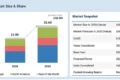
The Automotive Sensor Fusion Market size is projected to grow from USD 0.3 billion in 2023 to USD 3.3 billion by 2030, registering a CAGR of 42.4% during the forecast period. Increasing demand for vehicle safety, advancements in ADAS, supportive government regulations, and the development of autonomous driving technologies are among the major factors driving Automotive Sensor Fusion Market growth.
Automotive Sensor Fusion Market Overview
Automotive sensor fusion involves combining information generated by multiple sensors, such as cameras, radar, lidar, and ultrasonic sensors, to create a more reliable representation of the vehicle’s surrounding environment.
Individual sensors have limitations under certain operating conditions. Sensor fusion helps overcome these limitations by combining complementary information from multiple sensing technologies. This improves environmental perception, situational awareness, and decision-making for ADAS and autonomous driving systems.
The report covers sensor fusion across L2, L3, and L4 levels of autonomy, passenger cars, light commercial vehicles (LCVs), and heavy commercial vehicles (HCVs), as well as BEVs, PHEVs, and FCEVs.
Advancements in ADAS Driving Automotive Sensor Fusion Market Growth
Continuous advancements in ADAS technology are a major driver of the Automotive Sensor Fusion Market. Modern ADAS functions increasingly depend on information from multiple sensors to accurately detect vehicles, pedestrians, road markings, obstacles, and changing road conditions.
Applications such as adaptive cruise control, lane-keeping assistance, automatic emergency braking, and automated parking increasingly use combinations of cameras, radar, ultrasonic sensors, and other sensing technologies.
As automakers expand ADAS capabilities across passenger vehicles and commercial vehicles, demand for sophisticated sensor fusion systems is expected to increase significantly.
Data Fusion Leading the Automotive Sensor Fusion Market
Data fusion is expected to account for the largest share of the Automotive Sensor Fusion Market by fusion level. Data fusion combines raw information generated by multiple sensors to create a more accurate representation of the surrounding environment.
By combining complementary sensor inputs, data fusion can improve accuracy and redundancy while helping autonomous vehicles make more reliable decisions. However, processing large volumes of raw sensor data requires substantial computational capabilities, which can increase system complexity and cost.
Companies such as LeddarTech, Robert Bosch, and BASELABS provide data-fusion technologies for autonomous vehicles.
Download PDF Brochure @ https://www.marketsandmarkets.com/pdfdownloadNew.asp?id=260287840
Autonomous Driving Accelerating Sensor Fusion Market Demand
Autonomous driving is expected to be the fastest-growing segment during the forecast period. Autonomous vehicles depend heavily on sensor fusion because they need to continuously perceive and interpret their surroundings before making driving decisions.
Modern autonomous vehicles can combine information from cameras, lidar, radar, and ultrasonic sensors to create a detailed real-time representation of the environment. This enables the vehicle to identify objects, understand road conditions, predict potential movements, and make appropriate driving decisions.
As the automotive industry progresses from conventional ADAS toward L3 and higher levels of automation, the role of sensor fusion will become increasingly important.
AI and Machine Learning Transforming Automotive Sensor Fusion
Artificial intelligence and machine learning are increasingly important technologies within automotive sensor fusion systems. Large volumes of sensor data must be processed rapidly to identify objects, classify road users, understand driving environments, and support real-time decision-making.
AI-based algorithms can process sensor information and continuously improve perception and decision-making capabilities. Machine learning also enables autonomous vehicles to learn from large datasets and improve their ability to interpret complex road environments.
The integration of AI, deep learning, edge computing, and advanced sensor fusion algorithms is therefore expected to remain an important trend in the automotive sensor fusion industry.
L2 and L3 Autonomy Creating New Market Opportunities
The expansion of L2 and L3 autonomous driving technologies is creating significant opportunities for automotive sensor fusion providers. L2 systems require advanced perception and decision-making capabilities while L3 systems place greater responsibility on vehicle systems under defined operating conditions.
As automakers introduce increasingly sophisticated automated driving functions, the need for redundant and reliable perception systems will increase. Sensor fusion allows multiple sensing technologies to work together, improving environmental awareness and supporting the safety requirements associated with higher levels of automation.
Sensor Fusion Supporting Safer Connected and Autonomous Vehicles
Sensor fusion is becoming a critical technology for improving the safety and reliability of connected and autonomous vehicles. By combining multiple sources of information, vehicles can achieve greater redundancy and reduce dependence on a single sensing technology.
This is particularly important when individual sensors encounter challenging conditions. Combining information from multiple sensors can provide a more comprehensive understanding of the environment and support safer vehicle operation.
The growing emphasis on reducing road accidents and improving vehicle safety is expected to continue driving demand for sensor fusion technologies globally.
Asia Pacific Leading the Automotive Sensor Fusion Market Share
Asia Pacific is expected to hold the largest share of the Automotive Sensor Fusion Market. China, Japan, and South Korea are major contributors to regional growth due to their strong vehicle production capabilities and increasing adoption of advanced automotive electronics.
China’s position as the world’s largest vehicle manufacturing market, combined with increasing implementation of vehicle safety regulations and growing demand for advanced safety features, is creating significant opportunities for sensor fusion technology providers.
The presence of major automotive manufacturers and sensor suppliers across the region is also supporting the development and deployment of advanced sensing and autonomous driving technologies.
Europe Emerging as a High-Growth Automotive Sensor Fusion Market
Europe is projected to be the second-fastest-growing region in the Automotive Sensor Fusion Market. Increasing emphasis on vehicle safety, stringent regulations, and growing deployment of autonomous driving technologies are contributing to regional demand.
The European Union’s focus on reducing road fatalities and introducing advanced safety requirements is encouraging automakers to integrate technologies such as lane departure warning, automatic emergency braking, and driver monitoring systems.
Germany, France, and the UK are also progressing with regulations and testing frameworks for automated vehicles, creating additional opportunities for sensor fusion technologies.
Future Outlook for the Automotive Sensor Fusion Market
The future of the Automotive Sensor Fusion Market will be shaped by ADAS, autonomous driving, artificial intelligence, machine learning, high-performance computing, and the increasing integration of cameras, radar, lidar, and ultrasonic sensors.
As vehicles progress toward higher levels of autonomy, sensor fusion will become increasingly important for creating accurate, redundant, and real-time environmental perception. Growing investments by automotive OEMs, semiconductor companies, sensor manufacturers, and autonomous driving technology providers will further accelerate innovation.
With the market projected to increase from USD 0.3 billion in 2023 to USD 3.3 billion by 2030 at a CAGR of 42.4%, the Automotive Sensor Fusion Market is positioned for substantial growth as sensor-based perception becomes increasingly central to next-generation ADAS and autonomous vehicles.
Request Free Sample Report @ https://www.marketsandmarkets.com/requestsampleNew.asp?id=260287840