The global Hardware Security Modules (HSM) Market is poised for significant growth as organizations increasingly prioritize cybersecurity, data protection, and secure digital transactions. The growing frequency of cyberattacks, rising adoption of cloud computing, and stringent data security regulations are driving businesses to invest in advanced cryptographic security solutions.
According to MarketsandMarkets, the global Hardware Security Modules market is projected to grow from USD 2.04 billion in 2026 to USD 4.80 billion by 2032, registering a compound annual growth rate (CAGR) of 15.3% during the 2026–2032 forecast period. The market was valued at USD 1.74 billion in 2025, highlighting the increasing demand for hardware-based cryptographic protection across industries.
Rising Cybersecurity Threats Fuel Market Demand
The increasing sophistication of cyber threats has become a major factor accelerating the adoption of Hardware Security Modules. Organizations across financial services, healthcare, government, telecommunications, and manufacturing are facing growing risks associated with data breaches, ransomware, identity theft, and unauthorized access.
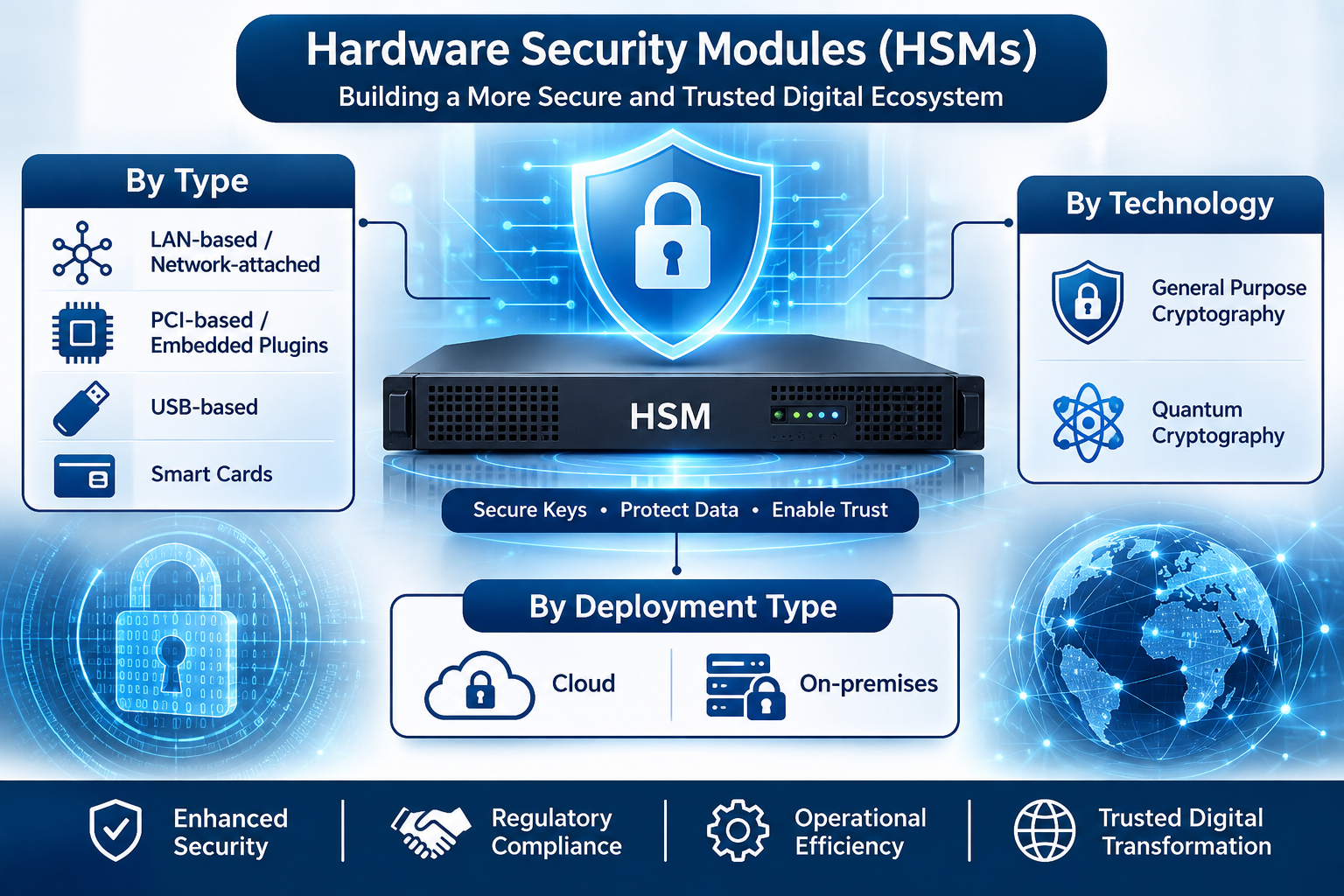
Hardware Security Modules are specialized physical devices designed to generate, store, and manage cryptographic keys while performing secure encryption and decryption operations. By keeping sensitive cryptographic keys within a protected hardware environment, HSMs help organizations strengthen data confidentiality, maintain information integrity, and secure critical digital transactions.
As businesses expand their digital infrastructure, the need for reliable encryption and secure key management solutions is becoming increasingly important. Consequently, HSMs are emerging as a critical component of enterprise cybersecurity strategies.
Growing Cloud Adoption Creates New Opportunities
The rapid transition toward cloud computing and hybrid IT environments is creating substantial opportunities for HSM providers. Organizations are increasingly adopting cloud-based applications, digital platforms, and distributed infrastructure, increasing the complexity of protecting sensitive information.
Cloud-based Hardware Security Modules offer scalable cryptographic services without requiring organizations to maintain all the necessary physical infrastructure on-premises. These solutions help businesses manage encryption keys, protect cloud workloads, and secure applications across multiple environments.
The growing popularity of multi-cloud strategies and security-as-a-service models is expected to accelerate demand for cloud-based HSM solutions. According to MarketsandMarkets, the cloud-based deployment segment is anticipated to record the highest growth during the forecast period.
Download PDF Brochure @ https://www.marketsandmarkets.com/pdfdownloadNew.asp?id=162277475
Digital Payments and Financial Services Drive Adoption
The banking, financial services, and insurance (BFSI) sector represents a major application area for Hardware Security Modules. The increasing adoption of online banking, mobile wallets, contactless payments, and digital financial transactions has created a greater need for secure cryptographic infrastructure.
HSMs help financial institutions protect payment credentials, encryption keys, transaction data, and digital identities. They also support payment processing, authentication, public key infrastructure (PKI), and secure communication.
According to MarketsandMarkets, the BFSI sector accounted for 37.8% of the global Hardware Security Modules market in 2025. The increasing volume of digital payments, combined with regulatory requirements and growing concerns about financial fraud, is expected to support continued market expansion.
Regulatory Compliance Strengthens Market Growth
Increasing regulatory pressure surrounding data privacy and cybersecurity is another important factor supporting HSM adoption. Organizations must comply with various security standards and regulations, including the General Data Protection Regulation (GDPR), Payment Card Industry Data Security Standard (PCI DSS), and Health Insurance Portability and Accountability Act (HIPAA), where applicable.
Hardware Security Modules help organizations strengthen their security frameworks through secure key storage, encryption management, authentication, and digital signing capabilities.
As regulatory requirements become more demanding, businesses are increasingly investing in dedicated cryptographic hardware to improve compliance readiness and reduce exposure to cybersecurity risks.
Technological Advancements Transform the HSM Landscape
Technological developments are creating new growth opportunities in the Hardware Security Modules market. The emergence of quantum computing, artificial intelligence, Internet of Things (IoT), and edge computing is increasing the demand for advanced cryptographic protection.
Post-quantum cryptography is gaining attention as organizations prepare for potential future threats posed by quantum computers. HSM manufacturers are increasingly exploring quantum-resistant cryptographic capabilities and crypto-agility solutions to help enterprises prepare for evolving security requirements.
Additionally, the expansion of IoT ecosystems and connected infrastructure is increasing the need for secure device authentication, identity management, and machine-to-machine communication.
These developments are expected to encourage innovation and strengthen the role of HSMs in next-generation cybersecurity infrastructure.
Asia Pacific Expected to Witness Strong Market Growth
Asia Pacific is expected to register the highest growth rate in the Hardware Security Modules market during the 2026–2032 forecast period. Increasing investments in cybersecurity infrastructure, expanding digital banking ecosystems, cloud adoption, and smart city initiatives are contributing to regional market development.
Countries across the region are accelerating digital transformation across financial services, telecommunications, government, and manufacturing. The growing use of connected devices and digital platforms is creating additional demand for secure encryption and cryptographic key management solutions.
Meanwhile, Europe is also expected to experience significant growth, supported by increasing cybersecurity investments and stringent data protection requirements.
Key Companies Operating in the Hardware Security Modules Market
The competitive landscape includes established cybersecurity and technology companies focusing on product innovation, strategic partnerships, and advanced cryptographic solutions.
Some of the prominent players in the global market include:
- Thales
- Utimaco Management Services GmbH
- IBM
- Entrust Corporation
- Eviden SAS
- Futurex
- STMicroelectronics
- Microchip Technology
- Infineon Technologies
- Yubico
These companies are strengthening their market positions through advancements in cloud security, encryption technologies, payment protection, digital identity management, and quantum-resistant cryptography.
High Costs and Integration Complexities Remain Key Challenges
Despite strong growth opportunities, the Hardware Security Modules market faces certain challenges. High initial investment costs associated with hardware procurement, implementation, integration, and maintenance can limit adoption, particularly among small and medium-sized enterprises.
Additionally, organizations may face difficulties integrating HSM solutions into complex hybrid and multi-cloud IT environments. The shortage of skilled cryptography and cybersecurity professionals can further complicate implementation and management.
Addressing these challenges through cost-effective solutions, simplified deployment models, and managed cryptographic services will be important for expanding market adoption.
Future Outlook
The future of the Hardware Security Modules market looks promising as organizations continue to strengthen their cybersecurity infrastructure and protect increasingly valuable digital assets. Rising cyber threats, expanding digital payment ecosystems, cloud transformation, and evolving regulatory requirements are expected to remain major growth drivers.
Furthermore, developments in post-quantum cryptography, IoT security, and cloud-based cryptographic services are likely to create new opportunities for market participants.
With the global Hardware Security Modules market projected to reach USD 4.80 billion by 2032, the industry is positioned for substantial expansion. As businesses increasingly recognize the importance of securing cryptographic keys and sensitive information, Hardware Security Modules are expected to play an increasingly important role in the global cybersecurity ecosystem.
Frequently Asked Questions (FAQs) – Hardware Security Modules Market
1. What is driving the growth of the Hardware Security Modules market?
The Hardware Security Modules market is primarily driven by rising cybersecurity threats, increasing data breaches, growing adoption of cloud computing, digital payment expansion, and stringent data protection regulations. Organizations are increasingly deploying HSMs to secure sensitive information and cryptographic keys.
2. What is the projected size of the global Hardware Security Modules market?
According to MarketsandMarkets, the global Hardware Security Modules market is projected to grow from USD 2.04 billion in 2026 to USD 4.80 billion by 2032, registering a CAGR of 15.3% during the forecast period.
3. Which industry holds the largest share of the Hardware Security Modules market?
The Banking, Financial Services, and Insurance (BFSI) sector is a major end-user of Hardware Security Modules. It accounted for 37.8% of the global market in 2025, driven by increasing digital transactions, payment security requirements, and financial data protection needs.
4. Which region is expected to experience the fastest growth in the Hardware Security Modules market?
Asia Pacific is expected to register the highest growth during the forecast period. Increasing digitalization, expanding financial services, cloud adoption, and rising cybersecurity investments are supporting regional market expansion.
5. Who are the key players in the Hardware Security Modules market?
Major companies operating in the global Hardware Security Modules market include Thales, IBM, Entrust Corporation, Utimaco, Eviden, Futurex, STMicroelectronics, Microchip Technology, Infineon Technologies, and Yubico. These companies focus on product innovation, cloud security, and advanced cryptographic technologies.
About MarketsandMarkets™
MarketsandMarkets™ has been recognized as one of America’s Best Management Consulting Firms by Forbes, as per their recent report.
MarketsandMarkets™ is a blue ocean alternative in growth consulting and program management, leveraging a man-machine offering to drive supernormal growth for progressive organizations in the B2B space. With the widest lens on emerging technologies, we are proficient in co-creating supernormal growth for clients across the globe.
Today, 80% of Fortune 2000 companies rely on MarketsandMarkets, and 90 of the top 100 companies in each sector trust us to accelerate their revenue growth. With a global clientele of over 13,000 organizations, we help businesses thrive in a disruptive ecosystem.
The B2B economy is witnessing the emergence of $25 trillion in new revenue streams that are replacing existing ones within this decade. We work with clients on growth programs, helping them monetize this $25 trillion opportunity through our service lines – TAM Expansion, Go-to-Market (GTM) Strategy to Execution, Market Share Gain, Account Enablement, and Thought Leadership Marketing.
Built on the ‘GIVE Growth’ principle, we collaborate with several Forbes Global 2000 B2B companies to keep them future-ready. Our insights and strategies are powered by industry experts, cutting-edge AI, and our Market Intelligence Cloud, KnowledgeStore™, which integrates research and provides ecosystem-wide visibility into revenue shifts.
To find out more, visit www.MarketsandMarkets™.com or follow us on Twitter , LinkedIn and Facebook .
Contact:
Mr. Rohan Salgarkar
MarketsandMarkets™ INC.
1615 South Congress Ave.
Suite 103, Delray Beach, FL 33445
USA: +1-888-600-6441
