The IoT Technology Market growth is expanding as connected devices, smart infrastructure, industrial automation, artificial intelligence (AI), cloud computing, and advanced connectivity become increasingly integrated across industries. Internet of Things (IoT) technologies enable devices, machines, sensors, and systems to collect and exchange data, supporting real-time monitoring, automation, predictive analytics, and data-driven decision-making.
According to MarketsandMarkets, the global IoT Technology Market was valued at USD 959.30 billion in 2025 and is projected to reach USD 1,148.62 billion by 2030, registering a CAGR of 3.7% from 2025 to 2030. The market is being supported by the growing adoption of connected devices, increasing internet penetration, Industry 4.0 initiatives, smart homes, 5G networks, cloud platforms, and AI-enabled IoT applications.
The expansion of IoT is moving beyond simple device connectivity. Organizations are increasingly using connected systems to automate operations, optimize assets, improve energy efficiency, monitor equipment remotely, enhance customer experiences, and generate actionable insights from large volumes of data. This transition is creating new opportunities across manufacturing, healthcare, automotive and transportation, buildings, retail, agriculture, energy, consumer electronics, and smart cities.
IoT Technology Market Statistics and Growth Outlook
The IoT Technology Market growth outlook reflects the continued digitalization of industrial and consumer environments. The market is expected to increase from USD 959.30 billion in 2025 to USD 1,148.62 billion by 2030 at a 3.7% CAGR. MarketsandMarkets identifies rapid adoption of connected devices across industries as a primary factor supporting market expansion.
IoT technology connects physical assets with software, cloud platforms, communication networks, and analytics systems. This enables organizations to monitor assets in real time and use collected data to optimize processes. In manufacturing, for example, connected machines can provide information about equipment performance, production conditions, energy consumption, and maintenance requirements.
In consumer environments, smart appliances, wearable devices, connected security systems, and home automation platforms are expanding the number of connected endpoints. Meanwhile, industrial IoT (IIoT) is enabling factories and infrastructure operators to integrate sensors, machines, analytics, and automation systems.
Smart Devices Accelerate IoT Technology Adoption
The increasing adoption of smart devices is one of the major contributors to IoT Technology Market expansion. Consumers and businesses are deploying connected devices across homes, offices, factories, transportation systems, healthcare facilities, and public infrastructure.
Smart home devices such as connected appliances, security cameras, smart locks, lighting systems, thermostats, and entertainment systems allow users to monitor and control equipment remotely. MarketsandMarkets identifies increasing adoption of smart home devices as a key growth driver for the IoT Technology Market.
Wearable devices are also expanding IoT applications by continuously collecting information and connecting users to digital platforms. Smartwatches, fitness trackers, connected medical devices, and other wearable technologies can support real-time monitoring and personalized services.
The growing number of connected devices is increasing demand for processors, sensors, connectivity ICs, memory devices, and software platforms capable of managing large amounts of device-generated information.
Download PDF Brochure @ https://www.marketsandmarkets.com/pdfdownloadNew.asp?id=258239167
Industrial Automation Creates New Market Opportunities
Industrial automation represents one of the most important opportunities within the IoT Technology Market. Manufacturers are deploying connected sensors, machines, robotics, and software platforms to improve productivity, quality, asset utilization, and operational visibility.
Industry 4.0 initiatives are accelerating the integration of IoT with manufacturing systems. Connected equipment can continuously collect operational data, enabling manufacturers to identify abnormal conditions, optimize production processes, and implement predictive maintenance strategies.
IoT-enabled industrial automation can also reduce unplanned downtime. Sensors installed on motors, pumps, production equipment, and other assets can monitor parameters such as temperature, vibration, pressure, and energy consumption. Analytics platforms can then identify potential equipment issues before they result in major failures.
MarketsandMarkets identifies the expansion of Industry 4.0 and smart manufacturing as a key driver of IoT adoption.
AI and IoT Convergence Enables Intelligent Operations
The convergence of AI and IoT, often referred to as AIoT, is creating new capabilities across connected environments. IoT systems generate large volumes of data, while AI technologies can analyze that information to identify patterns, make predictions, and support automated decisions.
AI-powered IoT can improve predictive maintenance, anomaly detection, demand forecasting, quality control, asset optimization, and intelligent automation. In manufacturing, AI can analyze sensor data to identify patterns associated with machine failures or production inefficiencies.
In smart cities, AI and IoT can be combined for traffic management, energy optimization, public safety, waste management, and infrastructure monitoring. In healthcare, connected devices and AI analytics can support remote patient monitoring and data-driven clinical workflows.
MarketsandMarkets identifies AI integration as one of the technologies accelerating the development of IoT ecosystems.
5G Connectivity Expands IoT Applications
The deployment of 5G networks is creating new opportunities for IoT by providing higher connectivity capabilities, lower latency, and support for large numbers of connected devices.
5G can support applications requiring fast and reliable communication, including connected vehicles, industrial automation, smart cities, healthcare systems, and large-scale sensor networks.
In manufacturing environments, 5G connectivity can support wireless industrial networks and connected machinery. In transportation, it can support communication between vehicles, infrastructure, and cloud platforms.
MarketsandMarkets identifies the growing deployment of 5G networks as a key IoT Technology Market growth driver because of its ability to support large-scale connected applications.
Edge Computing Strengthens Real-Time IoT Applications
As the number of connected devices increases, organizations need to process data closer to where it is generated. This is increasing demand for edge computing within IoT ecosystems.
Traditional cloud architectures may require device-generated data to travel to centralized data centers for processing. Edge computing moves some processing capabilities closer to devices, machines, and sensors. This can reduce latency and support faster responses.
Edge computing is particularly relevant to industrial automation, autonomous systems, smart transportation, healthcare monitoring, and security applications. Edge AI can enable connected devices to analyze data locally and make decisions without continuously depending on centralized cloud infrastructure.
The combination of IoT, edge computing, and AI is therefore creating a more responsive architecture for real-time industrial and consumer applications.
IoT Node Components Support Connected Devices
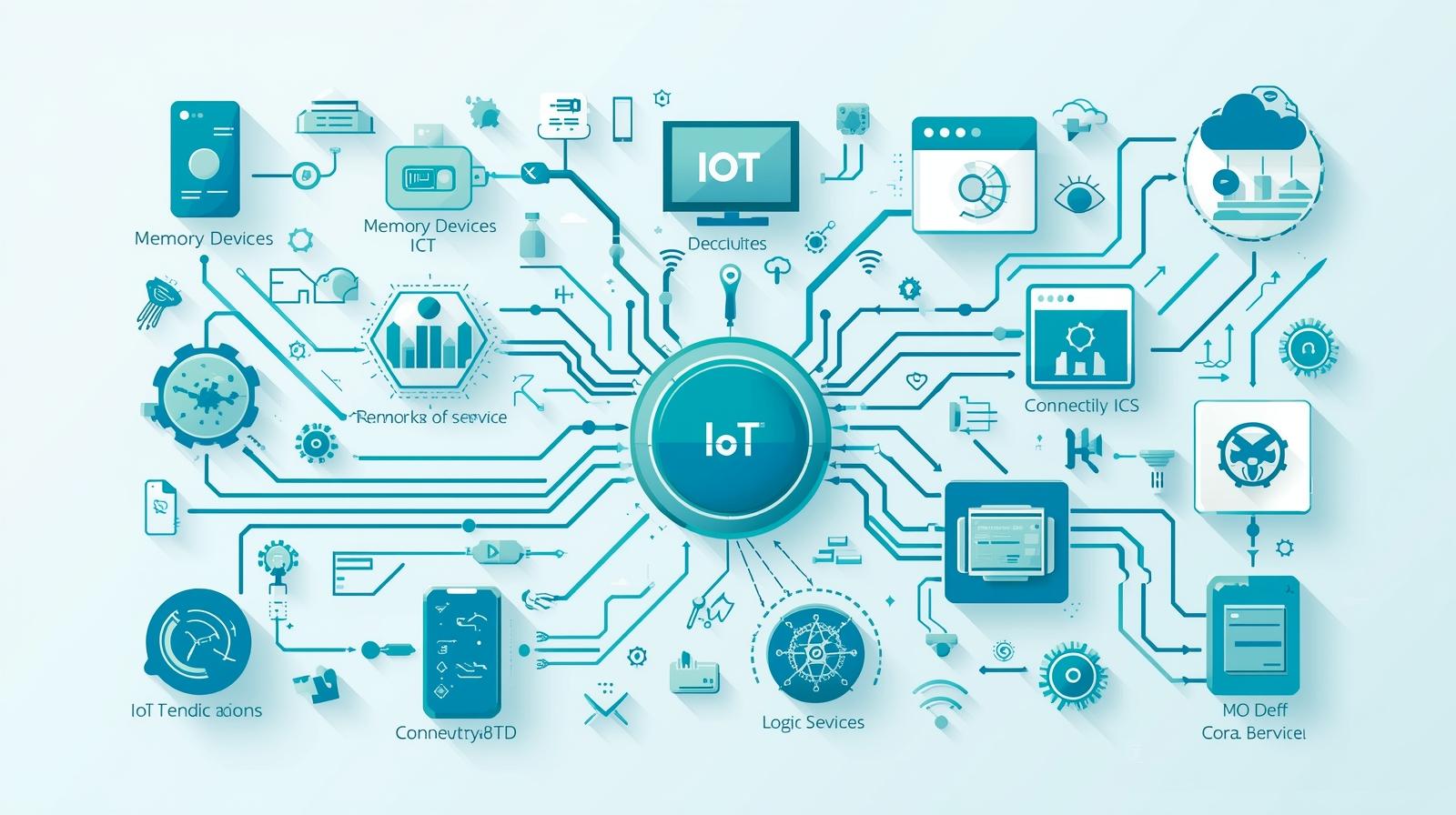
The IoT node component ecosystem includes processors, connectivity ICs, sensors, memory devices, and logic devices. These components provide the hardware foundation required for connected systems.
According to MarketsandMarkets, processors are expected to account for the largest share within IoT node components during the forecast period. As IoT devices become more sophisticated, processors need to support greater levels of data processing, connectivity, analytics, and device functionality.
Sensors are equally important because they enable IoT systems to collect information from physical environments. Temperature, pressure, motion, proximity, light, vibration, and other sensors can generate data used for monitoring and automation.
Advances in miniaturization, edge AI, and low-power wide-area network (LPWAN) technologies are expanding the potential applications of IoT nodes across healthcare, agriculture, smart cities, industrial environments, and consumer electronics.
IoT Software Solutions Experience Strong Growth
The software solution segment is expected to register the highest growth rate in the IoT Technology Market. This segment includes data management, real-time streaming analytics, network bandwidth management, remote monitoring, and security solutions.
The growing diversity of IoT devices is increasing the need for software capable of managing heterogeneous connected environments. Organizations need platforms that can collect, organize, analyze, and secure data generated by thousands or millions of connected endpoints.
Remote monitoring is particularly important for industrial operations. It allows organizations to track equipment and infrastructure from centralized locations, reducing the need for frequent physical inspections.
Security solutions are also becoming increasingly important because connected devices can create additional cybersecurity entry points. IoT software therefore needs to address authentication, data protection, device security, network security, and privacy requirements.
IoT Platforms Improve Device and Network Management
IoT platforms provide centralized capabilities for managing connected devices, applications, and networks. MarketsandMarkets categorizes IoT platforms into device management, application management, and network management.
Device management platforms can help organizations monitor connected assets, configure devices, deploy updates, and track device performance. Application management platforms provide tools for developing and operating IoT applications.
Network management platforms help organizations maintain connectivity across large and complex IoT environments.
Highly customizable platforms can also allow developers to build specialized applications using APIs and other platform capabilities. This flexibility is becoming increasingly important as companies develop IoT solutions tailored to specific industries and operational requirements.
Cloud Platforms Support IoT Scalability
Cloud computing is playing an important role in the expansion of IoT ecosystems. Cloud platforms provide scalable computing and storage resources for processing large volumes of IoT-generated data.
Organizations can use cloud infrastructure to manage connected devices, analyze data, deploy applications, and integrate IoT systems with enterprise software.
Cloud-based IoT platforms can also support remote monitoring across geographically distributed assets. This is particularly valuable for organizations operating factories, vehicles, energy infrastructure, retail locations, and other assets across multiple locations.
The increasing adoption of cloud platforms is identified by MarketsandMarkets as a major driver of IoT Technology Market growth.
Smart Cities Create Significant IoT Opportunities
Smart city development is creating new applications for IoT technologies. Cities are deploying connected sensors and systems to monitor transportation, energy consumption, environmental conditions, infrastructure, public safety, and utilities.
IoT-enabled traffic management systems can collect real-time information about road conditions and vehicle movements. Connected lighting systems can optimize energy consumption, while smart waste management systems can monitor collection requirements.
Smart infrastructure can also support predictive maintenance by monitoring bridges, roads, buildings, utilities, and other assets.
Government investments in smart city projects are particularly important in emerging markets, where IoT technologies can be incorporated into new digital infrastructure.
Connected Healthcare Expands IoT Applications
Healthcare is another important application area for IoT technology. Connected medical devices and remote monitoring systems can collect patient information and transmit it to healthcare providers.
IoT technologies can support remote patient monitoring, connected medical equipment, hospital asset tracking, medication management, and healthcare facility automation.
The combination of IoT with AI and cloud computing can provide healthcare organizations with more tools for analyzing patient and operational data. Connected healthcare can also support services outside traditional healthcare facilities through remote monitoring and home-based care.
Automotive and Transportation Drive Connected Systems
IoT is transforming the automotive and transportation industries through connected vehicles, telematics, fleet management, intelligent transportation systems, and infrastructure connectivity.
Connected vehicles can generate information about vehicle performance, location, driving behavior, and operating conditions. Fleet operators can use this information to optimize routes, monitor vehicle health, and improve asset utilization.
IoT technologies can also support advanced driver assistance systems, connected infrastructure, predictive maintenance, and smart transportation networks.
As vehicles become increasingly software-defined and connected, the integration of sensors, processors, communication systems, cloud platforms, and analytics will continue to expand the role of IoT in transportation.
Asia Pacific Emerges as the Fastest-Growing Region
Asia Pacific is expected to be the fastest-growing region in the global IoT Technology Market. MarketsandMarkets projects the regional market to increase from USD 260.76 billion in 2025 to USD 351.03 billion by 2030, representing a CAGR of 6.1%.
The region’s growth is supported by rapid digital transformation, strong manufacturing capabilities, smart city initiatives, 5G deployment, and increasing adoption of connected devices.
China, Japan, South Korea, and India are investing in smart infrastructure, Industry 4.0, digital manufacturing, connected transportation, healthcare technology, and consumer electronics.
The region’s large technology manufacturing ecosystem also supports the development of IoT hardware, semiconductors, connectivity technologies, and electronic devices.
IoT Services Support Implementation and Management
The IoT services segment consists broadly of professional services and managed services. Professional services include deployment and integration, consulting, support, and maintenance services.
As IoT deployments become larger and more complex, organizations often require specialized expertise to integrate connected devices with existing enterprise systems.
Managed services can help organizations operate IoT environments after deployment. These services may include device monitoring, network management, security, maintenance, and analytics support.
Service providers therefore have opportunities to support companies throughout the entire IoT lifecycle, from planning and implementation to ongoing management.
Data Analytics Becomes a Core IoT Capability
IoT systems generate substantial volumes of data, making real-time data analytics increasingly important. Organizations are moving beyond data collection toward using IoT data to generate actionable insights.
Analytics can help companies identify operational inefficiencies, forecast equipment failures, optimize resources, monitor customer behavior, and improve decision-making.
Real-time streaming analytics can be particularly valuable in environments where immediate responses are required. Manufacturing facilities, transportation networks, healthcare systems, and energy infrastructure can use real-time information to respond to changing conditions.
The growing demand for real-time analytics is therefore contributing to the development of IoT software and platforms.
Key Challenges in the IoT Technology Market
Despite significant opportunities, the IoT Technology Market faces several challenges. Data security and privacy concerns remain major restraints because connected devices can transmit sensitive information across multiple networks and platforms.
Cybersecurity risks include unauthorized access, data breaches, device manipulation, and attacks against connected infrastructure. As the number of endpoints increases, securing the entire IoT ecosystem becomes more complex.
Interoperability and lack of common standards are additional challenges. Organizations often deploy devices from different vendors, using different communication protocols and software environments. Ensuring seamless communication between heterogeneous devices can increase deployment complexity.
The shortage of professionals with expertise across IoT hardware, software, cloud computing, data analytics, networking, and cybersecurity is another challenge identified by MarketsandMarkets.
Opportunities from Cross-Domain Collaboration
Cross-domain collaboration represents an important opportunity for the IoT Technology Market. Partnerships among semiconductor companies, software providers, cloud platforms, system integrators, telecommunications companies, manufacturers, and government organizations can accelerate IoT development.
Government-led funding for IoT research can also support innovation in connectivity, security, edge intelligence, smart infrastructure, and industrial applications.
MarketsandMarkets identifies increasing cross-domain collaborations and government-led funding for IoT research projects as important opportunities.
These collaborations can help organizations develop industry-specific IoT solutions while addressing challenges related to interoperability, cybersecurity, data management, and scalability.
Key Companies in the IoT Technology Market
The IoT Technology Market includes semiconductor manufacturers, technology companies, cloud providers, networking companies, and IoT software providers.
Key companies identified by MarketsandMarkets include Intel Corporation, Qualcomm Technologies, Texas Instruments, STMicroelectronics, IBM, Hewlett Packard Enterprise, Cisco Systems, Microsoft, PTC, and Amazon Web Services (AWS).
These companies are strengthening their IoT capabilities through product launches, partnerships, acquisitions, cloud platforms, connected-device technologies, edge computing, analytics, and IoT management solutions.
The competitive landscape is therefore increasingly centered on integrated IoT ecosystems rather than individual connected devices.
Future Outlook for the IoT Technology Market
The future of the IoT Technology Market will be shaped by the convergence of connected devices, AI, edge computing, cloud platforms, 5G, advanced sensors, cybersecurity, and automation.
The market is projected to reach USD 1,148.62 billion by 2030, reflecting continued adoption across industrial and consumer environments.
Industrial automation will remain an important growth opportunity as manufacturers adopt connected equipment, predictive maintenance, digital monitoring, and smart production systems. At the same time, smart homes, wearables, connected vehicles, healthcare devices, and smart city infrastructure will continue expanding the consumer and commercial IoT ecosystem.
The increasing integration of AI and edge computing will also shift IoT from simple connectivity toward intelligent and autonomous operations. Organizations will increasingly use IoT-generated data to automate processes, optimize resources, and make faster decisions.
Top 10 Key Takeaways
- The global IoT Technology Market was valued at USD 959.30 billion in 2025.
- The market is projected to reach USD 1,148.62 billion by 2030, growing at a CAGR of 3.7% from 2025 to 2030.
- Smart devices, industrial IoT, and connected systems are expanding IoT adoption across consumer and industrial environments.
- Industrial automation and Industry 4.0 are creating opportunities for predictive maintenance, real-time monitoring, and production optimization.
- The software solution segment is expected to register the highest growth rate during the forecast period.
- Asia Pacific is expected to be the fastest-growing regional market, reaching USD 351.03 billion by 2030 at a 6.1% CAGR.
- AI, edge computing, cloud computing, and 5G are enabling more intelligent, scalable, and real-time IoT applications.
- Processors are expected to account for the largest share among IoT node components during the forecast period.
- Data security, privacy, interoperability, common standards, and skilled-professional shortages remain important challenges.
- Smart cities, connected healthcare, industrial automation, intelligent transportation, and sustainable IoT solutions offer significant opportunities for future market expansion.
Frequently Asked Questions
1. What is the size of the IoT Technology Market in 2025?
The global IoT Technology Market was valued at USD 959.30 billion in 2025.
2. What will be the IoT Technology Market size by 2030?
The market is projected to reach USD 1,148.62 billion by 2030, registering a CAGR of 3.7% from 2025 to 2030.
3. Which segment is expected to grow fastest in the IoT Technology Market?
The software solution segment is expected to register the highest growth rate during the forecast period.
4. Which region is expected to be the fastest-growing IoT Technology Market?
Asia Pacific is expected to be the fastest-growing region, with its market projected to grow from USD 260.76 billion in 2025 to USD 351.03 billion by 2030 at a 6.1% CAGR.
5. Who are the key companies in the IoT Technology Market?
Key companies include Intel Corporation, Qualcomm Technologies, Texas Instruments, STMicroelectronics, IBM, Hewlett Packard Enterprise, Cisco Systems, Microsoft, PTC, and Amazon Web Services.
Conclusion
The IoT Technology Market Growth is being driven by the increasing deployment of smart devices, industrial automation, connected infrastructure, AI, cloud computing, edge computing, and 5G connectivity. The market’s projected expansion from USD 959.30 billion in 2025 to USD 1,148.62 billion by 2030 demonstrates the continuing importance of IoT as an enabling technology for digital transformation.
Industrial automation is emerging as a particularly important opportunity as manufacturers use connected equipment, sensors, analytics, and automation to improve productivity and operational visibility. Meanwhile, smart homes, healthcare, transportation, retail, agriculture, and smart cities are expanding the applications of IoT beyond traditional industrial environments.
As IoT ecosystems become more intelligent and interconnected, the focus will increasingly shift from simply connecting devices toward generating actionable insights, automating processes, improving efficiency, and enabling real-time decision-making. The convergence of IoT, AI, 5G, edge computing, and cloud platforms is expected to shape the next phase of IoT technology development through 2030.
About MarketsandMarkets™
MarketsandMarkets™ has been recognized as one of America’s Best Management Consulting Firms by Forbes, as per their recent report.
MarketsandMarkets™ is a blue ocean alternative in growth consulting and program management, leveraging a man-machine offering to drive supernormal growth for progressive organizations in the B2B space. With the widest lens on emerging technologies, we are proficient in co-creating supernormal growth for clients across the globe.
Today, 80% of Fortune 2000 companies rely on MarketsandMarkets, and 90 of the top 100 companies in each sector trust us to accelerate their revenue growth. With a global clientele of over 13,000 organizations, we help businesses thrive in a disruptive ecosystem.
The B2B economy is witnessing the emergence of $25 trillion in new revenue streams that are replacing existing ones within this decade. We work with clients on growth programs, helping them monetize this $25 trillion opportunity through our service lines – TAM Expansion, Go-to-Market (GTM) Strategy to Execution, Market Share Gain, Account Enablement, and Thought Leadership Marketing.
Built on the ‘GIVE Growth’ principle, we collaborate with several Forbes Global 2000 B2B companies to keep them future-ready. Our insights and strategies are powered by industry experts, cutting-edge AI, and our Market Intelligence Cloud, KnowledgeStore™, which integrates research and provides ecosystem-wide visibility into revenue shifts.
To find out more, visit www.MarketsandMarkets™.com or follow us on Twitter , LinkedIn and Facebook .
Contact:
Mr. Rohan Salgarkar
MarketsandMarkets™ INC.
1615 South Congress Ave.
Suite 103, Delray Beach, FL 33445
USA: +1-888-600-6441
