The global technology landscape is undergoing a significant transformation with the emergence of quantum computing. As businesses and governments increasingly seek advanced computational capabilities, quantum computing is gaining attention for its potential to solve complex problems that traditional computing systems struggle to process efficiently. The growing adoption of artificial intelligence (AI), machine learning, cloud computing, and high-performance computing is further accelerating interest in this emerging technology.
According to MarketsandMarkets, the global quantum computing market was valued at USD 3.52 billion in 2025 and is projected to reach USD 20.20 billion by 2030, registering a compound annual growth rate (CAGR) of 41.8% during the forecast period. This rapid expansion highlights the growing importance of quantum technologies across industries, including banking and financial services, healthcare, pharmaceuticals, energy, chemicals, and logistics.
This Quantum Computing Industry Analysis explores the major market dynamics, emerging technological developments, competitive landscape, regional opportunities, and future growth prospects shaping the global industry.
Quantum Computing Industry Analysis: Overview of Market Growth
Quantum computing uses principles of quantum mechanics, including superposition and entanglement, to process information in fundamentally different ways from classical computers. Unlike traditional bits, which represent either zero or one, quantum bits (qubits) can represent combinations of states, enabling certain computational problems to be approached using quantum algorithms.
The increasing complexity of industrial and scientific challenges is creating demand for advanced computing solutions. Organizations are exploring quantum technologies to improve optimization, accelerate molecular simulations, enhance financial modeling, and support next-generation artificial intelligence applications.
According to the MarketsandMarkets market assessment, the industry is benefiting from technological advancements, growing research investments, cloud-based quantum computing services, and increasing collaboration between technology companies and research institutions.
The growing availability of Quantum Computing as a Service (QCaaS) is also making the technology more accessible. Businesses can experiment with quantum hardware and software through cloud platforms without investing in expensive infrastructure.
Key Market Dynamics Driving Quantum Computing Growth
1. Increasing Investments in Quantum Technologies
Government initiatives, venture capital funding, and investments from leading technology companies are playing an important role in expanding the quantum computing ecosystem. Major technology organizations are investing in quantum hardware development, advanced algorithms, software platforms, and error-correction technologies.
National research programs are also supporting the development of quantum infrastructure, skilled professionals, and academic-industry partnerships. These investments are strengthening the commercialization potential of quantum computing and encouraging innovation across the global technology sector.
2. Growing Adoption in Banking and Financial Services
The banking, financial services, and insurance (BFSI) sector represents an important application area for quantum computing. Financial institutions handle enormous volumes of complex data and require advanced computational capabilities for risk assessment, fraud detection, asset pricing, and portfolio optimization.
Quantum computing could help improve selected optimization and modeling processes by exploring complex possibilities more efficiently. Financial institutions are therefore investigating quantum algorithms to enhance decision-making, improve operational efficiency, and develop advanced risk-management solutions.
3. Increasing Demand for Quantum Computing in Drug Discovery
Healthcare and pharmaceutical companies are exploring quantum computing for molecular simulation, chemical modeling, and drug discovery. Traditional computational methods can face limitations when modeling highly complex molecular interactions.
Quantum technologies could provide new approaches to understanding molecular structures and simulating chemical reactions. These capabilities may support pharmaceutical research, accelerate early-stage drug development, and improve the discovery of potential therapeutic compounds.
4. Expansion of Cloud-Based Quantum Computing Services
Cloud deployment is becoming a major growth opportunity in the quantum computing market. Quantum hardware is expensive, technically complex, and requires specialized operating environments.
Cloud-based platforms allow researchers, developers, and enterprises to access quantum processors, simulators, and development tools remotely. This reduces infrastructure requirements and enables organizations to experiment with quantum applications without purchasing physical systems.
The increasing availability of quantum computing services is expected to encourage broader enterprise adoption and generate new revenue opportunities for technology providers.
Download PDF Brochure @ https://www.marketsandmarkets.com/pdfdownloadNew.asp?id=144888301
Major Challenges Restraining the Quantum Computing Industry
Despite its strong growth potential, the quantum computing industry faces several technological and commercial challenges.
Qubit instability and high error rates: Quantum systems are highly sensitive to environmental disturbances. Noise and decoherence can affect computational accuracy, making error correction and system stability critical priorities.
High development and infrastructure costs: Quantum computers require specialized hardware, advanced cooling technologies, and sophisticated engineering systems. These requirements increase development expenses and create barriers for smaller organizations.
Shortage of skilled professionals: The industry requires expertise in quantum physics, computer science, mathematics, engineering, and algorithm development. Limited availability of qualified professionals can slow research and commercialization.
Limited commercial scalability: Although quantum computing has demonstrated potential in selected applications, many technologies are still developing. Organizations must establish clear business cases before adopting quantum solutions at scale.
Addressing these challenges will be essential for transforming experimental quantum technologies into commercially viable computing solutions.
Competitive Landscape of the Quantum Computing Market
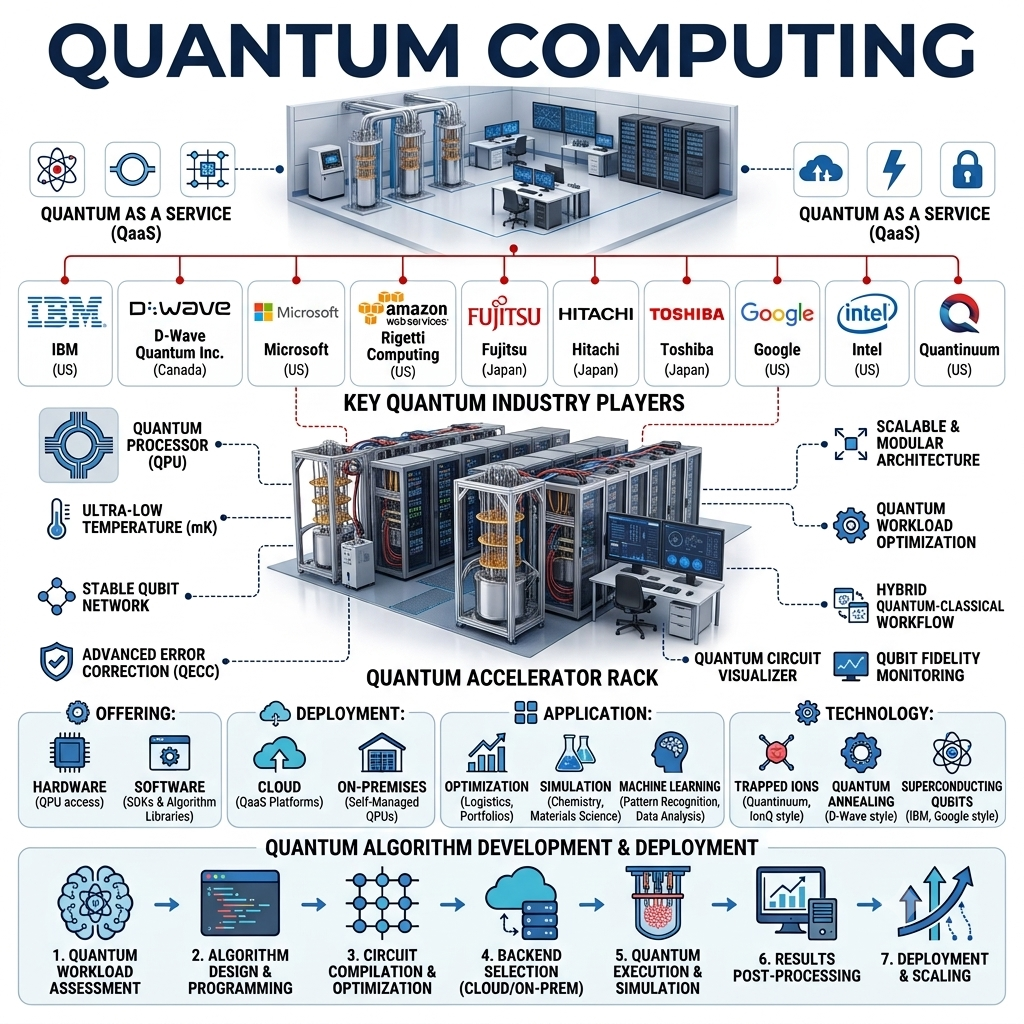
The competitive landscape is characterized by continuous technological innovation, strategic partnerships, research investments, and product development. Established technology companies and specialized quantum computing startups are competing to develop scalable hardware, advanced software, and accessible computing platforms.
Some of the major companies identified in the MarketsandMarkets report include:
- IBM: Focuses on superconducting quantum processors, quantum software, and enterprise-oriented quantum computing platforms.
- Google: Invests in quantum hardware research, quantum algorithms, and advancements in quantum processor performance.
- Microsoft: Develops quantum software, cloud-based quantum services, and research initiatives targeting scalable quantum computing.
- Amazon Web Services (AWS): Expands access to quantum computing technologies through its cloud-based quantum computing ecosystem.
- IonQ: Focuses on trapped-ion quantum computing technologies and commercial quantum computing services.
- Rigetti Computing: Develops superconducting quantum processors and integrated quantum computing systems.
- D-Wave Quantum: Specializes in quantum annealing technology and optimization-focused applications.
- Quantinuum: Develops quantum hardware, software, and integrated quantum computing solutions.
- Intel: Invests in quantum hardware research, semiconductor technologies, and quantum processor development.
- Toshiba: Contributes to the broader quantum technology ecosystem, including quantum-related research and technologies.
Companies are strengthening their competitive positions through research and development, strategic collaborations, acquisitions, cloud partnerships, and new product launches. Competition is increasingly focused on improving qubit performance, reducing errors, enhancing scalability, and making quantum computing more accessible to enterprise customers.
Market Segmentation and Emerging Opportunities
The quantum computing market can be analyzed across several important segments:
By Offering: The market includes systems, application software, and services. Services represent a significant opportunity because cloud-based quantum access allows customers to use quantum resources without purchasing expensive hardware.
By Deployment: The market is divided into on-premises and cloud-based deployment. Cloud deployment is gaining traction because it offers flexibility, remote access, and reduced infrastructure requirements.
By Technology: Major technology categories include superconducting qubits, trapped ions, quantum annealing, photonic networks, and other emerging approaches. Superconducting qubits hold a prominent position due to their technological maturity and established development ecosystem.
By Application: Key applications include optimization, machine learning, simulation, and other specialized computing tasks. Optimization is an important application area, particularly for financial services, logistics, and industrial operations.
By End-User Industry: Banking and financial services, healthcare, pharmaceuticals, energy, chemicals, space and defense, logistics, academia, and government represent important areas of adoption.
These segments demonstrate the diverse opportunities available to hardware manufacturers, software developers, cloud service providers, and specialized technology companies.
Regional Outlook: Asia Pacific Emerging as a Growth Opportunity
Regional developments are playing an important role in shaping the future of the quantum computing industry.
According to MarketsandMarkets, Asia Pacific is projected to register the fastest growth during the forecast period. Increasing government investments, research initiatives, digital transformation, and technology development programs are supporting regional expansion.
Countries such as China, Japan, South Korea, India, and Australia are strengthening their quantum research capabilities through national strategies, academic partnerships, and industry investments.
North America remains an important market due to the presence of major technology companies, research institutions, quantum computing startups, and established cloud infrastructure providers. Europe is also strengthening its position through government-backed research programs, innovation initiatives, and cross-border technology collaborations.
The growing regional focus on quantum research is expected to create opportunities for technology providers, research organizations, and enterprises seeking advanced computing solutions.
Future Scope of the Quantum Computing Industry
The future of quantum computing will depend on continued improvements in hardware performance, error correction, software development, and commercial scalability.
One of the most promising developments is the integration of quantum computing with artificial intelligence and classical high-performance computing. Hybrid computing architectures could allow organizations to combine the strengths of conventional and quantum processors for specialized computational workloads.
Drug discovery, advanced materials development, financial modeling, supply chain optimization, and energy management are expected to remain important areas of research and potential commercialization.
Furthermore, improvements in quantum processors, cloud accessibility, and quantum software ecosystems could encourage more enterprises to explore practical applications.
The competitive environment is also expected to evolve as technology companies focus on strategic collaborations, product innovation, and scalable quantum infrastructure.
As these developments progress, the Quantum Computing Industry Analysis indicates substantial long-term opportunities for businesses investing in quantum hardware, software, services, and application-specific solutions.
The global quantum computing market is entering an important phase of technological development and commercial exploration. Rising investments, increasing demand for advanced computational capabilities, cloud-based accessibility, and expanding industrial applications are supporting market growth.
However, challenges associated with qubit stability, error correction, infrastructure costs, and skilled workforce availability continue to influence commercialization.
With the market projected to grow from USD 3.52 billion in 2025 to USD 20.20 billion by 2030, according to MarketsandMarkets, the industry presents significant opportunities for technology developers, investors, and enterprise users.
Overall, the future of quantum computing will be shaped by technological breakthroughs, strategic collaborations, and the successful transition from experimental systems to practical business applications. Continued innovation is expected to establish quantum computing as an important component of the next generation of advanced computing technologies.
Frequently Asked Questions (FAQs)
1. What is the current growth outlook for the quantum computing market?
The global quantum computing market was valued at USD 3.52 billion in 2025 and is projected to reach USD 20.20 billion by 2030, growing at a CAGR of 41.8%, according to MarketsandMarkets.
2. What are the major factors driving the quantum computing market?
Key growth drivers include increasing investments in quantum technologies, advancements in artificial intelligence, rising demand for high-performance computing, cloud-based quantum services, and growing applications across healthcare, finance, and manufacturing.
3. Who are the major players in the quantum computing industry?
Major companies operating in the market include IBM, Google, Microsoft, Amazon Web Services, IonQ, Rigetti Computing, D-Wave Quantum, Quantinuum, Intel, and Toshiba.
4. Which industries are expected to benefit most from quantum computing?
Banking and financial services, healthcare, pharmaceuticals, chemicals, energy, logistics, aerospace, and defense are among the major industries expected to benefit from quantum computing applications.
5. What is the future scope of the quantum computing market?
The future scope of the quantum computing market is promising, driven by advancements in quantum hardware, error correction, quantum algorithms, and cloud accessibility. Growing adoption in drug discovery, financial modeling, optimization, and artificial intelligence is expected to create significant long-term business opportunities.
