The IoT Technology Market Growth is accelerating as connected devices, advanced sensors, cloud platforms, artificial intelligence (AI), 5G networks, and edge computing become increasingly integrated across consumer and industrial environments. The Internet of Things (IoT) has evolved from a network of connected devices into an intelligent technology ecosystem capable of collecting, processing, and analyzing real-time data to support automation and decision-making.
According to MarketsandMarkets, the global IoT Technology Market is valued at USD 959.30 billion in 2025 and is projected to reach USD 1,148.62 billion by 2030, registering a CAGR of 3.7% from 2025 to 2030. Increasing adoption of connected devices, rising internet penetration, smart-home deployments, Industry 4.0 initiatives, 5G networks, cloud computing, and demand for real-time analytics are supporting market expansion.
The latest IoT Technology Market Growth is being shaped by the convergence of connectivity and intelligence. Devices are becoming more capable of processing data locally, while AI-powered analytics are helping organizations convert large volumes of IoT-generated information into actionable insights. This evolution is creating opportunities across manufacturing, healthcare, transportation, agriculture, retail, energy, smart buildings, and consumer electronics.
Top 10 Key Takeaways
- The global IoT Technology Market is projected to reach USD 1,148.62 billion by 2030 from USD 959.30 billion in 2025.
- The market is expected to grow at a 3.7% CAGR from 2025 to 2030.
- 5G deployment is enabling faster, lower-latency connectivity for large-scale IoT applications.
- Edge computing is bringing data processing closer to connected devices and supporting real-time applications.
- Smart homes, wearables, connected vehicles, and consumer electronics are expanding the IoT device ecosystem.
- Industry 4.0 and smart manufacturing are increasing demand for connected equipment, predictive maintenance, and automation.
- The software solution segment is expected to record the highest growth rate during the forecast period.
- Processors are expected to hold the largest share among IoT node components.
- Asia Pacific is projected to be the fastest-growing regional IoT Technology Market.
- AI, 5G, edge computing, smart infrastructure, and connected devices will create significant opportunities for the next phase of IoT development.
Download PDF Brochure @ https://www.marketsandmarkets.com/pdfdownloadNew.asp?id=258239167
5G Connectivity Accelerates IoT Technology Market Growth
The deployment of 5G networks is one of the major factors influencing IoT Technology Market Growth. IoT ecosystems require reliable connectivity to allow sensors, machines, vehicles, appliances, and enterprise systems to exchange data. 5G can support high device density, low latency, and high-speed communication, making it suitable for applications that require near-real-time data exchange.
MarketsandMarkets identifies the growing deployment of 5G networks as a key growth driver for the IoT Technology Market. 5G connectivity supports applications across transportation, healthcare, smart cities, industrial automation, and other environments where large numbers of connected devices must communicate efficiently.
The combination of 5G and IoT is particularly relevant to autonomous systems and connected infrastructure. Connected vehicles can exchange information with infrastructure and other systems, while factories can deploy large numbers of sensors and connected machines. In healthcare, connected devices can support remote monitoring and data transmission.
5G is therefore helping IoT evolve from relatively simple monitoring applications toward more responsive and data-intensive connected environments.
Edge Computing Brings Intelligence Closer to Devices
Edge computing is another important factor shaping IoT Technology Market Growth. Traditional IoT architectures often transmit large volumes of data to centralized cloud platforms for processing. As the number of connected devices increases, sending all data to the cloud can create latency, bandwidth, and data-management challenges.
Edge computing addresses these challenges by processing data closer to where it is generated. Sensors, gateways, industrial computers, and edge devices can analyze information locally and transmit only relevant data to centralized platforms.
The integration of AI, edge computing, and 5G is enabling faster data processing, predictive insights, and improved system reliability. MarketsandMarkets identifies this convergence as an important trend within the IoT ecosystem.
In manufacturing, edge computing can enable machines to identify abnormal operating conditions and trigger responses without waiting for cloud-based processing. In transportation, edge systems can process sensor data rapidly to support vehicle perception and decision-making. Smart cities can use edge infrastructure to process traffic, environmental, and security information closer to the point of collection.
As real-time applications expand, edge computing is expected to become an increasingly important layer of IoT infrastructure.
Smart Devices Expand Connected Ecosystems
The increasing adoption of smart devices is another major contributor to IoT Technology Market Growth. Connected appliances, security systems, wearable devices, smart speakers, thermostats, lighting systems, and consumer electronics are expanding the number of IoT endpoints deployed worldwide.
MarketsandMarkets identifies the growing adoption of smart-home devices as a key market driver. Connected appliances, smart security systems, and home-automation solutions are increasing the deployment of IoT technologies in residential environments.
Smart devices are also becoming more intelligent. Instead of simply collecting data, newer devices can incorporate processors, sensors, AI capabilities, and wireless connectivity to support local decision-making and automated functions.
The development of connected consumer ecosystems is creating opportunities for semiconductor manufacturers, connectivity providers, IoT platform companies, software developers, cybersecurity providers, and system integrators.
Industrial IoT and Industry 4.0 Drive Enterprise Adoption
Industrial applications represent a major opportunity for IoT Technology Market Growth. Manufacturers are deploying connected sensors, machines, robotics, industrial gateways, and analytics platforms to improve operational efficiency and production visibility.
MarketsandMarkets identifies the expansion of Industry 4.0 and smart manufacturing as a major growth driver. IoT-enabled sensors and connected equipment can support predictive maintenance, production optimization, real-time monitoring, and improved operational efficiency.
Predictive maintenance is an especially important application. Connected sensors can monitor temperature, vibration, pressure, energy consumption, and other equipment parameters. Analytics platforms can then identify patterns that may indicate potential equipment problems.
This approach can help manufacturers reduce unexpected downtime and improve asset utilization. IoT can also connect production equipment with enterprise systems, enabling organizations to create more comprehensive digital workflows.
The convergence of IoT with AI, robotics, digital twins, and industrial automation is further expanding the addressable market for connected technologies.
IoT Software Solutions Record Strong Growth
While hardware remains essential to IoT deployment, software is becoming increasingly important. MarketsandMarkets expects the software solution segment to register the highest growth rate during the forecast period. This segment includes data management, real-time streaming analytics, network bandwidth management, remote monitoring, and security solutions.
The growing importance of software reflects the increasing complexity of IoT ecosystems. Enterprises may operate thousands or millions of connected endpoints across different locations and networks. Managing these devices requires platforms capable of monitoring performance, processing data, managing connectivity, and maintaining security.
IoT software can also help address interoperability challenges associated with heterogeneous devices. Data-management and analytics capabilities allow organizations to transform raw sensor information into insights that can support operational decisions.
As IoT deployments mature, software and analytics are therefore becoming important sources of value beyond the physical connected device.
Sensors and Processors Strengthen the IoT Ecosystem
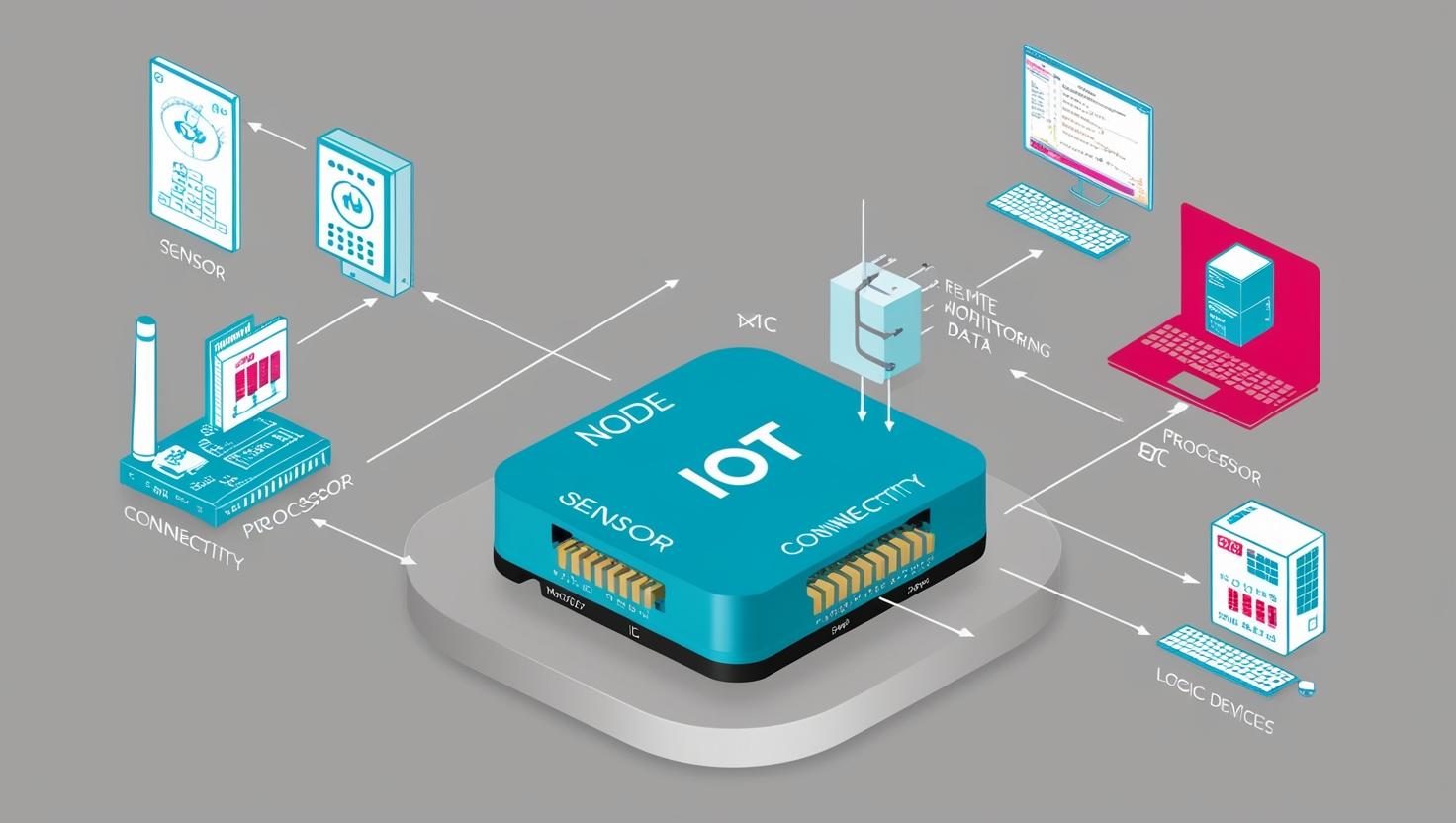
IoT node components form the foundation of connected systems. These include processors, connectivity ICs, sensors, memory devices, and logic devices. MarketsandMarkets indicates that processors are expected to hold the largest share among node components during the forecast period.
Processors are critical because IoT devices increasingly need to perform data processing, connectivity management, analytics, and device-level decision-making. As IoT applications become more sophisticated, demand is increasing for processors capable of handling greater computational workloads.
Sensors are equally important because they provide the data required by IoT systems. Advances in miniaturization, edge AI, and low-power wide-area network (LPWAN) technologies are expanding sensor applications across healthcare, agriculture, smart cities, and industrial environments.
The continued development of low-power and intelligent components will enable IoT devices to become smaller, more energy-efficient, and more capable.
Real-Time Analytics Creates New IoT Opportunities
Real-time data analytics is increasingly central to IoT Technology Market Growth. Connected devices generate continuous streams of information, but the commercial value of IoT depends largely on how effectively this information can be analyzed and used.
Organizations are increasingly using IoT-generated data to improve decision-making, optimize resources, monitor operations, and enhance customer experiences.
AI-powered analytics can identify patterns across large datasets and support predictive applications. In manufacturing, analytics can identify production anomalies. In healthcare, connected devices can support continuous monitoring. In retail, IoT data can help organizations understand customer behavior and inventory conditions.
The integration of real-time analytics with cloud and edge infrastructure is therefore creating an increasingly intelligent IoT ecosystem.
Smart Cities and Connected Infrastructure Create Growth Opportunities
Smart cities represent another important opportunity for IoT Technology Market Growth. Urban environments can deploy connected sensors and systems for traffic management, energy monitoring, public safety, waste management, environmental monitoring, and infrastructure management.
MarketsandMarkets highlights smart cities, connected healthcare, and industrial automation as major opportunity areas for IoT. Integration with AI, 5G, and edge computing can enable applications such as predictive maintenance, autonomous systems, and intelligent transportation.
Connected infrastructure can also help cities improve resource utilization. Smart lighting systems can monitor usage, connected environmental sensors can collect air-quality information, and intelligent transportation systems can use real-time data to improve traffic management.
Government-led funding for IoT research and development is another opportunity identified by MarketsandMarkets. Such initiatives can support collaboration among governments, technology companies, research institutions, and startups.
Asia Pacific Leads IoT Technology Market Growth
Asia Pacific is expected to be the fastest-growing regional market during the forecast period. MarketsandMarkets attributes this growth to rapid digital transformation, government initiatives, investments in 5G and AI, smart-city infrastructure, industrial IoT adoption, and a large technology-oriented population. China, India, Japan, and South Korea are among the important markets contributing to regional expansion.
The region’s manufacturing base also provides a significant opportunity for industrial IoT. Smart factories, connected supply chains, robotics, and automated production systems are increasing demand for IoT technologies.
India is another high-growth market within the region. MarketsandMarkets estimates India’s IoT Technology Market at approximately USD 23.24 billion in 2025, with a projected value of USD 35.80 billion by 2030, representing a 9.0% CAGR. Smart cities, industrial IoT, agriculture, healthcare, and 5G infrastructure are supporting adoption.
Security and Interoperability Remain Challenges
Despite strong opportunities, security and interoperability remain important challenges affecting IoT Technology Market Growth. The large volume of sensitive information exchanged among connected devices creates potential risks related to unauthorized access, cyberattacks, and data breaches.
MarketsandMarkets identifies data security and privacy concerns as a major restraint. Interoperability challenges and the lack of common standards can also complicate IoT deployment, while the shortage of skilled professionals creates difficulties in developing, implementing, and maintaining complex IoT systems.
Organizations therefore need to incorporate security throughout the IoT lifecycle, from device design and authentication to data transmission, cloud storage, and application management.
Standardization and cross-platform compatibility will also become increasingly important as IoT ecosystems expand across different vendors and industries.
Competitive Landscape and Future Outlook
The IoT Technology Market includes semiconductor manufacturers, cloud providers, networking companies, software providers, and IoT platform developers. Key companies identified by MarketsandMarkets include Intel, Qualcomm Technologies, Texas Instruments, STMicroelectronics, IBM, Hewlett Packard Enterprise, Cisco Systems, Microsoft, PTC, and Amazon Web Services. Companies are using product launches, partnerships, and acquisitions to expand their IoT capabilities.
Looking ahead, IoT Technology Market Growth will increasingly depend on the convergence of 5G, edge computing, AI, cloud platforms, advanced sensors, and real-time analytics. IoT is moving beyond basic device connectivity toward intelligent systems capable of sensing, analyzing, and responding to real-world conditions.
With the market expected to reach USD 1,148.62 billion by 2030, IoT is positioned to remain a foundational technology for digital transformation across industrial, commercial, and consumer environments.
Frequently Asked Questions
1. What is driving IoT Technology Market Growth?
Key growth drivers include rising internet penetration, increasing adoption of connected devices, smart-home deployment, Industry 4.0, 5G networks, cloud platforms, and demand for real-time data analytics.
2. What is the size of the IoT Technology Market?
The global IoT Technology Market is projected to grow from USD 959.30 billion in 2025 to USD 1,148.62 billion by 2030, at a CAGR of 3.7%.
3. How is 5G supporting IoT Technology Market Growth?
5G provides high-speed, low-latency connectivity and supports large numbers of connected devices, enabling applications across smart cities, transportation, healthcare, manufacturing, and other sectors.
4. Why is edge computing important for IoT?
Edge computing processes data closer to connected devices, helping reduce latency, manage bandwidth requirements, and support real-time analytics and decision-making.
5. Which region is expected to experience the fastest IoT Technology Market Growth?
Asia Pacific is expected to be the fastest-growing region, supported by digital transformation, 5G investments, smart-city initiatives, industrial IoT adoption, and government-led technology programs.
